Most High Glorious God, enlighten the darkness of my heart

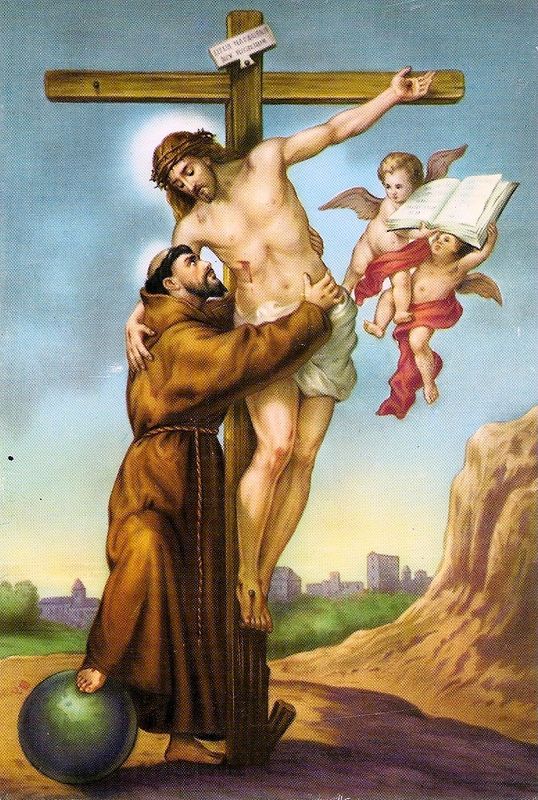
CELEBRATING A FRANCISCAN JUBILEE YEAR FOR THE 800TH ANNIVERSARY OF THE PASSING OF SAINT FRANCIS OF ASSISI (January 10, 2026 - January 10, 2027) Saint Francis of Assisi, Pray for us

CAPUCHIN FRIARS MINOR - CUSTODY OF
ST. FRANCIS OF ASSISI-CAMEROON

Who are Capuchins

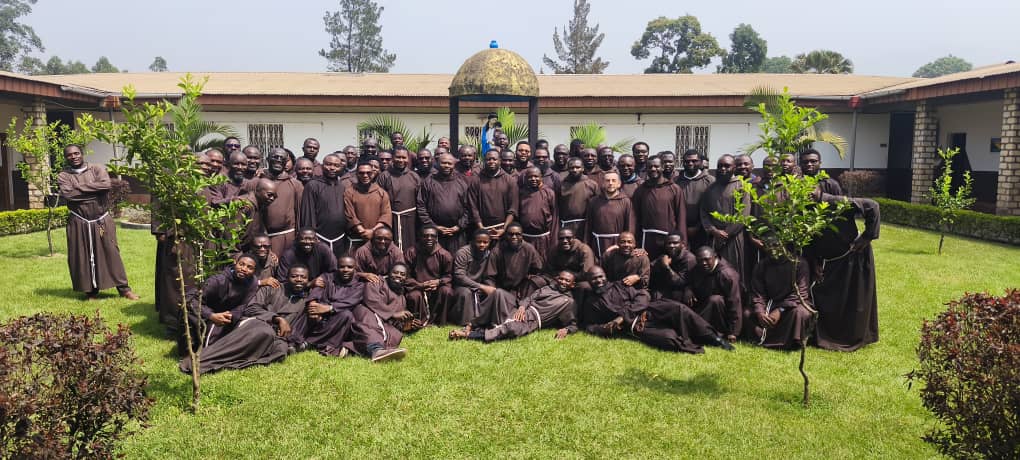
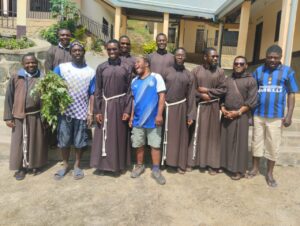
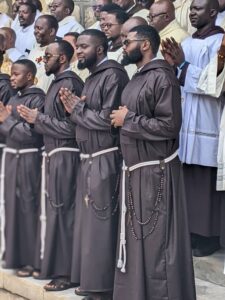
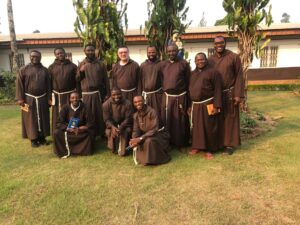
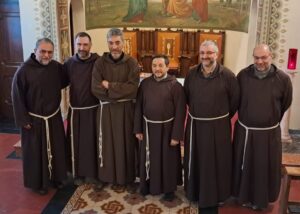
The Capuchins are one of the largest men’s Religious Orders in the Church, present all over the world. We are officially called the Order of Friars Minor Capuchin: ‘Friars Minor’ meaning ‘Lesser Brothers’. We strive to live the Gospel as a fraternity of brothers and priests, praying together as a community, being a source of nourishment and strength for each other so as to go out and share God’s love with others. Our charism of minority inspires us to seek to be lesser in our relationships with others so as to serve God in the other and help build and foster relationships and communion.

Our Charism

Like every religious order, the Capuchin charism is to build brotherhood, inspired by the Gospel and the example of St Francis of Assisi wherever we find ourselves. This leads Capuchins to be involved in a great diversity of ministries, since every area of church life and ministry needs the healing touch of wholesome relationships. Capuchins are drawn strongly to the places and people whose relationships are particularly fragile and vulnerable. Thus, many Capuchins minister among poor and marginalized people and by living the Gospel, we see our talents and potentials realized in our community life and ministry.

Our History

The Order was founded around 1525, when the Franciscan friar Matteo da Bascio – ordained priest in the Marche region, Italy – was convinced that the lifestyle led by the Franciscans of his time was not what Saint Francis had imagined. He wished to return to the original lifestyle in solitude and penance as practiced by the founder of his order.

His superiors tried to suppress these new notions, and thus Matteo and his first companions were forced to hide from the Church authorities, who wanted to arrest them for abandoning their religious obligations. These were the years of the Lutheran Reformation and, therefore, any attempt at renewal was badly regarded by the superiors of the religious orders. Matteo and his friends found refuge with the Camaldolese monks; in gratitude, they subsequently adopted the hood worn by that order, which was the hermit’s mark in the Marche region, in addition to wearing a beard. The popular name of their movement originates from this characteristic of their habit.

In 1528, with the mediation of Caterina Cibò, Duchess of Camerino, Matteo obtained the approval of Pope Clement VII with the bull Religionis zelus. He was given permission to live as a hermit and to go everywhere preaching to the poor. And this permission was not only for him, but for all those who would join him in his attempt to restore the most literal observance possible of the rule of St. Francis. Matteo and the original group were soon joined by others and initially they were called Friars Minor of the Hermetical Life and due to the opposition of the Observants, they became the congregation: the Friars Minor Hermits, a branch of the Conventual Franciscans, but with their own vicar.

A difficult period was encountered in 1542, when the Vicar General of the Order, Bernardino Ochino, joined the Protestant Reformation.

Pope Gregory XIII, in 1574, allowed the Order to settle in “France and all other parts of the world and to erect houses, places, Custodies and Provinces”, authorizing, in fact, its diffusion outside Italy. In the 16th century, the Capuchins numbered about 14,000 friars with nearly 1,000 friaries. The order’s numbers would further increase between 1600 and the mid-1700s. Eventually, they would reach 34,000 friars and 1,700 friaries. These were also the years in which the Order modified, or rather, perfected some of its initial characteristics. While remaining faithful to the vow of radical poverty, the Capuchins had shown themselves to be excellent preachers; and this, given the initial relationships with the Conventual branch, led to a “conventualization”. This process was also supported by the Holy See, which in those years urged religious orders to suppress lesser or undersized religious houses, convinced that by encouraging larger local fraternities, they could be better controlled. The initial small shelves of books became real libraries, necessary to ensure good training for preachers. To understand the role of the order during this century and a half period, consider Alessandro Manzoni’s choice of a Capuchin, Br. Cristoforo, to oppose Don Rodrigo in his Promessi Sposi (The Betrothed).

The Capuchins were also very active in the missions: for example, as Pellegrino da Forlì reports, the Indian archdiocese of Agra was entrusted to the brothers of the order since 1703.

From the Second Half of the
Eighteenth Century Until Today

From the second half of the 1700s to the end of the 1800s, the Order experienced a time of crisis. Bear in mind that between 1787 and 1847, no General Chapter of the Order was held, only assemblies of major superiors among groups of provinces divided up within the Order. These difficulties were due more to political-social than religious reasons. The French Revolution and similar experiences in other European states led to the suppression of friaries and even entire provinces. The same can be said for Italy in the late nineteenth century, where the law of Guarentigie deprived religious orders of many goods and even religious houses. However, this was accompanied by a more conscious missionary work, especially in the Americas, where the Order grew very rapidly.

Despite the difficulties at the beginning of the twentieth century, the Capuchins numbered around 9,500 in over 600 friaries. The General Chapter of 1884 had decided to repurchase many of the friaries that had been lost during the previous century and the new Constitutions were approved. The precedents were from 1643. The twentieth century was, for all religious orders, the century of the return to origins and the opening to novelties in the contemporary world. Consider the Second Vatican Council and the invitation to all religious communities to rediscover the original reasons for their charism. The Capuchins were not exempt from the crisis of vocations, which hit the Catholic Church in Europe and North America in the 1960s and 1980s. Nonetheless, the Capuchins remain one of the largest and most widespread orders of the Catholic Church.

The Spirituality

The Capuchins, since their origins, have been marked by a particular attachment to prayer and care for the poor and the sick. The Order grew rapidly both in size and popularity, given its tendency to imitate the life of Jesus as described by the Gospels. These different approaches were often complemented by their mission in the countryside, which was poorly served by the existing parishes. Here, they were meeting the needs of the faithful in the absence of an effectively prepared secular clergy. They maintained a characteristic proximity to the peripheral towns and to the countryside, adopting a simple homiletic style imbued with everyday life.

THE CUSTODY OF CAMEROON

Brief History of the Custody of Cameroon

The Capuchins arrived in Cameroon on the 17th of February 1982 through the invitation of Late Archbishop Emeritus Paul Verdzekov of the Archdiocese of Bamenda at the request of the Tertiary Sisters of Saint Francis of Assisi who were in need of Friars to assist them in Formation especially on their Spiritual needs. They settled in Shisong – Diocese of Kumbo. The first Friar to arrive in Cameroon was Br Umberto Paris of blessed memory. He was later followed by Brothers Ferruccio Ferry and Massimo Tewelde. They first settled in Shisong running the Sacred Heart Parish which is the seed ground of Christianity in the Diocese and beyond.

At the moment, the Capuchins have the following fraternities (Communities) in Cameroon: Shisong, Mbohtong, Sop, Bambui, Big-Babanki, Bafoussam (Toket et Balengou), Buea, Bayong, Kumba and a presence in the Emmaus Center-Bameda for the mentally sick persons. About the formation houses, Saint Anthony’s Fraternity Mbohtong runs the Postulancy; Our Lady of Angels’ Friary Sop runs the novitiate house; Saint Francis of Assisi’s Friary Bambui runs the students house (students in theology); other presences are more into Parish apostolates.

The Custody of Cameroon counts for the 2024/2025 pastoral year 91 professed Friars, 70 of whom are perpetual professed members (69 clerics, 1 lay Friar) and 21 temporary professed Friars, 6 novices et 14 Postulants.

 The Apostolates of the Capuchin Friars in Cameroon.

The Capuchin Friars in Cameroon are into variant apostolates. They run formation houses (postulancy, novitiate, post-novitiate programs, house for students in theology), they run prison apostolates, have a center for disabled persons at the Emmaus Outreach center (https://www.capcameroonofm-org.stackstaging.com), parish apostolates where other aspects of the life are explored (the spirit of penitence, apostolates to the underpreviledged etc), farming apostolates (Capuchin Organic Farm) from where medications from herbs are prepared for those in need, wine is produced (Capuchin Cameroonian Herbal Tonic Wine), rearing of animals (fowls, pigs…).

 Formation

The Formation of Capuchin Friars runs through four stages beginning with the Postulancy for two years, the Novitiate for one year and the Post Novitiate that which begins with Temporary Profession and ends with Perpetual Profession. Permanent or Ongoing Formation takes central stage after Perpetual Profession for both Clerics and Non-Cleric Friars.

Administration

Since October of 2020, the administration of the Friars in Cameroon has been in the hands of Local Friars headed by Br Kenneth Kinyuy Ayuni and supported by Four Councillors. He is currently serving his last term of office as a Regular Superior.

Seat of the Custos – SHISONG

Capuchin Friars Minor
Custody of St. Francis of Assisi
* P. O. Box 11 – KUMBO – N.W.R. – Cameroon
( C/o (+237) 679687617
: custoscameroon@gmail.com
website: https://www.capcameroonofm-org.stackstaging.com
Facebook: https://www.facebook.com/orderoffriarsminorcapuchincameroon


the joy of fraternity

News-Announcements-Information

Impressions of Brothers

Impressions of Brothers

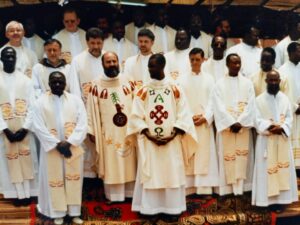
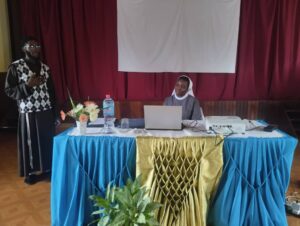
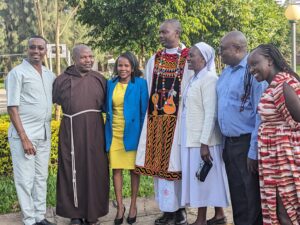
At the close of the 12th Elective Chapter of the Custody, brothers give their impressions about this custody event. Many expressed their joy and satisfaction seeing the brothers assemble from various corners of the world and custody, others used the opportunity to thank their formators for their formation, some thanked the chapter for giving them some assignments that were wonderfully performed and more for the first time in a Chapter. The Provincial Minister, after expressing gratitude too to the fraternity of Bambui, to the Old Council for their work, to the New Council, exorting them it is a grace and a responsibility they are given, then blessed the brothers, who departed in joy, singing and dancing.


New Custos and His Council

NEW CUSTOS AND COUNCIL FOR THE CAMEROON CUSTODY OF SAINT FRANCIS OF ASSISI

Today, January 29, 2026, the New Custos and his Council were voted by 74 Brothers present at the Elective Chapter in Bambui.

Br. Terence Sahven as Custos, Br. Derick Ajeande Ajende as First Councillor, Br. Amos Bamenjo as Second Councillor, Br. Valantine Fuhnwi as Third Councillor, and Br. Christopher Shiyghan as Fourth Councillor. 

This election was followed by the oath taking by the new Custos, Br. Terence Sahven, who promised fidelity to the Faith and to the Church.

May the Lord accompany them in this new mission for the Custody

Capuchins in Cameroon gather for their Elective Chapter

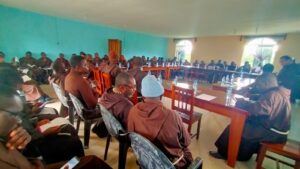
73 Capuchin Brothers in Cameroon, in the presence of the Provincial Minister, Bro Angelo Borghino, gather in Saint Francis of Assisi’s Fraternity Bambui, for their Elective Chapter. This chapter, that began on Sunday 25 January 2026, will end on Saturday 31 January 2026. We pray God blesses this special moment of fraternal sharing.


Fr. DUFE’S 25 years of Priestly Ministry

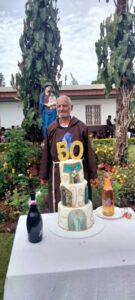
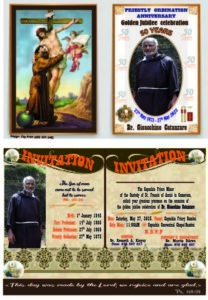
Fr. Dufe Joseph Ndzelen celebrates 25 Years of Priestly Ministry

While the Order of Capuchins in Cameroon celebrates the Perpetual entry  of seven young men, the same Order celebrates an elderly friar who has faithfully minister to God’s people for 25 good years (28 April 2000 – 28 April 2025).

What does Fr. Dufe say about himself after 25 years of ministry?

I feel like I am between the axe and the anvil – being asked to examine myself! This is a challenge, and I would not say the biggest in the priesthood. The priesthood is a life filled with challenges. And so is all of life. At one time you think that you are finishing with one, then another one pops up. But the good thing is that life goes on – and the priesthood goes on, because they good Lord is always with us. The priesthood is a grace from God, bestowed on those he has called to the ministry or service, and who answer “yes”, as Our Lady did. I answered a definitive “yes” to this call on April 28, 2000, the Great Jubilee Year. Today we are in another Jubilee Year, the Jubilee of Hope. Before this definitive “yes”, inside me I had heard the Lord calling, and doing so through the local Shisong community that embraced me in the faith and nourished it in me. Of course, I would not have heard the call unless my parents and families kept encouraging me in the faith – and this, they did enormously. I therefore owe much gratitude to them and to the Christian community of Shisong. It was while this flame kept burning inside me – sometimes strongly, sometimes almost going out – that the Capuchins arrived in Cameroon in 1982. From the moment of my encounter with them, the flame remained brighter than ever before and even till today. If I am a Capuchin priest today, it is thanks to them. When I opted to join them – as a response to the call – I did not have a clue of their formation program; so, from 1991, till today, life has become for me a series of discoveries – discovery of friends, discovery of the mission, discovery of places and tasks, discovery of needs, and discovery of God. When I look back at my formation days in the seminary of Bambui, and in the Capuchin community, and consider what I have in hand now, I just have to be grateful to the formators.

In 2000, when I was being ordained, there were rumours that the world was coming to an end. One pious lady wondered why a young man would allow himself to be ordained a priest in a world that was about to end – as if it was going to end only for me and not for her. Here we are today, and the world has not ended, and it will not end. It is not about hope, but it is about reality. Each person’s world ends when they die, and then another door opens for them, but life goes on for those who remain behind. And how many people have I accompanied towards this new opening. If I am celebrating 25 years, I am not celebrating myself, I am celebrating the people who have influenced by life and vocation, and who whose lives and vocations I have also greatly influenced – that is walking together, that is synodality, that is fraternity, that is community, that is the family spirit. My further formation in Rome, from 2004 to 2006 empowered me with the knowledge of moral principles that guide life and faith. These principles impinged something deep in me, the respect for the dignity of the human person, and since then, I look at life differently. Through these principles, I have come to know myself more, and to know others more as well, as sons and daughters of the one God, brothers and sisters of Christ. I am applying this knowledge currently in Loreto, where I encounter fragile human being inside the confession – which is a serious school of formation for me, as formation never ends.

I started my priestly ministry in St. Theresia’s Parish Sop, moved to Rome for studies, taught in the seminary for 12 years, proudly forming young priests, and within these 12 years, I moved to Bafoussam where I lived in the little community, sometimes assisting in the St. Charles Lwanga Parish of Ngouache, then I moved back to Sop, where my dream of becoming a parish priest got fulfilled. It was during my 5 years in Sop that I was appointed the first Vicar for Religious of the Diocese of Kumbo, and before I could enjoy this function, I was moved to Bambui again. As the second year in the Bambui students’ house was coming to an end I was moved to the St. Bernard’s Parish Big Babanki, from where I was catapulted to Loreto after another 2 years. All these places have served me as the seed-ground for pastoral engagement. I call it seed-ground because I have left much in the hearts of people which they are encouraged to let blossom and bloom. They have also planted much in my heart. Much still lies ahead, and I hope that God will continue to give me the strength to continue ploughing on. The harvest surely awaits the many that will feel my impact, but all honour goes to God. I would like to thank everyone who has been part of the fabric of my life, and wish them lots of sunshine and God’s blessings.

Perpetual Profession in Cameroon

SEVEN, ADD TO THE NUMBERS

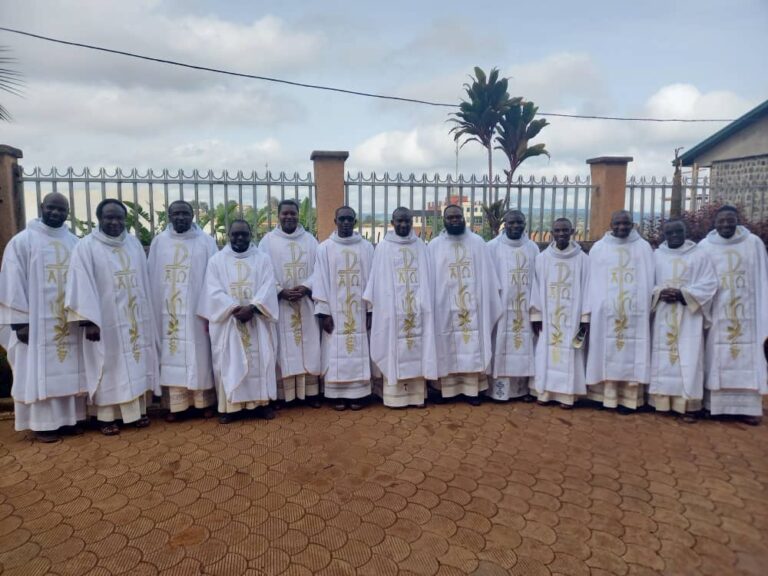
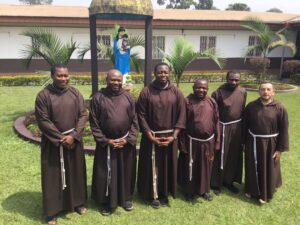
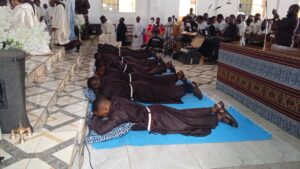
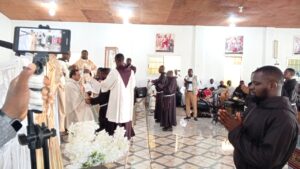
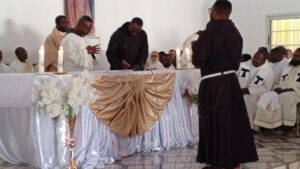
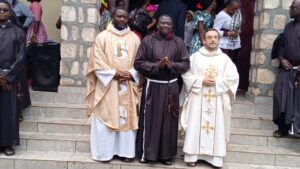
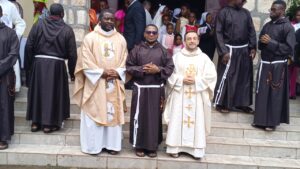
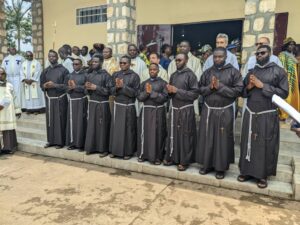
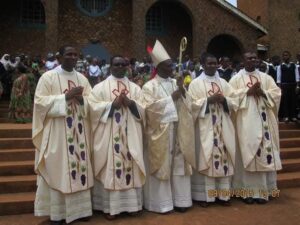
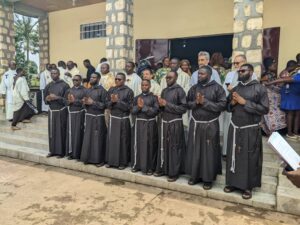
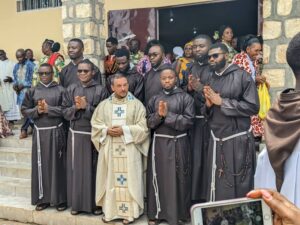
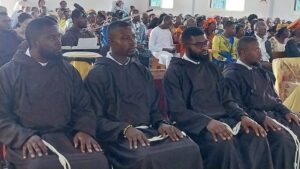
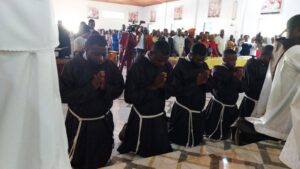
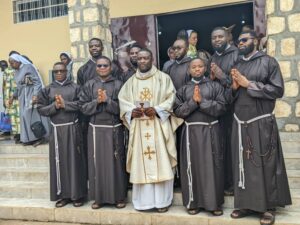
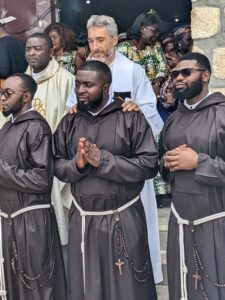
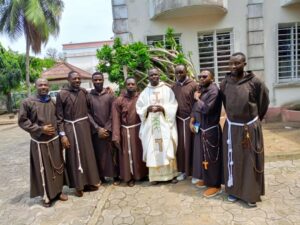
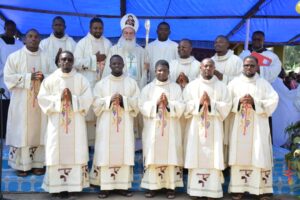
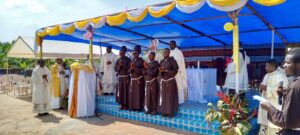
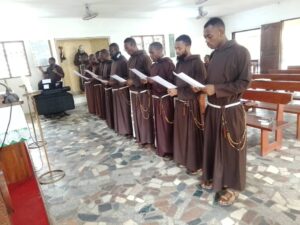
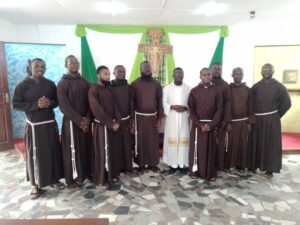
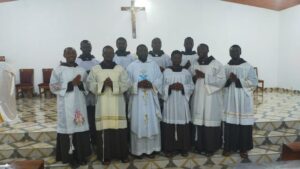
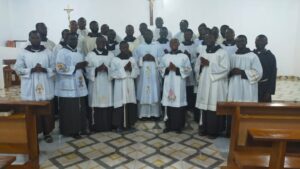
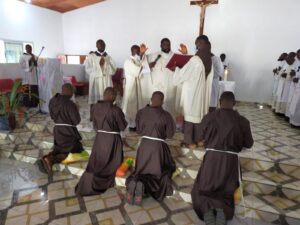
The Capuchin Friary in Bambui, in July 31, 2025, welcomed hundreds of christians and about 30 priests coming to witness to the final profession of seven Capuchin brothers: Demaya Magloire, Romaric Koumetio, Jude Njodzeka, Boris Lafon, Andrew Ndzewiyi, Bill-Collins Mbiydzenyuy and William Kongnyuy. The seven brothers make the number of perpetually professed brothers of Cameroon to seventy seven.
During his meditation, the provincial Minister, Br. Angelo Borghino who presided over the  liturgical celebration, and commenting on the first reading from the First Book of Samuel on the call of Samuel, exhorted the brothers to remain attentive to the voice of God all the days of their lives if they want to be faithful to Him.

May God continue to bless our loving Custody through the intercession of Saint Francis and Saint Claire.


The Assembly of Friars in Cameroon

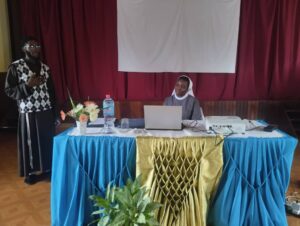
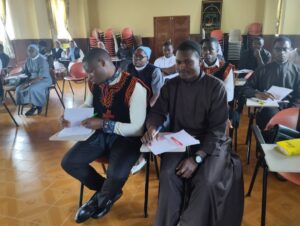
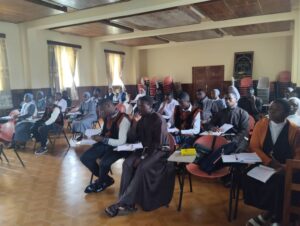
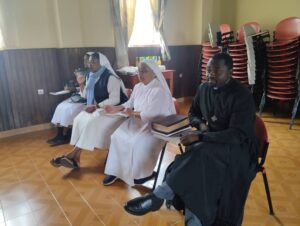
The Custody’s Assembly in Bambui 

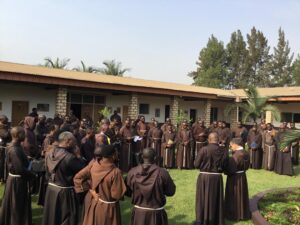
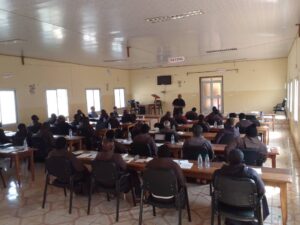
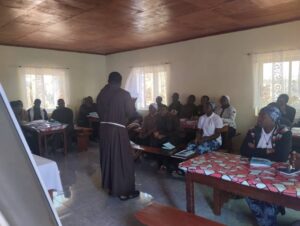
On the 30 July 2025, about 60 Capuchin Friars in Cameroon, gathered in the Capuchin Friary Bambui, for their assembly in the presence of the Provincial Minister, Br. Angelo Borghino. This assembly was aimed at preparing for the up-coming 12th Elective Chapter of the Custody, to take place in January 2026. During the Assembly, the following subjects were discussed

  1. The content of ongoing formation, time and mission
  2. Relationship between parishes and our fraternities
  3. Expectations regarding the government of our Custody (Custos, Council, Bursar, and Secretary.

We equally appreciated the presence of Br. Giovanni Cropelli, the secretary of the Missionary Center who presented the projects of the Custody supported by the Missionary Center. He admired the fact that brothers have kept to the charism. His cry was that agreements be signed with bishops in parishes where we administer inorder to avoid being embarassed when we take up some major projects and the bishops take back from their parishes.

The Provincial Minister, appreciating brothers for the work done, exhorted them to remain in a spirit of prayer as we prepare for the upcoming elective chapter. He appealed that brothers build a strong fraternity amongst themselves, avoiding issues that could bring disharmony, and hatred.

It was so wonderful having brothers from all over the Custody together with Br. Julius Lendzemo from Ivory Coast participating at the Assembly.

THE CAPUCHIN POSTULANTS MOVE TO OUR LADY OF ANGELS FRIARY-SOP TO START THE NOVITIATE

The Capuchin Postulants make a Historic Step today JUNE 25, 2025.

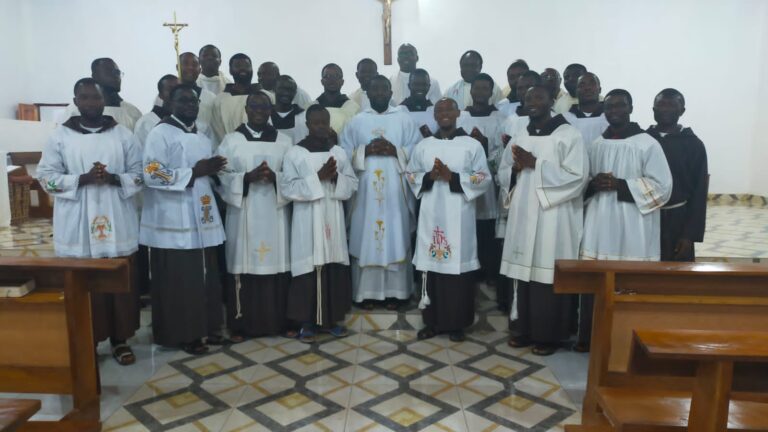
Today, six Postulants move to the Capuchin Novitiate Formation House -Sop in preparation to start their Novitiate Canonical year.

We give thanks to the Lord as six Postulants make their entrance today to the Our Lady of the Angels’ Novitiate Fraternity. What a great joy for the entire Custody to witness another historical and significant event in the year 2025.

We render gratitude to the Formation Team of the Postulancy led by Br. Anthony Nyuydini OFMCap., for a work well done.

Fra. Cedric Kohyen Verbe Ofmcap


ECHOES FROM THE CAPUCHIN LIVE-IN EXPERIENCE 2025

CAPUCHIN FRANCISCAN LIVE-IN EXPERIENCE,  21st – 24th June 2025.

Nine Aspirants answered present on the evening of Friday, June 21, 2025. The Opening Mass took place, on Saturday 22nd June 2025 was presided over by Br. Derick Ajende on behalf of the Councillor for Formation Br. Peter Ghani. He thanked all who answered present and urged them to be attentive during their stay in the novitiate community. For this formation house is the summary of the Capuchin way of life and charism. He reminded them that it was a privilege to have their live-in Experience in the Novitiate House. He equally thanked the Vocation’s Coordinator, Friar Christopher Shiyghan for the Job well done. This day, Our Lady of Angels Fraternity- Sop was  blessed to host an amazing “Come and See Live-in Experience, where nine incredible men joined us to explore their call to Religious Life with the Capuchin Franciscan Friars. It’s truly a weekend filled with deep prayer, reflection, and joyful moments of Fraternity. During this moment, our Aspirants experienced what it means to live as a Capuchin Friar. From the stillness of morning prayer to the shared joy of recreation. This helped them to be able to connect on a deeper level with each other and with God. The rhythm of daily Mass, the Divine Office and time for personal reflection permitted each participant to draw closer to the Lord and discern how He is calling them. This day was rounded up by Compline.

ok

     JUNE 23, 2025 was recorded as the Second day with fresh LIVE- IN ECHOES. The weekend wasn’t just about prayer, though—it was also filled with fun and fellowship! We shared meals, stories, and laughter, enjoying simple but meaningful recreation activities that helped strengthen the bonds of brotherhood. Whether it was playing sports or engaging in conversations about life and faith, every moment was a reminder of the joy that comes from living in community.

Each of the men who joined us brought their own unique gifts and stories. As they move forward in their discernment journey, we pray that God will continue to guide them, opening their hearts to His will. It’s always inspiring to witness how God works in the lives of those discerning Religious Life, and we are excited to see where He will lead each of these men. The come together gave the opportunity to celebrate equally the birthday of one of the Aspirants as a Novitiate Community.

A big thank you to everyone who helped make this Live in Experience possible! Your prayers, support, and dedication to the vocation ministry are invaluable. We also want to extend our gratitude to the 9 participants for their openness and availability to follow this Franciscan Capuchin Way of Life.

   This experience which started on Friday 21st drew its curtains with the closing Mass on the feast of St. John the Baptist. Br. Donatus Kum presided over the Eucharistic celebration. During the Homily he preached on the Theme: ” Leave your Country,  leave your father’s House to the land I will show you”. He encouraged and praised them for the choice of the Capuchin Order asking them to trust God on their vocational journey as Abraham did and all will be well. Furthermore, on behalf of the group the representative thanked the Aspirant Master for the opportunity to participate and they promised to join in the vocation animation and to bring more Aspirants.

Fra Christopher Shiyghan OFM Cap, Custody of St francis of Assisi, Cameroon

(more…)

A Brief History of the Capuchins in Cameroon

The Custody of Cameroon


The Capuchins arrived in Cameoon on the 17th of February 1982 through the invitation of Late Archbishop Emeritus Paul Verdzekov of the Archdiocese of Bamenda at the request of the Tertiary Sisters of Saint Francis of Assisi who were in need of Friars to assist them in Formation especially on their Spiritual needs. They settled in Shisong – Diocese of Kumbo. The first Friar to arrive in Cameroon was Br Umberto Paris of blessed memory. He was later followed by Brothers Ferruccio Ferry and Massimo Tewelde. They first settled in Shisong running the Sacred Heart Parish which is the seed ground of Christianity in the Diocese and beyond.

At the moment, the Capuchins have the following fraternities (Communities) in Cameroon: Shisong, Mbohtong, Sop, Bambui, Big-Babanki, Bafoussam (Toket et Balengou), Buea, Bayong, Kumba and a presence in the Emmaus Center-Bameda for the mentally sick persons. About the formation houses, Saint Anthony’s Fraternity Mbohtong runs the Postulancy; Our Lady of Angels’ Friary Sop runs the novitiate house; Saint Francis of Assisi’s Friary Bambui runs the students house (students in theology); other presences are more into Parish apostolates.

The Custody of Cameroon counts for the 2024/2025 pastoral year 91 professed Friars, 70 of whom are perpetual professed members (69 clerics, 1 lay Friar) and 21 temporary professed Friars, 6 novices et 14 Postulants.

The Apostolates of the Capuchin Friars in Cameroon.

The Capuchin Friars in Cameroon are into variant apostolates. They run formation houses (postulancy, novitiate, post-novitiate programs, house for students in theology), they run prison apostolates, have a center for disabled persons at the Emmaus Outreach center ( https://www.capcameroonofm.org ), parish apostolates where other aspects of the life are explored (the spirit of penitence, apostolates to the underpreviledged etc), farming apostolates (Capuchin Organic Farm) from where medications from herbs are prepared for those in need, wine is produced (Capuchin Cameroonian Herbal Tonic Wine), rearing of animals (fowls, pigs…).

Formation

The Formation of Capuchin Friars runs through four stages beginning with the Postulancy for two years, the Novitiate for one year and the Post Novitiate that which begins with Temporary Profession and ends with Perpetual Profession. Permanent or Ongoing Formation takes central stage after Perpetual Profession for both Clerics and Non-Cleric Friars.

Administration

Since October of 2020, the administration of the Friars in Cameroon has been in the hands of Local Friars headed by Br Kenneth Kinyuy Ayuni and supported by Four Councillors. He is currently serving his last term of office as a Regular Superior.

Seat of the Custos – SHISONG

Capuchin Friars Minor

Custody of St. Francis of Assisi

  • O. Box 11 – KUMBO – N.W.R. – Cameroon

website: https://www.capcameroonofm.org

Facebook: https://www.facebook.com/orderoffriarsminorcapuchincameroon

Compiled by Br. Jude Berinyuy and Br. Cedric Verbe KOHYEN

The Capuchin Novices leave a great mark at the St. Francis of Assisi Fraternity-Bambui amongst the Student Friars

The Capuchin Novices leave a great mark at the St. Francis of Assisi Fraternity( House for Theology Students) -Bambui amongst the Student Friars

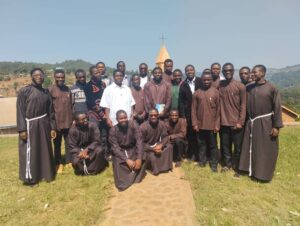
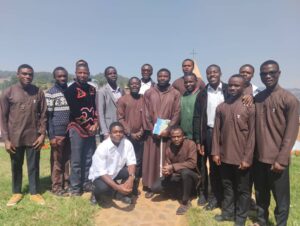
The Capuchin Novices accompanied by their Director had a brief sojourn with the student friars in the Theology House- Bambui. This was an exceptional moment for them. A moment of deep fraternal encounter and encouragement especially as they gradually draw the curtains of the Canonical year. This brings to mind the words of our seraphic father Francis in his Testament “the Lord gave me brothers.” For how wonderful it is when brothers live together for it is like oil running down the beards of Aaron.

This remains a memorable day in the lives of the young brothers as they prepare for the next formative stage. This day was significantly immortalised.

Kudos to the Novitiate Formation Team.


Friar Beltus Dor. 

Novice

The Capuchin Novices of the Canonical year 2024/2025 make a maiden visit to the Emmaus Outreach Centre Bamenda.  

The Capuchin Novices for the canonical year 2024/2025 make a maiden visit to the Emmaus Outreach Centre Bamenda.  

The 6 Cameroonian Novices in the company of their Master Friar Christopher Shiyghan Mbiydzela Ofmcap., made a maiden visit to the Emmaus Centre run by the Capuchin Friars. This is in consonance with the Constitutions of the Capuchin friars Minor. The novitiate is a period of more intense initiation and more profound experience of the Capuchin Franciscan gospel life in its fundamental demands. It requires a free and mature decision to try out our form of religious life. (Cfr. Const. CHAPTER II, THE VOCATION TO OUR LIFE AND THE FORMATION OF THE BROTHERS,  Art. IV, Initiation to our Life, no. 31,1.). Coming in contact with the marginalised of our society; the mentally challenged persons is a way of Initiation to our way of life. The Son of God, assuming the condition of a servant, came not to be served but to serve and to give His life for the salvation of all. His kenosis is perpetuated in the sacrament of the Eucharist where He daily humbles himself and comes to us under humble appearances.Awestruck and deeply moved by the humility and compassion of God, Saint Francis chose to make himself lesser among the lesser ones. Following his example, and desiring to be conformed to Christ, we too strive to be truly lesser, never presuming to become greater. Inspired by this spirit, we generously dedicate ourselves to the service of all, especially of those who suffer want and hardship and even of those who persecute us. Therefore we gladly live our life as brothers among the poor, sharing their distress and lowly state with great love. 4While we relieve their material and spiritual needs, may our lives, actions and words be generously spent for the promotion of their human and Christian development ( Const. Article II Our Life in the Church, no. 14. 1-4). Jesus Christ, while proclaiming the Good News of the Kingdom, called people to repentance, that is, to a total transformation of themselves, through which they begin to think, judge, and conform their lives to the holiness and love of God manifested in the Son. This conversion into a new creature, begun with faith and Baptism, calls for a constant effort to deny ourselves daily. (Mt 16:24; Mk 8:34; Lk 9:23). In this way, living for the Lord alone, through penance we forge new relationships with people, especially with the poor, and are gradually strengthened to build gospel brotherhood (Test 1-3; 2C ). Furthermore, Saint Francis, by the Lord’s grace, began a life of penance and conversion by showing mercy to lepers, and making his exodus from the world. (Rom 6:4; Gal 6:15; 2Cor 5:17, Constitutions, CHAPTER VII OUR LIFE OF PENANCE, Art.  109, nn. 1-4.).

Fra. Christopher Shiyghan Ofmcap.

Novice Master

The Inmates of the Emmaus Outreach Centre Bamenda Celebrate Ascension Thursday with Gaiety and Pump

The Emmaus Outreach Centre Bamenda Celebrated Ascension Thursday with Gaiety and Pump

The community made up of mentally challenged persons both men and women gathered arnd their Pastor to celebrate the Solemnity of the Ascension of our Lord and Saviour Jesus Christ. The Eucharistic celebration was animated by the Youths from Bambui in memoriam of the long standing friendship with the Capuchin friars in Bambui and the Emmaus Centre -Citadel of God’s love. The Mass was presided over by Rev. Br. Fr. Pascal Fomonyuy the Director of the Centre on the Emmaus Ascension Hill. Like Jesus this Emmaus Community ascended like the Apostles to accompany Jesus on his way back to his Father.

Fra. Aloysius Ngongbi Ofmcap.

Pope Leo XIV Appoints A New Capuchin Bishop for Slovakia

Pope Leo XIV Appoints a New Capuchin Bishop for Slovakia Rev. Pavol Šajgalik OFMCap.

The Holy Father named the Rev. P. Military Ordinary Bishop for Slovakia,  Pavol Šajgalik OFMCap, Chaplain of the Catholic Community in Switzerland. 

Fra Pavol was born on November 13, 1964 in Bratislava. After completing his clandestine theological studies in Vienna, he obtained a doctorate in pastoral theology from the Faculty of Theology at the University of Vienna.

On February 2, 1986. He joined the Order of Minor Cappuccini Friars in Slovakia. On March 25, 1993 he issued the perpetual profession in our Order. He was ordained a priest on August 15, 1993 for the imposition of Mons’ hands. Rudolph the Packer. In the Slovak Province of Cappuccini he has held several positions: several times advisor to the provincial minister, provincial vicar, guardian of the Bratislava convent and, at the same time, Rector of the Conventual Church of Saint Stephen in Bratislava (1997-2000); secretary and provincial economist.


Fra. Christopher Shiyhan Ofm.Cap

FORMEE’S DAY IN THE DIOCESE OF KUMBO FOR ALL RELIGIOUS CONGREGATIONS, FIRST OF ITS KIND

The Celebration of the 62nd World Prayer Day for Vocations this year 2025 came with great innovation from the Formators in the Diocese of Kumbo. The idea of having a Formee Open Day. This news was received with euphoria and great excitement on the part of Formees. This great innovation follows the heels of the Annual Lenten Retreat for Formees in the Diocese  spiced by a Common Meal and Sporting Activities. The Kumbo Formees’ Day started with the Holy Mass at 9:10 a.m at the St. Raphael Piarist Formation House Kumbo which was presided by Br. Christopher Shiyghan OFM Cap, the Coordinator of the Formation Team. He was assisted by Fr. Arnaud Hyacinthe Eyinga, RCJ, Br. Anthony Nyuydini OFMCap, Fr. Fernando Schp and Rev. Justin Bandin. During the Homily the preacher in the context of the 62nd Editon of the World Prayer Day for Vocations dwelt on the theme: The Church is the Mother of All Vocations. Highlighting that all Vocations are born in the Church, nurtured in the Church and meant to serve the Church. Drawing inspiration from the words of Jesus in the Gospel of the Day” My sheep hear my voice and follow me”. Taking Christ reflecting on “my Sheep hear my voice on the one hand, taking as the Model Jesus Christ, he underlined that Christ listened to the voice of the Father and did his will at all times. Calling the attention of the formees on the fact that today many voices speak to them daily such as the self, the world, friends, the devil, Christ. Thus the need to spend ample time in prayer to discern the Voice of Christ. On the other reflecting on ” the Sheep that listen to my voice , follow me”, he said ” to follow Christ is the response we give to Christ after listening to him”, surrendering ourselves to him, so that he can lead us to whatever direction he is calling us to go. Paul and Barabas are concret examples of of this positive response to the voice of christ to the missionary vocation he called them to. Eternal life is the reward for our answer to his call he said. He exhorted all to Listen to the voice of christ and follow him as well as to pray for more Vocations to the Priesthood and Religious life not only today but always. As Formees of the Diocese of kumbo on this Formees Day it is a moment to celebrate their Vocation and to encourage one another. It was a moment equally of thanksgiving to God for mothers on Mother’s Day, highlighting Mary as Model and source of Inspiration to all mothers with her unwavering faith, selflessness and nurturing spirit.
     After the Mass the day was immortalised with photographs.

Then entertainment with Choral music, music interpretation from different cultures like Kom, Nso, Congo, Bassa etc.,

This was animated by Novices of the various Religious Congregations. In attendance were the OFM Capuchin Postulants, Novices, and Temporary Professed Sisters of the Handmaid of the Child Jesus, Holy Union Sisters, Daughters of the Cross, Daughters of Our Lady on Mount Calvary, Piarists, Rogationists , T.S.S.F, Sisters of St. Michael as well as their Novices. These were accompanied by the Masters and Mistresses of the aforementioned formation Houses.

Friars Christopher Shiyhan & Anthony Nyuydini, Ofm.Cap

Formation Team


The Formators of the Ecclesiastical Province of Bamenda round up a session on on-going formation during their meeting in Babete West Region of Cameroon 4th to 8th May 2025

The meeting of the Formators of Religious in the Ecclesiastical Province of Bamenda took place from Sunday 4th to 8th May 2025 at Babete Monastery.

The meeting of the Formators of Religious in the Ecclesiastical Province of Bamenda took place from Sunday 4th to 8th May 2025 at Babete Monastery.Amongst those present representing the Capuchin Formation Team were friars Christopher Shiyhan – Novice Master,  Calvin Nsahlai- vice Student Master,  Rene Mbaku- Vice Postulant Master. The theme for this ongoing formation was : TOOLS FOR ACCOMPANIMENT AND OVERCOMING INNER FEARS OF FORMATORS animated by Rev. Dr. Alban Pascal Noudjom Tchana, Sj. PhD.
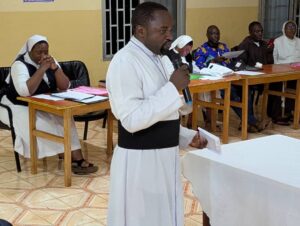

The Formators of the Bamenda Ecclesiastical Province arrived at the Centre at Monastery in Babete (West Region) by 3:30pm. Monday was devoted to a day of reflection on the theme: “Forming with courage. The other days followed suit. They were reminded not to form with their own Authority but with that of Christ this was underlined by the Prayer” Forming not with my own authority”. The facilitator emphasized in the course of the session some salient points such as : Formation in a wounded world thus it can no longer be just a structural program of theological instructions or community discipline but be be a spiritual journey accompaniment, mutual vulnerability and deep listening. We can no longer according to Henri Nouwen pretend to form othets from a position of superiority, detachment and false strength. Today a formator is no longer primarily a teacher but a companion in the mystery of human growth. Given that we live in a world fractured by crises where young people today wrestle with a crisis of identity, belonging, self worth and meaning. In this context they do not seek perfection rather Authenticity. He summarised the Approach of Religious formators as VUCA ( Value- Spiritual Dimension, Vision- Prophetic insightseeing with the eyes of faith, understanding- discernment , clarity- simplicity, choosing what truly matters before God, and Agility – Obedience the capacity to move where God leads). Today, formation takes place in a world which is volatile, uncertain complex, ambiguous, a context of Digital distractions and Relativism, where commitments are unstable and malleable, a world of growing tension between individualism and community living,a reality of broken firmees and wounded formators, understanding the inner fears of firmators is not disqualification but the staring point of an authentic formation
Courage as a virtue in formation was highlighted for between fear and courage lies hope filled endurance. The virtue of not fleeing when all seems lost and of trusting the unforseen courage is born. In the school of the cross and the silence of the heart the formator becomes not a hero/ heroine but a witness.
They were therefore drilled on the fools for accompaniment: forming in Dryness and forming through fears. These are to be understood not merely as technics but spiritual attitudes and disciplines that allow discernment and accompaniment to take place even when the Wells run empty and fears threaten the journey. These include Deep listening (Lectio cordis- Reading the heart), Spiritual conversation and Discernment- Ignatian approach, personal vulnerability and storytelling, Psychological safety and emotional intelligence, use of silence and Comtemplative Dialogue, Digital tools for connection and mentoring. Thus it was a call for a ministry of Presence in the Desert , a Presence that listens in silence , a presence that trusts even in fear and a presence that waits when the well is dry. Furthermore, they were drilled on How to overcome inner fears, a journey from vulnerability to inner Freedom, a real path for Formators- embracing your fears ( Theology of imperfection, anchoring your identity in Christ not in results, practice of daily examen for self awareness and healing, building support network among formators, developing a spirituality of Accompaniment – walking with others not above. In fine, overcoming inner fears is the courage to be born in the Dark, where God’s grace works slowly but powerfully. They were called to be Prophetic witnesses. this can only be achieved through the way of Christ( a formation of kenosis), being a living icon of what you preach, living Authenticity over perfection, in shirt being Prophets of Presence.

The Religious formators
This Session was one of its kind well appreciated by the Formators of the Ecclesiastical Province of Bamenda ( Kumbo, Bamenda, Buea, Kumba and Mamfe) the session ended with an excursion and relaxation.

Br. CHRISTOPHER SHIYHAN, Ofm.Cap

FORMATION COMMISSION

The Pastor of the Roman Church

A New Shepherd for the Roman Catholic Church

A New Shepherd for the Roman Catholic Church


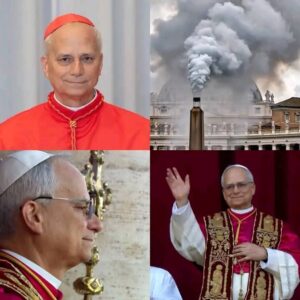
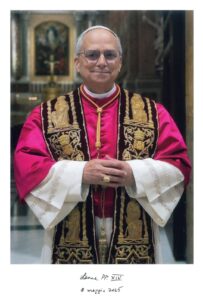
Leo XIV (born September 14, 1955, Chicago, Illinois, U.S.) is the pope, the leader of the Roman Catholic Church. He was elected to the papacy on May 8, 2025, succeeding Pope Francis and becoming the first American pope in history. An Augustinian priest who performed extensive missionary work in Peru and served as head of the Augustinian order from 2001 to 2013, he was made a cardinal by Francis in 2023. In his first address as pope, Leo XIV told the crowd assembled in St. Peter’s Square in Vatican City, “I am a son of St. Augustine, an Augustinian. He said, ‘With you I am a Christian, for you a bishop.’ So may we all walk together towards that homeland that God has prepared for us.
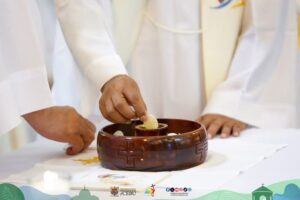
For more details on his background, click: https://en.wikipedia.org/wiki/Pope_Leo_XIV https://www.britannica.com/biography/Leo-XIV

Brother Peter Tar, a Capuchin Friar, tells us more about the Popes with the papal name “LEO”

The Pope, regardless of their chosen name, including Leo, has a unique and overarching role in the Catholic Church. As the successor of Peter, the Pope is the “perpetual and visible source and foundation of the unity both of the bishops and of the whole company of the faithful”. 

The papal name Leo carries with it a legacy of strength, reform, and profound influence on the history of the Catholic Church. Over more than 1,500 years, at least 13 popes have borne the name – each contributing in unique ways to theology, ecclesiastical authority, and society at large. Here’s an overview of their lives and legacies:

  1. Pope Leo I: His papacy began on September 29, 440, and concluded on November 10, 461. Known as Leo the Great, he is celebrated for his courageous intervention with Attila the Hun and his efforts to affirm the Church’s teaching on Christ’s dual nature. In his teachings, he puts together the loftiness of God and the lowliness of man, with each cooperating according to its nature. Leo I played an important role in defining the doctrine of the Incarnation, particularly through his famous Tome, which articulated the hypostatic union of Christ’s divine and human natures. This was affirmed at the Council of Chalcedon in 451. His theological letters and leadership helped in establishing the papal authority, setting a way-forward for future pontiffs. He asserted the primacy of the Roman See over other churches and emphasized the pope’s role as a spiritual leader. In other areas, Leo the Great also stressed the importance of both doctrine and pastoral care, confronting heresies and caring for the poor. He is also associated liturgy with the daily life of Christians, combining fasting with charity and almsgiving.

  2. Pope Leo II: His papacy began on August 17, 682, and concluded on July 3, 683. He is best known for his steadfast commitment to upholding orthodox Christian doctrine during a period marked by theological disputes and political challenges. His papacy followed the Third Council of Constantinople, which condemned Monothelitism, and Leo II worked diligently to ensure the implementation of the council’s decisions within the Church. He emphasized the importance of Christ’s dual nature and sought to reinforce the Church’s teachings against heretical influences.  Though his pontificate was brief, Leo II worked to confirm important decisions made by earlier councils and ensured continuity in doctrinal matters at a time of political turbulence.

  3. Pope Leo III: His papacy began on December 26, 795, and concluded on June 12, 816. Leo III is best known for his pivotal role in the relationship between the papacy and the Carolingian Empire, particularly during the reign of Charlemagne. In 800, Leo III crowned Charlemagne as Emperor of the Romans, which symbolized the revival of the Western Roman Empire and established a crucial alliance between the papacy and the Frankish monarchy. This act not only underscored the alliance between the papacy and emerging European states but also laid the groundwork for the medieval conception of Christian leadership. He focused on ecclesiastical reforms, including the promotion of the clergy’s moral integrity and the defense of the Church’s interests against secular powers. He also emphasized the importance of liturgical practices and the protection of Church property

  4. Pope Leo IV: His papacy began on April 10, 847, and concluded on July 17, 855. During his time as Pope, he worked to defend Rome against the Saracens, building the Leonine City to protect the Basilica of St. Peter. In the wake of Saracen raids, Leo IV focused on the physical and spiritual fortification of Rome by restoring and building defensive walls – an effort that symbolizes the Church’s resilience in troubled times.

  5. Pope Leo V: His papacy began on July 30, 903, and concluded on December 1, 903. His reign was extremely short and occurred during a chaotic period in papal history. Though less is known about his achievements, his papacy reflects the internal struggles of the Church during the dark ages of Roman politics.

  6. Pope Leo VI: His papacy began on May 28, 928, and concluded on December 1, 928. Another pope with a brief tenure, Leo VI’s time in office was marked by the complexities of local aristocratic influences over the papacy, characteristic of that era.

  7. Pope Leo VII: His papacy began on January 3, 936, and concluded on July 13, 939. Serving during a period of reform and transition, Leo VII is noted for promoting measures that helped stabilize and renew the Church’s spiritual and administrative life amidst political uncertainty.

  8. Pope Leo VIII: His papacy began on June 23, 964, and concluded on March 1, 965. His papacy remains controversial. Installed during a power struggle – with significant imperial interference – his legitimacy was and continues to be subject to historical debate, illustrating the perennial tension between secular and ecclesiastical authority.

  9. Pope Leo IX: His papacy began on February 12, 1049, and concluded on April 19, 1054. A key figure in the Gregorian Reform, Leo IX vigorously combated practices like simony and clerical marriage. His efforts to purify the Church’s practices were a catalyst for events that contributed to the East – West Schism in 1054.

  10. Pope Leo X: His papacy began on March 9, 1513, and concluded on December 1, 1521. Ascending to the papacy during the Renaissance, Leo X’s period was marked by both artistic patronage and significant turmoil. His decision to excommunicate Martin Luther after the outbreak of the Protestant Reformation profoundly influenced the future trajectory of Western Christianity.

  11. Pope Leo XI: His papacy began on April 1, 1605, and concluded on April 27, 1605. Notorious for having one of the shortest reigns – lasting only about 27 days – Leo XI’s brief time in office is a reminder that even in episodic leadership, the continuity of the papal name carried symbolic weight.

  12. Pope Leo XII: His papacy began on September 28, 1823, and concluded on February 10, 1829. In an era of post-Napoleonic restoration, Leo XII is remembered for his conservative policies and his efforts to reassert traditional ecclesiastical values during a time of rapid political and social change in Europe.

  13. Pope Leo XIII: His papacy began on February 20, 1878, and concluded on July 20, 1903. A modernizing figure, Leo XIII left an indelible mark on Catholic social teaching with his encyclical Rerum Novarum (1891), which addressed the rights and dignity of workers in an industrial age. His long and influential pontificate helped steer the Church through the challenges of modernity.

A New Chapter – Pope Leo XIV: (2025 – present) In a historic turn, Cardinal Robert Prevost has been elected as Pope Leo XIV. The first American pope, his previous leadership of the Order of St. Augustine and his commitment to issues such as peace, social justice, and reform resonate with the legacies of his namesakes. His choice of the name Leo underscores a continued commitment to addressing modern challenges while drawing inspiration from a long and storied tradition.

Compiled by Fra Peter Tar Fonyuy, OFM Cap.

A PRIEST IS NOT HIS OWN (Fulton Sheen)

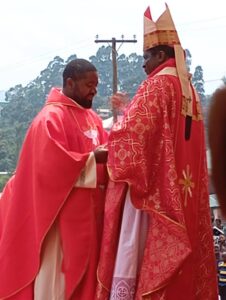
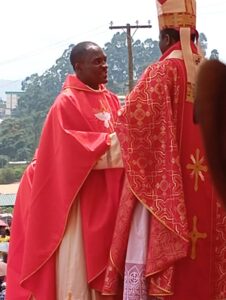
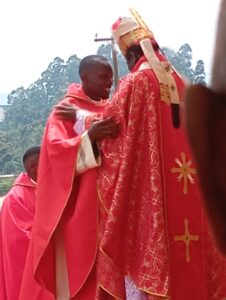
Two New Priests for the Order and the Church: Brother Esope Thaddeus Mosseu OFMCap. and Brother Ignatius Nyuydini Kenso, OFMCap., Ordained to the Priesthood corroborated the Month of Anniversaries

Two Capuchin Priests ordained for the Order and for the Church

Br. Esope ordained in Buea

On April 24th, 2025, ten deacons and a Capuchin brother received the Sacrament of Holy Orders in the priestly rank during a Eucharistic celebration officiated by His Lordship Michael Bibi, the Bishop of Buea, at Divine Mercy Co-Cathedral. Friar Thaddeus born on 30th January 1991in muyuka District hospital of late Pa Godefroy Mosseu and Ma Subin Victorine. Second in a family of six, five boys and a girl. The journey that started in 22012 as a Postulant witnessed his Perpetual Profession on August 25th 2022, ordained Deacon on 2nd December 2023 in Bambui by Mgr Angelo Pagano and by God’s grace two years after has ended in praise, ordained a Capuchin Priest by Mgr Michael Miabesue Bibi, Bishop of Buea, on the 24th April 2025 at the Divine Mercy Co-cathedral Molyko – Buea.
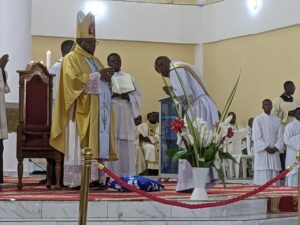
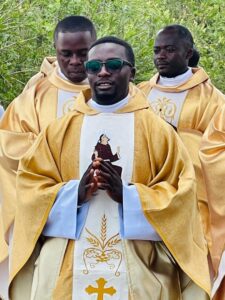
Bishop Bibi urged the newly ordained priests to bring hope to those who are suffering, saying, “My dear sons, be men of prayer, and never say you have arrived, for you are just about to begin. A prayer less priest is an instrument of the devil. Live a life of servant leadership, not seeking to be served. Be transparent and accountable to your Christian community, and embrace obedience and humility in your service to the Church.”
This is what he had to say on his Ordination Day “By the grace of God I am what I am and His grace towards me has not been fruitless” (1Cor 15:10).
All what I have been through, who I am and what I wish to be in my life is thanks to the grace of God who made it possible and His grace has not been fruitless, today I am what I have dreamt and prayed for. I thank God for choosing me and to make His grace manifest in my life. He was among the 75th Anniversary Jubilee prpriest Ordained for the Diocese of Buea.

Br. Kenso, ordained in St. Joseph’s Metropolitan Cathedral, Bamenda

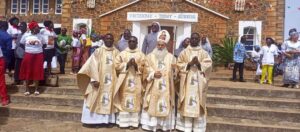
On another page we witnessed the serene forecourt of St. Joseph’s Metropolitan Cathedral in Bamenda became a sacred ground of grace and celebration on Friday, April 25, 2025, as the Catholic Church welcomed nine new priests into her fold. Among them was Brother Ignatius Nyuydini Kenso, OFMCap, a solemnly professed friar of the Order of Friars Minor Capuchin, ordained alongside eight diocesan deacons for the Archdiocese of Bamenda.

Due to ongoing construction and renovation works inside the Cathedral, the priestly ordination Mass was celebrated outdoors, directly in front of the Cathedral. The open-air setting allowed for an even larger number of faithful to participate in this momentous occasion, with the morning sun gently casting its rays over the colorful assembly of clergy, religious, and laity.
The ordination was presided over by His Grace Andrew Fuanya Nkea, Metropolitan Archbishop of Bamenda. In a deeply moving gesture that reflected the Church’s unity in sorrow and hope, the Archbishop opened the liturgy with an invitation to observe three minutes of silence in prayer for His Holiness, Pope Francis, who had passed away on Monday, April 21st, 2025. The moment was solemn, the silence profound, and hearts united across nations.
The Mass began at 9:00 a.m. under the clear Bamenda sky. From all parts of Cameroon—north, south, east, west—and even beyond, the faithful came in large numbers to witness the Church in her glory and to support the newly ordained as they received the sacred gift of Holy Orders.
In his homily, Archbishop Nkea drew from the Letter to the Hebrews (5:1–4), emphasizing that “every high priest is taken from among men.” With pastoral tenderness and spiritual authority, he reminded the ordinands that they had not chosen themselves, but were chosen by God, as Aaron was, to stand before Him on behalf of His people. “You remain human,” he told them, “and so you must continually strive for your own salvation in fear and trembling.”
He called on all the priests present to rekindle their original zeal, to look back with gratitude to the day of their own ordination, and to renew their commitment to serve God and His people with fidelity.
The liturgy came to a close around 1:00 p.m., and the celebration continued as crowds gathered around the newly ordained, offering congratulations, blessings, and joyful cheers. For Brother Ignatius, the joy was especially abundant, as Capuchin friars from across the country—from Shisong, Mbohtong, Sop, Babanki, Bafoussam, Nyandong (Diocese of Kumba), and Bambui—came in great numbers to witness this moment of grace and brotherhood. These brothers accompanied Brother Ignatius to the venue of his reception.
Before his ordination, Brother Ignatius served as a deacon at Sacred Heart Parish, Shisong, a mission experience that deepened his love for the Church and refined his readiness for priestly ministry.
The reception that followed was held in a nearby hall, where joy gave way to festivity. The place was alive with music, dancing, laughter, and testimonies of gratitude. His biological family, close friends, fellow friars, and numerous well-wishers shared in this overflowing joy. A significant delegation came from the West Region, particularly Mbouda, where Brother Ignatius was born and raised.
In a heartfelt address, his father welcomed the guests and shared his deep gratitude to God for the grace of priesthood in their family. “This joy is not ours alone,” he said, “but a joy for the Church, for the people of God, and for all who love the Lord.”
When Brother Ignatius stood to speak, the atmosphere grew still again. His words, rich with humility and spiritual depth, reflected what many described as “a joy that transcends words.” He gave thanks to God, to his family, to the Capuchin Order, and to all who had supported him along the way. His radiant smile and serene tone spoke louder than any speech ever could.
Even nature seemed to rejoice. The weather remained calm and clear, as if the heavens themselves had blessed the occasion.
The ordination of Brother Ignatius Nyuydini Kenso, OFMCap, is a powerful reminder that the Lord of the harvest continues to call—and young men continue to respond with generous hearts. At a time when the Church mourns the passing of the Supreme Pontiff, she is also renewed by the flame of new vocations.
As Brother Ignatius begins his journey as a priest of Jesus Christ, we entrust him to the intercession of St. Francis of Assisi, and pray that he may always be a humble, faithful, and joyful minister of the Gospel.

Priestly anniversaries

Within the month many Capuchin brothers of the Custody of St. Francis of Assisi celebrated their priestly Anniversaries of Ordination.
APRIL 12, 2025
We thanked the Lord for the gift of priestly vocation as we celebrated the presbyteral ordination anniversary of the following Brothers:
29TH ANNIVERSARY
Br. Tobias Wirmum Dzedzemon
18th ANNIVERSARY
Br. Donatus Wirkom Moshuimo
Br. Cyril Kerala
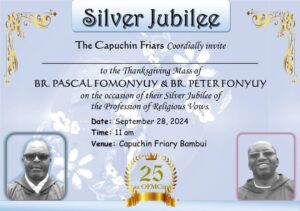
Br. Pascal Fomonyuy Tatah
Br. Peter Fonyuy Tar
APRIL 13, 2025
On this day that the Church celebrated Christ’s Entrance into Jerusalem to accomplish his Paschal Mystery, we remembered Br. Joseph Mengven Wirba and Br. Terence Sahven Lukong who celebrated the 13th anniversary of priestly Ordination.
APRIL 14, 2025
13TH ANNIVERSARY OF ORDINATIION of Br. Martin Dikwa! May each year of your priestly service be a reminder of the profound impact you’ve had on our faith and lives. Congratulations
APRIL 16, 2025
16th ANNIVERSARY of ORDINATION
We thanked the Lord for the gift of priestly vocation as we celebrated FRIARS Kenneth Kinyuy, John Maindze and Felix Afoni
APRIL 17, 2025
We thanked the Lord for the gift of priestly vocation as we celebrated  the 27th presbyteral ordination anniversary of Br. Kilian Ngitir Ngari.  You’re indeed a figure, an icon and a man with a golden heart. We celebrated the gifts and graces of God in you.
APRIL 19, 2025
We thanked the Lord for the gift of priestly vocation as we celebrated  the 8th presbyteral ordination anniversary of Br. Noel Nji.
APRIL 20, 2025
Happy 8th anniversary of Priestly Ordination anniversary Br. Theophile Seka Njolah!
APRIL 20, 2025
Congratulations Br Neville Nyame Nzume! In celebration of the 8th Anniversary of your Ordination, may God reward you and bless you for your caring and dedicated service.
April 21, 2025
We thanked the Lord for the gift of priestly vocation as we celebrated  the 19th presbyteral ordination anniversary of Br. Vitalis Tatah Nyuysever and Br. Francis Bongajum Dor. Wishing you a blessed priestly anniversary. May the years ahead be filled with God’s grace and the support of the Fraternity, achieving his Divine plan.
APRIL 28, 2025

We thanked the Lord for the gift of priestly vocation as we celebrated  the 25th presbyteral ordination anniversary of Br. Joseph Dufe ( Fara woo Loretto). Wishing you a joyous priestly anniversary! May the memories of the past and the promise of the future fill your heart with gratitude and hope.


We entrust all our Brother priests to Jesus Christ the High Priest in this prayer:

Gracious and loving God, we thank You for the gift of our priests.
Through them, we experience your presence in the sacraments.
Help our priests to be strong in their vocation.
Set their souls on fire with love for your people.
Grant them the wisdom, understanding, and strength they need to follow in the footsteps of Jesus.

Inspire them with the vision of your Kingdom.
Give them the words they need to spread the Gospel.
Allow them to experience joy in their ministry.
Help them to become instruments of your divine grace.
We ask this through Jesus Christ, who lives and reigns as our Eternal Priest.
Amen.

Congratulations to our Brothers! No man takes this honour upon himself. May the Lord who called you, sustain and direct you and may He always grant you a double portion of Elijah’s anointing. Amen
To God be the highest glory!

By Br. Gideon Nyuyshiyi WIRSIY, OFMCap; Br. Theophile Seka, OFMCap. & Br. Cedric Verbe Kohyen, OFMCap.
Cameroon — 5th May, 2025

Nigeria mourns seven friars

The Capuchin Friars of Nigerian Custody mourn seven of their friars

The Custody of Saint Francis and Saint Clare of Nigeria cries the departure of seven  friars after a tragic incident that took place on the evening of May 3rd, 2025. These brothers are: Somadina Ibe-Ojuludu, Chinedu Nwachukwu, Marcel Ezenwafor, Gerald Nwogueze, Kingsley Nwosu, Wilfred Aleke, and Chukwudi Obueze. May God console their biological and religious families. May He grant them rest in his kingdom and to the six brothers still in the hospital, a quick recovery.

Triennium 2022-2025 Announcement


APRIL A MONTH OF PRIESTLY ANNIVERSARIES FOR MOST FRIARS


Here comes another APRIL 9, 2025 marking a milestone in the life and ministry of 8 Capuchin friars of the Custody of St. Francis of Assisi -Cameroon.

We the Capuchins in Cameroon thank the Lord for the gift of priestly vocation in the church as we celebrate today the 15TH and 10TH presbyteral ordination anniversaries respectively of :

Br. Derick Ajeande Ajende
Br. Julius Tangko Lendzemo
Br. Thierry Yanou Nyassi
Br. Author Nga Abanfegha
And
Br. Divine Etimbi Esoh
Br. Cornelius Bamenjo Wirsiy


Br. Amos Bongdin Bamenjoh
How wonderful it is to have selfless brothers who through their lives and witnesses have saved many souls. Thank you friars for the unwavering services you have rendered to the church all these years. May the Lord renew in each one of you the grace of your Ordination.
Let us continue to pray for our Brothers and a bountiful harvest of the ministry. May God, through the intercession of the Blessed Virgin Mary, graciously guide our Brothers on their journey in leading and nurturing God’s flock, may they find strength in their calling and a deepened sense of purpose in serving others.

To God be the highest glory!
We join them to pray as they celebrate grace. Fulton Sheen says “a priest is not his own.
Gracious and loving God, we thank You for the gift of our priests.
Through them, we experience your presence in the sacraments.
Help our priests to be strong in their vocation.
Set their souls on fire with love for your people.
Grant them the wisdom, understanding, and strength they need to follow in the footsteps of Jesus.

Inspire them with the vision of your Kingdom.
Give them the words they need to spread the Gospel.
Allow them to experience joy in their ministry.
Help them to become instruments of your divine grace.
We ask this through Jesus Christ, who lives and reigns as our Eternal Priest.
Amen.

HAPPY ANNIVERSARY FRIARS

Fra Cedric Kohyen Verbe
Ofmcap.

The Novices in the Diocese of Kumbo attended a Seminar on April 8th 2025 on Conscience Formation at the Franciscan Convent in Shisong : Theme : Let Conscience Be Your Guide

LET CONSCIENCE BE OUR GUIDE
The Novices of the Diocese of Kumbo gathered on April 8th 2025 together as desired by the Formators in Kumbo Diocese at the Convent of the Tertiary Sisters of St. Francis ,Shisong as a follow up to the particular formation programs pursued by the various religious Congregations with formation houses in Kumbo. This seminar animated by Sister Dubam Pascaline, TSSF, St. Francis Province Shisong, had as theme: Let Conscience be your guide. For this formation session were present a total number of 25 Novices from the following congregations ; Order of friars Minor Capuchin, Order of Pious Schools ( Piarists), Rogationists, Tertiary Sisters of St. Francis ( TSSF Cameroon Provinces), Daughters of Our Lady on Mount Calvary, Daughters of the Cross.
As a major line of thought, it was highlighted to the Novices that in every human being there exist a silent gentle voice of God that calls one to choose to do good and avoid evil. This voice is called the Conscience. This voice can gradually be killed if one ignores it always or often or when it is badly formed. What each one needs to work on and to form is a good Christian conscience. This type is essential to live a good, holy and free life as a Religious in the Church as we strive everyday towards holiness of life.
As take home message each Novice was reminded that the goods conscience is the Palace of Christ in our heart, a messenger from God Himself, who in nature and grace speaks to us behind a veil. This conscience is formed by the teaching of the Church, Spiritual reading, Spiritual Direction, prayer, Church Doctrine, moral conduct, Ten commandments of God, Constitutions of religious congregations etc.
Pope St. John Paul II stated clearly that the future of a successful society is based on the formation of a good conscience and we can dare add that the future of religious life and religious congregations is assured by the formations of a good Christian conscience of novices the future of the church.
All very much elated and satisfied with the input. Go and put it into practice was the challenge for each.

Fr. Mark Ndifor Celebrates 26 years of Priestly Ordination as a Capuchin Priest

This APRIL 7, 2025 Marks a significant event in the life of the Custody of St. Francis of Assisi in Cameroon.

Happy Happy Anniversary Fr. Mark

We thank the Lord for the gift of priestly vocation as we celebrate today the 26th priestly ordination anniversary of Br. Mark Ndifor Ngwah. God bless and reward you for your years of service. And as you continue to serve Him may His love and compassion be in your heart always.

On this special day friar Mark Ndifor Ngwah had this to say “Who am I, LORD, and what is my family, that you have brought me this far? 2 Samuel 7: 18 .”I am happy and excited …To fall in love with God is the greatest romance; to seek him the greatest adventure; to find him, the greatest human achievement”. Quoting St. Augustine of Hippo.

Congratulations for your many years of faithful service Br. Mark. May your presence in the Capuchin custody of Kenya remain impactful.

PRAYER:
Gracious and loving God, we thank You for the gift of our priests.
Through them, we experience your presence in the sacraments.
Help our priests to be strong in their vocation.
Set their souls on fire with love for your people.
Grant them the wisdom, understanding, and strength they need to follow in the footsteps of Jesus.

Inspire them with the vision of your Kingdom.
Give them the words they need to spread the Gospel.
Allow them to experience joy in their ministry.
Help them to become instruments of your divine grace.
We ask this through Jesus Christ, who lives and reigns as our Eternal Priest.
Amen.

All the friars of this prestigious Custody of Cameroon heartily wish you a happy Anniversary of service in the Church.

Friar Christopher Shiyhan ofmcap.
Novice Master

Capuchin Postulants and Novices at the Enneagram session

ENNEAGRAM A GIANT STEP TO SELF KNOWLEDGE.

From the 11th and 12th of December 2024, in Kikiakelaki, a hamlet of Kumbo, in the convent of the sisters of Saint Michael the Arch Angel’s community, the novices and postulants participated in a seesion on Enneagram directed by Br. Aloysius Kongnyuy (OFM. Cap.) At the session were 15 postulants of the capuchins, 02 postulants of the sisters of St Dominic, 05 postulants of the sisters of St. Michael and 07 novices of the Capuchins, a total of 28 formees.

We were taught that “Enneagram” from the two Greek words ‘Ennea’ for nine and ‘Grammos’ for figure, indicated nine different personality types which are: Perfectionist,  Giver, Achiever, Individualist, Investigator, Skeptic, Enthusiast, Challenger, and Peacemaker. This session helped us understand ourselves better  so as to ease our living together, accommodating all and appreciating our persons as a sign of true gospel witnessing, manifested in fraternal living.


Br. Dor Beltus (Novice)

The Custody’s Annual Retreat in Babete

Friars for their Annual Retreat in BABETE

The Capuchin Brothers of the custody of Saint Francis of Assisi, Cameroon, gathered in the Benedictine Monastery in Babete, Bafoussam, from Sunday 12/01/2025 to Friday 17/01/2025 for their annual retreat.

This great, enriching and fraternal spiritual exercise was led by Dr. Peter Newburn with his Unbound team: Kurt Klement, Myriam Wright and Fr. Jude Bassebang, a Claretian priest.

The retreat was based on the five keys of UNBOUND – a practical guide to deliverance from unholy spirits (Repentance and Faith, Forgiveness, Renunciation, Authority and the Father’s Blessings). These five keys are aimed at bringing back the created man, captured by sin through the devil’s influence and rescued by Christ, to his original relationship with God, his Creator.

More of this is published in link below

Click on the link below for more details on the retreat

Spiritual Renewal – The Order of Friars Minor Capuchins Cameroon

Another blessing for the Custody of Saint Francis of Assisi in Cameroon

Another blessing for the Custody of Saint Francis of Assisi in Cameroon

Br. Kilian Ngitir, a friar from the Custody of Saint Francis of Assisi in Cameroon is appointed Rector of the International Collegio San Lorenzo

In the first General Council of the new six years, brother Kilian Ngitir was appointed Rector of the International Collegio San Lorenzo from Brindisi dei Frati Minori Cappuccini. Fra Kilian, who will take charge on January 1, 2025, was born in Shisong, Cameroon, on April 13, 1967. Entered the Order in 1991 in the Custody of Saint Francis of Assisi in Cameroon. He was ordained a priest in 1998. He studied philosophy and theology in Cameroon and obtained a bachelor in pedagogy and a doctorate in psycho education in Rome. In his experience, he was a master of applicants, first counselor of the Custody of Cameroon, trainer and guardian.

In the General Chapter of 2018, he was elected General Counselor of the Order for the period 2018-2024, Counselor for the Formation of the Order, General Counselor for the Conference Capuccinorum Africae Occidentalis (CONCAO), Delegate of the Minister General for Order Houses, including our Fraternity of the International College San Lorenzo di Brindisi and for Scholarships, for the Commission of the General Cappuccini Archive and for the Commission of Cappuccini Central Library, for the Historical Cappuccini Institute, for the Cappuccini Museum, and for the General Secretary for Education. 

Since 2016, he is professor at Antonianum and since 2017 until today, he is the Spiritual Father of the College.

After the intense commitment as General Counselor, in the numerous visits requested by the Minister General for the various Circumstances of the Order, he now assumes the service of Rector of our International College San Lorenzo da Brindisi. We all welcome him with joy and wish him all the best for this important mission in the service of our Order.

Beloved Brother Kilian Ngitir, your brothers in Cameroon send to you words of encouragement in the mission entrusted to you by the Order. Our prayers accompany you in this noble task in and for the Order.

The Custos, Br. Kenneth Kinyuy, receiving this great news of your appointment as Rector exclaimed: “This speaks volumes for the custody with regards to commitment and service. We congratulate our brother and put him in our prayers so that his guardian angel walks the path ahead with him for the greater glory of the Most High.”

May Saint Lawrence of Brindisi intercede for you.

Pax et Bonum

Br. Cedric Verbe KOHYEN

Spes Non Confudit

Spes Non Confudit

Le Jubilé 2025 de l’Église catholique a été officiellement proclamé le jeudi 9 mai par le pape François, qui a présidé la lecture officielle de la bulle d’indiction du Jubilé.

La bulle papale, intitulée « Spes Non Confudit », c’est-à-dire « L’espérance ne déçoit pas », déclare que l’année jubilaire commencera officiellement avec l’ouverture de la Porte Sainte de la basilique Saint-Pierre la veille de Noël 2024.

FRANÇOIS

ÉVÊQUE DE ROME

SERVITEUR DES SERVITEURS DE DIEU

À TOUS CEUX QUI LISENT CETTE LETTRE, QUE L’ESPÉRANCE REMPLISSE VOS CŒURS

  1. SPES NON CONFUNDIT. « L’espérance ne déçoit pas » (Rm 5,5). C’est dans un esprit d’espérance que l’apôtre Paul a adressé ces paroles d’encouragement à la communauté chrétienne de Rome. L’espérance est également le message central du prochain Jubilé que, conformément à une ancienne tradition, le pape proclame tous les vingt-cinq ans. Je pense à tous les pèlerins de l’espérance qui se rendront à Rome pour vivre l’Année Sainte et à tous ceux qui, ne pouvant se rendre dans la Cité des Apôtres Pierre et Paul, la célébreront dans leurs églises locales. Que le Jubilé soit pour tous un moment de rencontre authentique et personnelle avec le Seigneur Jésus, « porte » (cf. Jn 10,7.9) de notre salut, que l’Église est chargée d’annoncer toujours, partout et à tous comme « notre espérance » (1 Tm 1,1).

Tout le monde sait ce qu’est l’espérance. Dans le cœur de chacun, l’espérance réside comme le désir et l’attente de bonnes choses à venir, bien que nous ne sachions pas ce que l’avenir nous réserve. Cependant, l’incertitude quant à l’avenir peut parfois susciter des sentiments contradictoires, allant de la confiance à l’appréhension, de la sérénité à l’anxiété, de la conviction ferme à l’hésitation et au doute. Nous rencontrons souvent des personnes découragées, pessimistes et cyniques face à l’avenir, comme si rien ne pouvait leur apporter le bonheur. Que le Jubilé soit pour nous tous l’occasion de renouer avec l’espérance. La parole de Dieu nous aide à trouver les raisons de cette espérance. En la prenant pour guide, revenons au message que l’apôtre Paul a voulu communiquer aux chrétiens de Rome.

Une parole d’espérance
2. « Puisque nous sommes justifiés par la foi, nous sommes en paix avec Dieu par notre Seigneur Jésus Christ, qui nous a donné accès à la grâce dans laquelle nous nous trouvons, et nous nous glorifions de l’espérance d’avoir part à la gloire de Dieu… L’espérance ne déçoit pas, car l’amour de Dieu a été répandu dans nos cœurs par l’Esprit Saint qui nous a été donné » (Rm 5, 1-2.5). Dans ce passage, Saint Paul nous donne matière à réflexion. Nous savons que la Lettre aux Romains a marqué un tournant décisif dans son travail d’évangélisation. Jusqu’alors, il avait exercé son activité dans la partie orientale de l’Empire, mais maintenant il se tourne vers Rome et tout ce que Rome représente aux yeux du monde. Un grand défi se présente à lui, qu’il relève pour prêcher l’Évangile, qui ne connaît pas de barrières ni de limites. L’Église de Rome n’a pas été fondée par Paul, mais il s’est senti poussé à s’y rendre pour apporter à tous l’Évangile de Jésus-Christ, crucifié et ressuscité, un message d’espérance qui accomplit les anciennes promesses, conduit à la gloire et, fondé sur l’amour, ne déçoit pas.

  1. L’espérance naît de l’amour et se fonde sur l’amour qui jaillit du cœur transpercé de Jésus sur la croix : « Car si, alors que nous étions ennemis, nous avons été réconciliés avec Dieu par la mort de son Fils, à plus forte raison, après avoir été réconciliés, serons-nous sauvés par sa vie » (Rm 5,19). Cette vie se manifeste dans notre propre vie de foi, qui commence avec le baptême, se développe dans l’ouverture à la grâce de Dieu et est animée par une espérance constamment renouvelée et confirmée par l’action de l’Esprit Saint.

Par sa présence permanente dans la vie de l’Église en pèlerinage, l’Esprit Saint illumine tous les croyants de la lumière de l’espérance. Il maintient cette lumière allumée, comme une lampe toujours allumée, pour soutenir et revigorer nos vies. L’espérance chrétienne ne trompe ni ne déçoit parce qu’elle est fondée sur la certitude que rien ni personne ne pourra jamais nous séparer de l’amour de Dieu : « Qui nous séparera de l’amour du Christ ? L’épreuve, la détresse, la persécution, la famine, la nudité, le péril ou l’épée ? Non, en toutes ces choses nous sommes plus que vainqueurs par celui qui nous a aimés. Car j’ai l’intime conviction que ni la mort, ni la vie, ni les anges, ni les dominations, ni les choses présentes, ni les choses à venir, ni les puissances, ni la hauteur, ni la profondeur, ni rien de ce qui existe dans toute la création, ne pourra nous séparer de l’amour de Dieu dans le Christ Jésus notre Seigneur » (Rm 8.35.37-39). Nous voyons ici la raison pour laquelle cette espérance persévère au milieu des épreuves : fondée sur la foi et nourrie par la charité, elle nous permet d’aller de l’avant dans la vie. Comme l’observe Saint Augustin : « Quel que soit notre état de vie, nous ne pouvons pas vivre sans ces trois dispositions de l’âme, à savoir croire, espérer et aimer ». 

  1. Saint Paul est réaliste. Il sait que la vie a ses joies et ses peines, que l’amour est éprouvé par les épreuves et que l’espérance peut vaciller face à la souffrance. Malgré cela, il peut écrire : « Nous nous glorifions de nos souffrances : « Nous nous glorifions de nos souffrances, sachant que les souffrances produisent l’endurance, que l’endurance produit le caractère et que le caractère produit l’espérance » (Rm 5,3-4). Pour l’Apôtre, les épreuves et les tribulations marquent la vie de ceux qui prêchent l’Évangile dans l’incompréhension et la persécution (cf. 2 Co 6, 3-10). Pourtant, dans ces mêmes contextes, au-delà des ténèbres, nous entrevoyons une lumière : nous nous rendons compte que l’évangélisation est soutenue par la puissance qui découle de la croix et de la résurrection du Christ. Nous apprenons ainsi à pratiquer une vertu étroitement liée à l’espérance, à savoir la patience. Dans notre monde au rythme effréné, nous sommes habitués à vouloir tout, tout de suite. Nous n’avons plus le temps d’être simplement avec les autres ; même les familles ont du mal à se réunir et à profiter de la compagnie des autres. La patience a été mise à mal par la précipitation frénétique, ce qui s’est avéré préjudiciable, car cela conduit à l’impatience, à l’anxiété et même à la violence gratuite, avec pour conséquence davantage de malheur et d’égocentrisme.

La patience n’est pas non plus de mise à l’heure d’Internet, où l’espace et le temps cèdent la place à un « maintenant » omniprésent. Si nous étions encore capables de contempler la création avec un sentiment d’émerveillement, nous pourrions mieux comprendre l’importance de la patience. Nous pourrions apprécier les changements de saisons et leurs récoltes, observer la vie des animaux et leurs cycles de croissance, et jouir de la clarté de vision de saint François. Dans son Cantique des créatures, écrit il y a exactement huit cents ans, François voyait toute la création comme une grande famille et pouvait appeler le soleil son « frère » et la lune sa « sœur ». Une appréciation renouvelée de la valeur de la patience ne peut que s’avérer bénéfique pour nous-mêmes et pour les autres. Saint Paul parle souvent de la patience dans le contexte de notre besoin de persévérance et de confiance dans les promesses de Dieu. Mais avant tout, il témoigne de la patience de Dieu lui-même, « le Dieu de toute patience et de tout encouragement » (Rm 15,5). La patience, l’un des fruits de l’Esprit Saint, soutient notre espérance et la renforce en tant que vertu et mode de vie. Apprenons à prier fréquemment pour la grâce de la patience, qui est à la fois la fille de l’espérance et son fondement solide.

Un chemin d’espérance
5. Cette interaction entre l’espérance et la patience nous fait voir clairement que la vie chrétienne est un voyage qui appelle des moments de plus grande intensité pour encourager et soutenir l’espérance comme compagnon constant qui guide nos pas vers le but de notre rencontre avec le Seigneur Jésus. J’aime à penser que la proclamation du premier Jubilé, en l’an 1300, a été précédée d’un chemin de grâce inspiré par la spiritualité populaire. Comment ne pas rappeler les différentes manières dont la grâce du pardon a été répandue sur le peuple saint et fidèle de Dieu ? Nous nous souvenons, par exemple, du grand « Pardon » que saint Célestin V accorda à tous ceux qui visitèrent la basilique de Santa Maria di Collemaggio in Aquila les 28 et 29 août 1294, six ans avant que le pape Boniface VIII n’institue l’Année sainte. L’Église faisait déjà l’expérience de la grâce du Jubilé comme d’une effusion de la miséricorde divine. Plus tôt encore, en 1216, le pape Honorius III avait accédé à la demande d’indulgence de saint François pour tous ceux qui se rendaient à la Portioncule les deux premiers jours du mois d’août. Il en va de même pour le pèlerinage à Saint-Jacques-de-Compostelle : en 1222, le pape Callistus II a permis que le Jubilé y soit célébré chaque fois que la fête de l’apôtre Jacques tombait un dimanche. Il est bon que de telles célébrations « dispersées » du Jubilé se poursuivent, afin que la puissance du pardon de Dieu puisse soutenir et accompagner les communautés et les individus sur leur chemin de pèlerinage.

Le pèlerinage est bien sûr un élément fondamental de chaque événement du Jubilé. Partir en voyage est traditionnellement associé à notre quête humaine du sens de la vie. Un pèlerinage à pied est une aide précieuse pour redécouvrir la valeur du silence, de l’effort et de la simplicité de la vie. Au cours de l’année à venir, les pèlerins de l’espérance ne manqueront pas de parcourir les routes anciennes et plus modernes afin de vivre pleinement le Jubilé. À Rome même, outre les visites habituelles aux catacombes et aux sept églises, d’autres itinéraires de foi seront proposés. En voyageant d’un pays à l’autre comme si les frontières ne comptaient plus, en passant d’une ville à l’autre pour contempler la beauté de la création et les chefs-d’œuvre de l’art, nous apprenons à apprécier la richesse des différentes expériences et cultures, et nous sommes inspirés pour élever cette beauté, dans la prière, vers Dieu, en action de grâce pour ses œuvres merveilleuses. Les églises jubilaires situées le long des routes de pèlerinage et dans la ville de Rome peuvent servir d’oasis de spiritualité et de lieux de repos sur le chemin de la foi, où l’on peut s’abreuver aux sources de l’espérance, surtout en s’approchant du sacrement de la réconciliation, point de départ essentiel de tout véritable chemin de conversion. Dans les Églises particulières, on veillera tout particulièrement à préparer les prêtres et les fidèles à célébrer le sacrement de la confession et à le rendre facilement accessible sous sa forme individuelle.

D’une manière particulière, je voudrais inviter les fidèles des Églises orientales, surtout ceux qui sont déjà en pleine communion avec le Successeur de Pierre, à participer à ce pèlerinage. Ils ont beaucoup souffert, souvent jusqu’à la mort, pour leur fidélité au Christ et à l’Église, et ils doivent donc se sentir particulièrement bienvenus dans cette ville de Rome qui est aussi leur Mère et qui garde tant de souvenirs de leur présence. L’Église catholique, enrichie par leurs anciennes liturgies et par la théologie et la spiritualité de leurs pères, moines et théologiens, veut donner une expression symbolique à son étreinte envers eux et envers leurs frères et sœurs orthodoxes en ces temps où ils endurent leur propre chemin de croix, souvent contraints par la violence et l’instabilité à quitter leurs patries, leurs terres saintes, pour des lieux plus sûrs. Pour eux, l’espérance née de la certitude qu’ils sont aimés par l’Église, qui ne les abandonne pas mais les suit où qu’ils aillent, rendra le symbolisme du Jubilé d’autant plus puissant.

  1. L’Année Sainte 2025 s’inscrit elle-même dans la continuité des célébrations de grâce précédentes. Lors du dernier Jubilé ordinaire, nous avons franchi le seuil des deux millénaires qui nous séparent de la naissance de Jésus-Christ. Puis, le 13 mars 2015, j’ai proclamé un Jubilé extraordinaire pour faire connaître et favoriser la rencontre avec le « visage miséricordieux de Dieu », message central de l’Évangile pour tous les hommes et toutes les femmes de tous les temps et de tous les lieux. Le temps est venu d’un nouveau Jubilé, où la Porte Sainte sera à nouveau ouverte pour inviter chacun à une expérience intense de l’amour de Dieu, qui réveille dans les cœurs l’espérance sûre du salut dans le Christ. L’Année Sainte guidera également nos pas vers une autre célébration fondamentale pour tous les chrétiens : 2033 marquera le bimillénaire de la rédemption obtenue par la passion, la mort et la résurrection du Seigneur Jésus. Nous sommes sur le point d’accomplir un pèlerinage marqué par de grands événements, dans lequel la grâce de Dieu précède et accompagne son peuple qui avance fermement dans la foi, activement dans la charité et fermement dans l’espérance (cf. 1 Th 1, 3).

Fort de cette grande tradition et certain que l’Année jubilaire sera pour toute l’Église une expérience vivante de grâce et d’espérance, je décrète par la présente que la Porte Sainte de la Basilique Saint-Pierre au Vatican sera ouverte le 24 décembre 2024, inaugurant ainsi le Jubilé ordinaire. Le dimanche suivant, le 29 décembre 2024, j’ouvrirai la Porte Sainte de ma cathédrale, Saint-Jean-de-Latran, qui fêtera le 9 novembre prochain le 1700e anniversaire de sa dédicace. Ensuite, le 1er janvier 2025, en la solennité de Marie, Mère de Dieu, la porte sainte de la basilique papale Sainte-Marie-Majeure sera ouverte. Enfin, le dimanche 5 janvier 2025, la porte sainte de la basilique papale Saint-Paul-hors-les-murs sera ouverte. Ces trois dernières Portes Saintes seront fermées le dimanche 28 décembre 2025.

Je décrète en outre que le dimanche 29 décembre 2024, dans toutes les cathédrales et co-cathédrales, les évêques diocésains célébreront la Sainte Messe en tant qu’ouverture solennelle de l’Année jubilaire, en utilisant les indications rituelles qui seront fournies à cette occasion. Pour les célébrations dans les co-cathédrales, l’évêque peut être remplacé par un délégué dûment désigné. Un pèlerinage qui part d’une église choisie pour la collectio et se rend ensuite à la cathédrale peut symboliser le chemin d’espérance qui, éclairé par la Parole de Dieu, unit tous les fidèles. Au cours de ce pèlerinage, on pourra lire des passages du présent Document, ainsi que l’annonce de l’indulgence jubilaire à obtenir selon les prescriptions figurant dans les indications rituelles mentionnées ci-dessus. L’Année Sainte s’achèvera dans les Églises particulières le dimanche 28 décembre 2025 ; au cours de l’année, on s’efforcera de permettre au Peuple de Dieu de participer pleinement à l’annonce de l’espérance en la grâce de Dieu et aux signes qui en attestent l’efficacité.

Le Jubilé ordinaire s’achèvera par la fermeture de la Porte Sainte de la Basilique papale Saint-Pierre au Vatican, le 6 janvier 2026, en la solennité de l’Épiphanie du Seigneur. Au cours de l’Année Sainte, que la lumière de l’espérance chrétienne illumine chaque homme et chaque femme, comme un message de l’amour de Dieu adressé à tous ! Et que l’Église témoigne fidèlement de ce message dans toutes les parties du monde !

Signes d’espérance
7. En plus de l’espérance dans la grâce de Dieu, nous sommes appelés à découvrir l’espérance dans les signes des temps que le Seigneur nous donne. Comme l’a observé le Concile Vatican II : « À chaque époque, l’Église a la responsabilité de lire les signes des temps et de les interpréter à la lumière de l’Évangile. Ainsi, dans un langage adapté à chaque génération, elle peut répondre aux questions persistantes des hommes sur le sens de la vie présente et de la vie à venir, et sur les rapports entre les deux. » Nous devons reconnaître l’immense bonté présente dans notre monde, de peur d’être tentés de nous croire submergés par le mal et la violence. Les signes des temps, qui incluent l’aspiration des cœurs humains à la présence salvatrice de Dieu, doivent devenir des signes d’espérance.

  1. Le premier signe d’espérance devrait être le désir de paix dans notre monde, qui se trouve à nouveau plongé dans la tragédie de la guerre. Sans se soucier des horreurs du passé, l’humanité est confrontée à une nouvelle épreuve, car de nombreux peuples sont en proie à la brutalité et à la violence. Quel est l’avenir de ces peuples qui ont déjà tant souffert ? Comment est-il possible que leur appel à l’aide désespéré ne motive pas les dirigeants du monde à résoudre les nombreux conflits régionaux, compte tenu de leurs conséquences possibles au niveau mondial ? Est-ce trop rêver que les armes se taisent et cessent de faire pleuvoir la destruction et la mort ? Que le Jubilé nous rappelle que les artisans de paix seront appelés « enfants de Dieu » (Mt 5,9). Le besoin de paix nous interpelle tous et exige que des mesures concrètes soient prises. Que la diplomatie s’engage sans relâche à rechercher, avec courage et créativité, toutes les occasions d’entreprendre des négociations en vue d’une paix durable.

  2. Regarder l’avenir avec espoir, c’est aussi avoir de l’enthousiasme pour la vie et être prêt à la partager. Malheureusement, dans de nombreuses situations, cela fait défaut. Une première conséquence est la perte du désir de transmettre la vie. Plusieurs pays connaissent une baisse alarmante de la natalité en raison du rythme effréné de la vie actuelle, de la peur de l’avenir, de l’absence de sécurité de l’emploi et de politiques sociales adéquates, et de modèles sociaux dont l’agenda est dicté par la recherche du profit plutôt que par le souci de la relation. Dans certains milieux, la tendance « à blâmer la croissance démographique, plutôt que le consumérisme extrême et sélectif de certains, est une façon de refuser de faire face aux [vraies] questions ».

L’ouverture à la vie et à la paternité responsable est le dessein que le Créateur a implanté dans le cœur et le corps des hommes et des femmes, une mission que le Seigneur a confiée aux époux et à leur amour. Il est urgent qu’une législation responsable de la part des Etats soit accompagnée du soutien ferme des communautés de croyants et de l’ensemble de la communauté civile dans toutes ses composantes. Car le désir des jeunes de donner naissance à de nouveaux fils et filles, signe de la fécondité de leur amour, assure un avenir à toute société. Il s’agit d’une espérance : elle naît de l’espérance et elle engendre l’espérance.

Par conséquent, la communauté chrétienne devrait être en première ligne pour souligner la nécessité d’un pacte social qui soutienne et encourage l’espérance, un pacte qui soit inclusif et non idéologique, œuvrant pour un avenir rempli de rires de bébés et d’enfants, afin de remplir les berceaux vides dans tant de régions de notre monde. Mais nous devons tous retrouver la joie de vivre, car les hommes et les femmes, créés à l’image et à la ressemblance de Dieu (cf. Gn 1, 26), ne peuvent se contenter de vivre au jour le jour, de se contenter de l’ici et du maintenant et de chercher leur épanouissement dans les seules réalités matérielles. Cela conduit à un individualisme étroit et à la perte de l’espérance ; cela engendre une tristesse qui se loge dans le cœur et porte des fruits de mécontentement et d’intolérance.

  1. Au cours de l’Année Sainte, nous sommes appelés à être des signes tangibles d’espérance pour nos frères et sœurs qui connaissent des difficultés de toute nature. Je pense aux prisonniers qui, privés de liberté, ressentent quotidiennement la dureté de la détention et de ses restrictions, le manque d’affection et, dans plus d’un cas, le manque de respect pour leur personne. Je propose qu’en cette année jubilaire, les gouvernements entreprennent des initiatives visant à restaurer l’espoir ; des formes d’amnistie ou de pardon destinées à aider les individus à retrouver confiance en eux-mêmes et dans la société ; des programmes de réinsertion dans la communauté, y compris un engagement concret en faveur du respect de la loi.

Il s’agit d’un appel ancien, tiré de la parole de Dieu, dont la sagesse reste toujours d’actualité. Il appelle à des actes de clémence et de libération qui permettent de nouveaux départs : « Vous sanctifierez la cinquantième année et vous proclamerez la liberté dans tout le pays pour tous ses habitants » (Lv 25, 10). Cette institution de la loi mosaïque a été reprise plus tard par le prophète Isaïe : « Le Seigneur m’a envoyé porter la bonne nouvelle aux opprimés, panser ceux qui ont le cœur brisé, proclamer aux captifs la liberté et aux prisonniers la délivrance, proclamer une année de grâce du Seigneur » (Is 61,1-2). Jésus a fait siennes ces paroles au début de son ministère, se présentant comme l’accomplissement de « l’année de la faveur du Seigneur » (cf. Lc 4,18-19). Dans toutes les parties du monde, les croyants, et en particulier leurs pasteurs, doivent être unis pour exiger des conditions de vie dignes pour les détenus, le respect de leurs droits humains et surtout l’abolition de la peine de mort, une disposition contraire à la foi chrétienne et qui élimine toute espérance de pardon et de réinsertion. Afin d’offrir aux détenus un signe concret de proximité, j’aimerais moi-même ouvrir une Porte Sainte dans une prison, comme un signe invitant les détenus à regarder l’avenir avec espérance et une confiance renouvelée.

  1. Des signes d’espérance doivent également être donnés aux malades, à la maison ou à l’hôpital. Leurs souffrances peuvent être apaisées par la proximité et l’affection de ceux qui les visitent. Les œuvres de miséricorde sont aussi des œuvres d’espérance qui suscitent une immense gratitude. Il convient également d’exprimer notre gratitude à l’égard de tous les professionnels de la santé qui, dans des conditions souvent précaires, accomplissent leur mission avec une attention et une sollicitude constantes à l’égard des malades et des personnes les plus vulnérables.

Il convient également d’accorder une attention particulière à tous ceux qui se trouvent dans des situations particulièrement difficiles, qui connaissent leurs propres faiblesses et limites, en particulier ceux qui sont affectés par des maladies ou des handicaps qui limitent fortement leur indépendance et leur liberté personnelles. L’attention qui leur est portée est un hymne à la dignité humaine, un chant d’espérance qui appelle la participation chorale de la société tout entière.

  1. Les signes d’espoir sont également nécessaires à ceux qui sont l’incarnation même de l’espoir, à savoir les jeunes. Malheureusement, ils voient souvent leurs rêves et leurs aspirations frustrés. Nous ne devons pas les décevoir, car l’avenir dépend de leur enthousiasme. Il est gratifiant de voir l’énergie dont ils font preuve, par exemple, en retroussant leurs manches et en se portant volontaires pour aider lorsque des catastrophes surviennent et que des personnes sont dans le besoin. Pourtant, il est triste de voir des jeunes sans espoir, confrontés à un avenir incertain et peu prometteur, sans emploi ni sécurité d’emploi, ni perspectives réalistes après la fin de leurs études. Sans l’espoir de voir leurs rêves se réaliser, ils seront inévitablement découragés et apathiques. La fuite dans la drogue, la prise de risque et la recherche d’un plaisir momentané leur fait surtout plus de mal, car elle les ferme à la beauté et à la richesse de la vie, et peut les conduire à la dépression, voire à des actes autodestructeurs. C’est pourquoi le Jubilé devrait inciter l’Église à redoubler d’efforts pour les atteindre. Avec une passion renouvelée, montrons notre attention et notre souci pour les adolescents, les étudiants et les jeunes couples, la génération montante. Rapprochons-nous des jeunes, car ils sont la joie et l’espérance de l’Église et du monde !

  2. Des signes d’espoir devraient également être présents pour les migrants qui quittent leur pays d’origine à la recherche d’une vie meilleure pour eux-mêmes et pour leur famille. Leurs attentes ne doivent pas être frustrées par les préjugés et le rejet. L’esprit d’accueil, qui embrasse chacun dans le respect de sa dignité, doit s’accompagner d’un sens des responsabilités, afin que personne ne se voie refuser le droit à une existence digne. Les exilés, les personnes déplacées et les réfugiés, que les tensions internationales poussent à émigrer pour échapper à la guerre, à la violence et à la discrimination, doivent se voir garantir la sécurité et l’accès à l’emploi et à l’éducation, moyens dont ils ont besoin pour trouver leur place dans un nouveau contexte social.

Que la communauté chrétienne soit toujours prête à défendre les droits des plus vulnérables, en ouvrant largement ses portes pour les accueillir, afin que personne ne soit privé de l’espérance d’un avenir meilleur. Que les paroles du Seigneur dans la grande parabole du Jugement dernier trouvent toujours un écho dans nos cœurs : « J’étais un étranger et vous m’avez accueilli », car « comme vous l’avez fait à l’un de ces plus petits de mes frères, c’est à moi que vous l’avez fait » (Mt 25, 35.40).

  1. Les personnes âgées, qui se sentent souvent seules et abandonnées, méritent elles aussi des signes d’espérance. L’estime pour le trésor qu’elles sont, leurs expériences de vie, leur sagesse accumulée et la contribution qu’elles peuvent encore apporter, incombe à la communauté chrétienne et à la société civile, qui sont appelées à coopérer au renforcement de l’alliance entre les générations.

Je voudrais également mentionner les grands-parents, qui représentent la transmission de la foi et de la sagesse à la jeune génération. Qu’ils trouvent un soutien dans la gratitude de leurs enfants et dans l’amour de leurs petits-enfants, qui découvrent en eux leurs racines et une source de compréhension et d’encouragement.

  1. Je demande de tout cœur que l’espérance soit accordée aux milliards de pauvres qui manquent souvent de l’essentiel. Devant le flot continu de nouvelles formes d’appauvrissement, nous pouvons facilement nous habituer et nous résigner. Pourtant, nous ne devons pas fermer les yeux sur les situations dramatiques que nous rencontrons aujourd’hui tout autour de nous, et pas seulement dans certaines parties du monde. Chaque jour, nous rencontrons des personnes pauvres ou appauvries, qui peuvent même être nos voisins de palier. Souvent, elles sont sans abri ou manquent de nourriture pour la journée. Elles souffrent de l’exclusion et de l’indifférence de beaucoup. Il est scandaleux que dans un monde doté d’immenses ressources, destinées en grande partie à la production d’armes, les pauvres continuent d’être « la majorité de la population de la planète, des milliards de personnes ». Aujourd’hui, ils sont mentionnés dans les discussions politiques et économiques internationales, mais on a souvent l’impression que leurs problèmes sont évoqués après coup, comme une question qui s’ajoute presque par devoir ou de manière tangentielle, quand elle n’est pas traitée comme un simple dommage collatéral. En effet, en fin de compte, ils restent souvent en bas de la pile ». N’oublions pas que les pauvres sont presque toujours les victimes et non les coupables.

Appels à l’espoir
16. En écho au message séculaire des prophètes, le Jubilé nous rappelle que les biens de la terre ne sont pas destinés à quelques privilégiés, mais à tous. Les riches doivent être généreux et ne pas détourner les yeux du visage de leurs frères et sœurs dans le besoin. Je pense en particulier à ceux qui manquent d’eau et de nourriture : la faim est un scandale, une plaie ouverte sur le corps de notre humanité, et elle nous invite tous à un sérieux examen de conscience. Je renouvelle mon appel : « Avec l’argent consacré aux armes et aux autres dépenses militaires, créons un fonds mondial qui puisse enfin mettre fin à la faim et favoriser le développement des pays les plus pauvres, afin que leurs citoyens n’aient pas recours à des situations violentes ou illusoires, ou qu’ils ne soient pas obligés de quitter leur pays à la recherche d’une vie plus digne ».

Un autre appel sincère que je voudrais lancer à la lumière du prochain Jubilé s’adresse aux nations les plus riches. Je leur demande de reconnaître la gravité de tant de leurs décisions passées et de décider de remettre les dettes des pays qui ne pourront jamais les rembourser. Plus qu’une question de générosité, c’est une question de justice. Elle est d’autant plus grave aujourd’hui qu’une nouvelle forme d’injustice est de plus en plus reconnue, à savoir qu’« il existe une véritable “dette écologique”, en particulier entre le Nord et le Sud du monde, liée à des déséquilibres commerciaux ayant des effets sur l’environnement et à l’utilisation disproportionnée des ressources naturelles par certains pays sur de longues périodes de temps ». Comme l’enseigne l’Écriture sainte, la terre appartient au Seigneur et nous y habitons tous en tant qu’« étrangers et locataires » (Lv 25, 23). Si nous voulons vraiment préparer un chemin vers la paix dans notre monde, engageons-nous à remédier aux causes lointaines de l’injustice, à régler les dettes injustes et impayables, et à nourrir les affamés.

  1. La prochaine année jubilaire coïncidera également avec une date importante pour tous les chrétiens, à savoir le 1700e anniversaire de la célébration du premier grand concile œcuménique, celui de Nicée. Il convient de noter que, depuis les temps apostoliques, les évêques se sont réunis à diverses occasions pour discuter de questions doctrinales et disciplinaires. Au cours des premiers siècles du christianisme, les synodes ont été fréquents, tant en Orient qu’en Occident, montrant l’importance d’assurer l’unité du peuple de Dieu et l’annonce fidèle de l’Évangile. Le Jubilé peut être une occasion importante pour concrétiser cette forme de synodalité, que la communauté chrétienne considère aujourd’hui comme de plus en plus nécessaire pour répondre à l’urgence de l’évangélisation. Tous les baptisés, avec leurs charismes et leurs ministères respectifs, sont coresponsables de faire en sorte que de multiples signes d’espérance témoignent de la présence de Dieu dans le monde.

Le concile de Nicée a cherché à préserver l’unité de l’Église, gravement menacée par la négation de la pleine divinité de Jésus-Christ et donc de sa consubstantialité avec le Père. Quelque trois cents évêques y participent, convoqués à l’initiative de l’empereur Constantin ; leur première réunion a lieu dans le palais impérial le 20 mai 325. Après divers débats, ils ont approuvé à l’unanimité, par la grâce de l’Esprit, le Credo que nous récitons encore aujourd’hui, chaque dimanche, lors de la célébration de l’Eucharistie. Les Pères du Concile ont choisi de commencer ce Credo en utilisant pour la première fois l’expression « Nous croyons », signe que toutes les Églises étaient en communion et que tous les chrétiens professaient la même foi.

Le concile de Nicée a marqué une étape importante dans l’histoire de l’Église. La célébration de son anniversaire invite les chrétiens à s’unir dans un hymne de louange et d’action de grâce à la Sainte Trinité et en particulier à Jésus-Christ, le Fils de Dieu, « consubstantiel au Père », qui nous a révélé ce mystère d’amour. En même temps, Nicée représente un appel à toutes les Églises et Communautés ecclésiales à persévérer sur le chemin de l’unité visible et dans la recherche de moyens appropriés pour répondre pleinement à la prière de Jésus « afin que tous soient un. Comme toi, Père, tu es en moi et moi en toi, qu’eux aussi soient en nous, afin que le monde croie que tu m’as envoyé » (Jn 17,21).

Le concile de Nicée a également discuté de la date de Pâques. Aujourd’hui encore, des approches différentes de cette question empêchent de célébrer le même jour l’événement fondamental de notre foi. Providentiellement, une célébration commune aura lieu en 2025. Que cela serve d’appel à tous les chrétiens, d’Orient et d’Occident, pour qu’ils fassent un pas décisif vers l’unité autour d’une date commune pour Pâques. Il est bon de se rappeler que de nombreuses personnes, ignorant les controverses du passé, ne comprennent pas comment les divisions à cet égard peuvent continuer à exister.

Ancrés dans l’espérance
18. L’espérance constitue, avec la foi et la charité, le triptyque des « vertus théologales » qui expriment le cœur de la vie chrétienne (cf. 1 Co 13, 13 ; 1 Th 1, 3). Dans leur unité inséparable, l’espérance est la vertu qui, pour ainsi dire, donne une orientation intérieure et un but à la vie des croyants. C’est pourquoi l’apôtre Paul nous encourage à « nous réjouir dans l’espérance, à être patients dans la souffrance et à persévérer dans la prière » (Rm 12,12). Nous avons certainement besoin d’« abonder dans l’espérance » (cf. Rm 15,13), afin de rendre un témoignage crédible et attrayant de la foi et de l’amour qui habitent nos cœurs ; afin que notre foi soit joyeuse et notre charité enthousiaste ; afin que chacun de nous puisse offrir un sourire, un petit geste d’amitié, un regard bienveillant, une oreille attentive, une bonne action, sachant que, dans l’Esprit de Jésus, ils peuvent devenir, pour ceux qui les reçoivent, de riches semences d’espérance. Mais quel est le fondement de notre espérance ? Pour le comprendre, arrêtons-nous sur « les raisons de notre espérance » (cf. 1 P 3,15).

  1. « Je crois à la vie éternelle. Ainsi professe notre foi. L’espérance chrétienne trouve dans ces paroles un fondement essentiel. En effet, l’espérance est « cette vertu théologale par laquelle nous désirons […] la vie éternelle comme notre bonheur ». Le Concile Vatican II dit de l’espérance que « lorsque l’homme est privé de ce soutien divin et de l’espérance en la vie éternelle, sa dignité est profondément atteinte, comme on le voit si souvent aujourd’hui. Les problèmes de la vie et de la mort, de la culpabilité et de la souffrance restent sans solution, de sorte que l’homme est souvent jeté dans le désespoir ». Nous, en revanche, en vertu de l’espérance dans laquelle nous avons été sauvés, nous pouvons regarder le temps qui passe avec la certitude que l’histoire de l’humanité et notre propre histoire individuelle ne sont pas vouées à une impasse ou à un sombre abîme, mais qu’elles sont orientées vers la rencontre avec le Seigneur de gloire. Par conséquent, nous vivons notre vie dans l’attente de son retour et dans l’espoir de vivre éternellement en lui. Dans cet esprit, nous faisons nôtre la prière sincère des premiers chrétiens par laquelle se termine l’Écriture Sainte : « Viens, Seigneur Jésus ! » (Ap 22,20).

  2. La mort et la résurrection de Jésus sont le cœur de notre foi et le fondement de notre espérance. Saint Paul l’affirme de manière succincte par l’utilisation de quatre verbes : « Je vous ai transmis comme une chose de première importance ce que j’avais moi-même reçu, à savoir que le Christ est mort pour nos péchés, conformément aux Écritures, qu’il a été enseveli, qu’il est ressuscité le troisième jour, conformément aux Écritures, et qu’il est apparu à Céphas, puis aux Douze » (1 Co 15, 3-5). Le Christ est mort, a été enseveli, est ressuscité et est apparu. Pour nous, Jésus a vécu le drame de la mort. L’amour du Père l’a ressuscité dans la puissance de l’Esprit et a fait de son humanité les prémices de notre salut éternel. L’espérance chrétienne consiste précisément en ceci : en affrontant la mort, qui semble être la fin de tout, nous avons la certitude que, grâce à la grâce du Christ qui nous est communiquée dans le Baptême, « la vie est changée, et non pas terminée », pour toujours. Ensevelis avec le Christ dans le baptême, nous recevons dans sa résurrection le don d’une vie nouvelle qui brise les murs de la mort et en fait un passage vers l’éternité.

La réalité de la mort, en tant que séparation douloureuse d’avec ceux qui nous sont chers, ne peut être atténuée par une rhétorique vide. Le Jubilé nous offre cependant l’occasion d’apprécier à nouveau, et avec une immense gratitude, le don de la vie nouvelle que nous avons reçue dans le Baptême, une vie capable de transfigurer le drame de la mort. Il vaut la peine de réfléchir, dans le contexte du Jubilé, à la manière dont ce mystère a été compris depuis les premiers siècles de la vie de l’Église. Un exemple serait la tradition de construire des fonts baptismaux en forme d’octogone, comme on le voit dans de nombreux baptistères anciens, comme celui de Saint-Jean-de-Latran à Rome. Cela devait symboliser le fait que le baptême est l’aube du « huitième jour », le jour de la résurrection, un jour qui transcende le passage normal et hebdomadaire du temps, en l’ouvrant à la dimension de l’éternité et à la vie éternelle : le but vers lequel nous tendons au cours de notre pèlerinage terrestre (cf. Rm 6,22).

Le témoignage le plus convaincant de cette espérance est fourni par les martyrs. Inébranlables dans leur foi au Christ ressuscité, ils ont renoncé à la vie même ici-bas, plutôt que de trahir leur Seigneur. Les martyrs, en tant que confesseurs de la vie qui ne connaît pas de fin, sont présents et nombreux à chaque époque, et peut-être encore plus à notre époque. Nous devons garder précieusement leur témoignage, afin de confirmer notre espérance et de lui permettre de porter de bons fruits.

Les martyrs, issus de différentes traditions chrétiennes, sont aussi des semences d’unité, des expressions de l’œcuménisme du sang. J’espère vivement que le Jubilé comprendra également des célébrations œcuméniques afin de mettre en lumière la richesse du témoignage de ces martyrs.

  1. Qu’adviendra-t-il donc de nous après la mort ? Avec Jésus, au-delà de ce seuil, nous trouverons la vie éternelle, qui consiste en une pleine communion avec Dieu, en contemplant et en partageant pour toujours son amour infini. Tout ce que nous vivons aujourd’hui dans l’espérance, nous le verrons alors dans la réalité. Nous nous souvenons des paroles de saint Augustin : « Quand je serai un avec toi dans tout mon être, il n’y aura plus ni douleur ni labeur ; ma vie sera la vraie vie, une vie entièrement remplie par toi ». Qu’est-ce qui caractérisera cette plénitude de communion ? Le bonheur. Le bonheur est notre vocation humaine, un but auquel tous aspirent.

Mais qu’est-ce que le bonheur ? Quel est le bonheur que nous attendons et que nous désirons ? Non pas un plaisir fugace, une satisfaction momentanée qui, une fois éprouvée, nous fait désirer davantage, dans une quête désespérée qui laisse nos cœurs insatisfaits et de plus en plus vides. Nous aspirons à un bonheur qui se trouve définitivement dans la seule chose qui puisse nous combler, c’est-à-dire l’amour. Ainsi, nous pourrons dire dès aujourd’hui : « Je suis aimé, donc j’existe : Je suis aimé, donc j’existe ; et je vivrai pour toujours dans l’amour qui ne déçoit pas, l’amour dont rien ne pourra jamais me séparer. Écoutons encore une fois les paroles de l’Apôtre : « J’ai l’intime conviction que ni la mort, ni la vie, ni les anges, ni les dominations, ni les choses présentes, ni les choses à venir, ni les puissances, ni la hauteur, ni la profondeur, ni rien de ce qui existe dans toute la création, ne pourra nous séparer de l’amour de Dieu dans le Christ Jésus notre Seigneur » (Rm 8, 38-39).

  1. Une autre réalité liée à la vie éternelle est le jugement de Dieu, tant à la fin de notre vie individuelle qu’à la fin de l’histoire. Les artistes ont souvent tenté de le représenter – nous pensons ici à l’opus magnum de Michel-Ange dans la Chapelle Sixtine – en accord avec la vision théologique de leur époque et dans le but d’inspirer un sentiment de crainte à l’observateur. Nous devons en effet nous préparer consciemment et sobrement au moment où notre vie sera jugée, mais nous devons toujours le faire sous l’angle de l’espérance, la vertu théologale qui soutient notre vie et la protège de la peur infondée. Le jugement de Dieu, qui est amour (cf. 1 Jn 4, 8.16), sera certainement fondé sur l’amour, et en particulier sur tout ce que nous avons fait ou omis de faire à l’égard de ceux qui sont dans le besoin et au milieu desquels se trouve le Christ, le Juge lui-même (cf. Mt 25, 31-46). Il est donc clair qu’il s’agit d’un jugement différent de tous ceux qui sont prononcés par les tribunaux humains et terrestres ; il doit être compris comme un rapport de vérité avec le Dieu qui est amour et avec soi-même, dans le mystère insondable de la miséricorde divine. L’Écriture Sainte affirme : « Tu as enseigné à ton peuple que le juste doit être bon, et tu as rempli tes enfants d’une bonne espérance, parce que tu donnes le repentir pour les péchés, afin que […] lorsque nous sommes jugés, nous puissions espérer la miséricorde » (Sg 12, 19.22). Selon les mots de Benoît XVI : « Au moment du jugement, nous faisons l’expérience et nous absorbons la puissance écrasante de son amour sur tout le mal dans le monde et en nous-mêmes. La douleur de l’amour devient notre salut et notre joie ».

Le jugement concerne donc le salut que nous espérons et que Jésus a gagné pour nous par sa mort et sa résurrection. Il doit nous amener à une rencontre définitive avec le Seigneur. Le mal que nous avons fait ne peut rester caché, il doit être purifié pour permettre cette rencontre définitive avec l’amour de Dieu. C’est ici que nous commençons à voir la nécessité de nos prières pour tous ceux qui ont terminé leur pèlerinage terrestre, notre solidarité dans une intercession efficace en vertu de la communion des saints, et le lien commun qui nous rend un dans le Christ, le premier-né de toute la création. L’indulgence jubilaire, grâce à la force de la prière, est destinée de manière particulière à ceux qui nous ont précédés, afin qu’ils obtiennent la pleine miséricorde.

  1. En effet, l’indulgence est une manière de découvrir le caractère illimité de la miséricorde de Dieu. Ce n’est pas un hasard si, pour les anciens, les termes « miséricorde » et « indulgence » étaient interchangeables, comme expression de la plénitude du pardon de Dieu, qui ne connaît pas de limites.

Le sacrement de pénitence nous assure que Dieu efface nos péchés. Nous faisons l’expérience de ces paroles puissantes et réconfortantes du psaume : « C’est lui qui pardonne toutes tes fautes, qui guérit chacun de tes maux, qui rachète ta vie du tombeau, qui te couronne d’amour et de compassion… Le Seigneur est compassion et amour, lent à la colère et riche en miséricorde… Il ne nous traite pas selon nos péchés, il ne nous rend pas selon nos fautes. Autant les cieux sont élevés au-dessus de la terre, autant son amour est grand pour ceux qui le craignent. Autant l’orient est éloigné de l’occident, autant il éloigne nos péchés » (Ps 103, 3-4.8.10-12). Le sacrement de la réconciliation n’est pas seulement un magnifique don spirituel, mais aussi une étape décisive, essentielle et fondamentale sur notre chemin de foi. Là, nous permettons au Seigneur d’effacer nos péchés, de guérir nos cœurs, de nous relever, de nous embrasser et de nous révéler son visage tendre et compatissant. Il n’y a pas de meilleure façon de connaître Dieu que de le laisser nous réconcilier avec lui-même (cf. 2 Cor 5, 20) et de savourer son pardon. Ne négligeons pas la confession, mais redécouvrons la beauté de ce sacrement de guérison et de joie, la beauté du pardon de Dieu pour nos péchés !

Pourtant, comme nous le savons par expérience personnelle, tout péché « laisse des traces ». Le péché a des conséquences, non seulement extérieures par les effets du mal que nous faisons, mais aussi intérieures, dans la mesure où « tout péché, même véniel, entraîne un attachement malsain aux créatures, qui doit être purifié soit ici-bas, soit après la mort, dans l’état appelé Purgatoire ». Dans notre humanité, faible et attirée par le mal, certains effets résiduels du péché demeurent. Ils sont éliminés par l’indulgence, toujours par la grâce du Christ qui, comme l’a écrit saint Paul VI, « est lui-même notre “indulgence” ». La Pénitencerie apostolique émettra des normes pour obtenir et rendre spirituellement fructueuse la pratique de l’indulgence jubilaire.

Cette expérience du plein pardon ne peut manquer d’ouvrir nos cœurs et nos esprits à la nécessité de pardonner à notre tour aux autres. Le pardon ne change pas le passé, il ne peut pas changer ce qui s’est passé dans le passé, mais il peut nous permettre de changer l’avenir et de vivre une vie différente, sans colère, sans animosité et sans vindicte. Le pardon rend possible un avenir plus lumineux, qui nous permet de regarder le passé avec des yeux différents, plus sereins, même s’ils portent encore la trace des larmes du passé.

Pour le dernier Jubilé extraordinaire, j’ai institué des Missionnaires de la Miséricorde, qui continuent à accomplir une mission importante. Au cours du prochain Jubilé, qu’ils exercent leur ministère en ravivant l’espérance et en offrant le pardon chaque fois qu’un pécheur s’adresse à eux avec un cœur ouvert et un esprit de pénitence. Qu’ils demeurent une source de réconciliation et un encouragement à regarder l’avenir avec une espérance sincère inspirée par la miséricorde du Père. J’encourage les évêques à mettre à profit leur précieux ministère, notamment en les envoyant là où l’espérance est mise à rude épreuve : dans les prisons, les hôpitaux et les lieux où la dignité des personnes est bafouée, où la pauvreté est omniprésente et où le délabrement social prévaut. En cette année jubilaire, que personne ne soit privé de la possibilité de recevoir le pardon et la consolation de Dieu.

  1. L’espérance trouve son témoignage suprême dans la Mère de Dieu. En la Sainte Vierge, nous voyons que l’espérance n’est pas un optimisme naïf mais un don de la grâce au milieu des réalités de la vie. Comme toute mère, chaque fois que Marie regardait son Fils, elle pensait à son avenir. Elle a certainement médité dans son cœur les paroles qui lui ont été dites au Temple par le vieillard Siméon : « Cet enfant est destiné à la chute et au relèvement de beaucoup en Israël, et à être un signe contre lequel on s’opposera, afin que se révèlent les pensées intérieures de beaucoup – et un glaive transpercera aussi ton âme » (Lc 2, 34-35). Au pied de la croix, elle a été témoin de la passion et de la mort de Jésus, son fils innocent. Accablée de douleur, elle renouvelle néanmoins son « fiat », sans jamais abandonner son espérance et sa confiance en Dieu. De cette manière, Marie a coopéré pour nous à l’accomplissement de tout ce que son Fils avait prédit en annonçant qu’il devrait « subir de grandes souffrances, être rejeté par les anciens, les chefs des prêtres et les scribes, être tué et ressusciter trois jours plus tard » (Mc 8, 31). Dans le travail de cette douleur, offerte dans l’amour, Marie est devenue notre Mère, la Mère de l’Espérance. Ce n’est pas un hasard si la piété populaire continue d’invoquer la Sainte Vierge comme Stella Maris, un titre qui évoque l’espoir certain que, dans les tempêtes de cette vie, la Mère de Dieu nous vient en aide, nous soutient et nous encourage à persévérer dans l’espérance et la confiance.

À cet égard, je voudrais souligner que le sanctuaire de Notre-Dame de Guadalupe, à Mexico, s’apprête à célébrer, en 2031, le cinquième centenaire de la première apparition de la Vierge. Par l’intermédiaire de Juan Diego, la Mère de Dieu a apporté un message d’espoir révolutionnaire qu’elle continue de transmettre à chaque pèlerin et à tous les fidèles : « Ne suis-je pas ici, qui suis votre Mère ? ». Ce message continue de toucher les cœurs dans les nombreux sanctuaires mariaux du monde entier, où d’innombrables pèlerins confient à la sainte Mère de Dieu leurs soucis, leurs peines et leurs espoirs. Au cours de l’année jubilaire, que ces sanctuaires soient des lieux sacrés d’accueil et des espaces privilégiés pour la renaissance de l’espérance. J’encourage tous les pèlerins qui se rendent à Rome à passer du temps en prière dans les sanctuaires mariaux de la ville, afin de vénérer la Sainte Mère et d’implorer sa protection. Je suis convaincu que tous, en particulier ceux qui souffrent et ceux qui sont le plus dans le besoin, connaîtront la proximité de Marie, la plus affectueuse des mères, qui n’abandonne jamais ses enfants et qui, pour le saint peuple de Dieu, est « un signe d’espérance certaine et de réconfort ».

  1. Dans notre marche vers le Jubilé, revenons à l’Écriture et réalisons qu’elle nous parle en ces termes : « Que nous, qui nous sommes réfugiés en lui, soyons vivement encouragés à saisir l’espérance qui nous est proposée. Nous avons cette espérance, ancre sûre et solide de l’âme, espérance qui pénètre dans le sanctuaire intérieur, derrière le rideau, où est entré Jésus, précurseur pour nous » (Héb. 6, 18-20). Ces mots nous encouragent fortement à ne jamais perdre l’espérance qui nous a été donnée, à nous y accrocher et à trouver en Dieu notre refuge et notre force.

L’image de l’ancre est éloquente ; elle nous aide à reconnaître la stabilité et la sécurité qui sont les nôtres au milieu des eaux troubles de cette vie, à condition que nous nous confiions au Seigneur Jésus. Les tempêtes qui nous assaillent ne l’emporteront jamais, car nous sommes fermement ancrés dans l’espérance née de la grâce, qui nous permet de vivre dans le Christ et de vaincre le péché, la peur et la mort. Cette espérance, qui transcende les plaisirs éphémères de la vie et la réalisation de nos objectifs immédiats, nous permet de nous élever au-dessus des épreuves et des difficultés, et nous incite à aller de l’avant, sans jamais perdre de vue la grandeur de l’objectif céleste auquel nous avons été appelés.

Le prochain Jubilé sera donc une Année Sainte marquée par l’espérance qui ne s’éteint pas, l’espérance en Dieu. Qu’il nous aide à retrouver la confiance dont nous avons besoin, dans l’Église et dans la société, dans nos relations interpersonnelles, dans les relations internationales et dans notre tâche de promotion de la dignité de toutes les personnes et du respect du don de Dieu qu’est la création. Que le témoignage des croyants soit pour notre monde un ferment d’espérance authentique, un signe avant-coureur des cieux nouveaux et de la terre nouvelle (cf. 2 P 3, 13), où les hommes et les femmes habiteront dans la justice et l’harmonie, dans l’attente joyeuse de l’accomplissement des promesses du Seigneur.

Soyons dès maintenant attirés par cette espérance ! Par notre témoignage, que l’espérance se propage à tous ceux qui la recherchent avec anxiété. Que notre façon de vivre leur dise en autant de mots : « Espérance dans le Seigneur ! « Espérer dans le Seigneur ! Tenez bon, prenez courage et espérez dans le Seigneur ! (Ps 27, 14). Que la force de l’espérance remplisse nos jours, alors que nous attendons avec confiance la venue du Seigneur Jésus-Christ, à qui reviennent la louange et la gloire, maintenant et pour toujours.

Donné à Rome, en la basilique Saint-Jean-de-Latran, le 9 mai, en la solennité de l’Ascension de notre Seigneur Jésus-Christ, en l’an 2024, douzième de mon pontificat.

COMMUNICATION, EXPRESSION DU VIVRE ENSEMBLE

COMMUNICATION, EXPRESSION DU VIVRE ENSEMBLE

 Article sur le seminaire 2024 Seminaire en image

EFFECTIVE COMMUNICATION

Article sur le séminaire 2024

Du mercredi 20 au jeudi 21 novembre 2024 s’est tenue la première session de formation des postulants à Shisong, précisément au postulat Sacre Cœur des Frères Mineurs Capucins. Etaient présents à ce séminaire, quinze postulants venus de trois congrégations différentes. On note huit de l’Ordre des Frères Mineurs capucins, Cinq postulantes de la communauté des Sœurs de Saint Michel Archange et deux de la communauté des Sœurs dominicaines. Ce séminaire a été organisé dans le but d’édifier les postulants à la communication. Notons que suivre le chemin de la vie consacrée c’est vivre la communion fraternelle avec les hommes et cela ne peut se faire sans communication. D’où la nécessité d’orienter les jeunes dans ce champ des relations personnelles et communautaires L’entretien a été donc ainsi conduit par la Sr Pascaline DUBAM, de la communauté des Sœurs Tertiaires de Saint François.

Après leur séminaire sur la communication avec la sœur Pascaline Dubam (TSSF), les postulants Capucins nous communiquent l’article suivant.

Vous ait il déjà arrivé de vous sentir dans la solitude, abandonné à vous-même, loin des siens? Pensez-vous vivable, un monde où tous aspirent à la solitude? Sans doute il serait difficile d’admettre la possibilité d’une vie dénuée de toute forme de communication. L’acte de communiquer reste le propre et l’apanage indubitable des êtres qui se réclament raisonnables. Il est donc préjudiciable de penser que l’existence des autres constitue une menace pour soi. Car communiquer est cet acte d’ouverture à l’autre en parole ou en geste, c’est un inter échange linguistique et sensationnelle qui rend compte de notre nature humaine et raisonnable. Toute relation est tributaire à la qualité d’inter échange avec autrui. Ceci dit, par le langage, c’est à dire cette capacité d’exprimer ce que l’on ressent,  l’homme est appelé à bonifier la vie en société et par là établir l’harmonie dans ses relations interpersonnelles et communautaires. Vous voulez vous découvrir ce mystère de communication ? Cet article vous permettra d’explorer les perspectives d’une communication effective tout en vous présentant les conséquences liées a son déficit.

De prime abord, l’acte d’interagir avec autrui est primordial et son déficit est susceptible de créer des tensions entre les homes. Rappelez-vous que la prolifération des conflits à travers le monde témoigne du manque de communication effective entre les humains. C’est pourquoi, depuis plusieurs années, l’on a accordé une attention particulière à cette dernière et plusieurs chercheurs ne cessent de mener des investigations dans ce domaine en vue de palier aux problèmes qui y sont lies. Dans l’essence de l’homme existe ce plan divin, celui du vivre ensemble. En remontant à la genèse du monde selon la religion chrétienne, nous voyons que “ADAM”, première créature fut dans la joie et satisfaction lors qu’il aperçut “EVE” sa compagnonne de vie (Genèse 1: 18-23). C’est dire que loin des siens l’homme est dépourvu du bonheur et se sent incomplet, car il est inscrit en lui cette disposition naturelle d’aller vers les autres. Voilà pourquoi communiquer est aussi cette action d’aller vers l’autre dans le but de se révéler à lui, l’influencer, l’impacter à travers nos paroles et nos gestes.

Le principe de vie harmonieuse et pacifique commence lorsque l’on prenne conscience que Dieu existe en chaque être. Ainsi, via le langage, l’homme participe à l’œuvre créatrice de Dieu. Sa parole agissant positivement en son semblable peut redonner vie et sourire aux désespérés, peut détruire comme construire une nation divisée et ainsi bâtir un monde de paix ou règne une parfaite communion entre les hommes. Cependant, s’il n’utilise pas à bon escient cette capacité d’expression reçue de Dieu, il est susceptible d’entraver la vie d’autrui, la déprimer. De ce fait aucune parole mauvaise ne doit sortir de votre bouche, s’il en a besoin dites une parole qui peut contribuer à la construction de l’humanité (Ephésiens 4:29).

Par ailleurs, pour une parfaite communion avec l’autre, nos expressions doivent reposer sur la fiabilité, prenant en compte la diversité des cultures, des langues, d’écritures et de sens des mots. Il faut toujours maintenir le contact visuel dans nos échanges, ce qui témoigne de la confiance en soi et en la crédibilité du message que nous délivrons. Ayez de l’estime de soi et des autres, aimez et se faire aimer. Il est important d’écouter avec empathie et connaitre l’autre afin de mieux s’adresser à lui. Et rappelez-vous: si vous voulez vivre heureux, cessez d’être le maître du monde, c’est à dire, arrêtez de vouloir forcer les autres à agir, penser et vivre comme vous. Quel serait le monde aujourd’hui si tous les hommes agissaient, pensaient et vivaient de la même manière ? Il faut toujours avoir en mémoire que l’autre est important pour votre survie. Malheureusement, ces principes de communication fluide ne sont pas connus de tous.

La diversité du monde reste une richesse cachée de la communication dont l’homme jouit des fruits. Elle reste cachée dans la mesure où son ignorance constitue un grand défaut à l’acte de communiquer avec autrui. Nous classons toujours la diversité des langues et langages dans l’ordre des obstacles à la communication parce qu’une information délivrée dans une langue non connue de tous, est susceptible d’une mal interprétation et ou d’une mal compréhension, ce qui peut engendrer des querelles. Parler a un interlocuteur dans une langue qu’il ne comprend pas c’est faire de la monotonie, du coup il y a pas de communication possible. Déplus, tous les mots n’ont pas la même signification dans toutes les langues et tout geste est compris différemment selon la tradition de chacun. Par exemple : le mot “cool” signifierait “froid” ou “frais” pour un camerounais et “bon” ou “génial” pour un américain. Ceci dit, il faut aussi augmenter son vocabulaire au quotidien puisque les langues connaissent des modifications au fil du temps.

Autre fait qui affecte la communication effective est l’inférence et ou la catégorisation. Très souvent, nous sommes tentés d’étendre le caractère d’une seule personne à sa race ou son peuple vice versa en prétendant le connaitre. Et nous le jugeons par rapport à cela. Les expressions communes que l’on utilise au quotidien sont par exemple “ils sont toujours comme ça”, “ces gens-là sont toujours comme ça”, “n’est-ce pas il est…”, “les camerounais sont toujours comme ça”. Des tels jugements bloquent la communication. Or l’homme est par nature un être ondoyant et divers. Tout être humain est unique en son genre. Il serait mieux d’apprendre à le connaitre, le comprendre tel qu’il est afin de vivre en partenariat avec lui et par là construire l’idée du vivre ensemble.

Ces obstacles sont généralement provoquer par nos sentiments personnels, nos besoins égoïstes, nos convictions exclusives, nos valeurs qui diffèrent les unes des autres, notre amour du pouvoir, de la grandeur. Et la fin de tout ceci c’est la violence, l’oppression, la guerre ou le conflit, l’insécurité et bien d’autres maux sociaux. Pour palier à ces conflits interrelationnels, il est judicieux de faire un examen d’introspection en accord avec les questions ci-après : Quel est l’aspect de ma vie qui participe à la croissance du conflit ? Quel est l’impact de ce conflit dans ma relation avec autrui ? Quel en est ma part de responsabilité ? Répondre a ces interrogations nous conduirait sans doute à développer le sens d’écoute, de la considération de l’autre et du respect de tout un chacun.

Pour finir, nous ne saurons parler de la communication sans faire mention des outils TIC (Technologie de l’Information et de Communication). La collections des nouvelles technologies ont contribué et continuent de participer activement à l’amélioration des relations interpersonnelles et communautaires des hommes dans le monde. Ces moyens de communication sont devenus forts indispensables pour l’épanouissement de l’homme, car ils permettent de divulguer dans l’heure les informations en quantité et en qualité et à plusieurs destinataires à la fois ; nous permettent de nous connecter aux réalités du monde aussi loin qu’elles soient. Ils ont facilité le travail humain à tous les niveaux. Cependant leur mauvaise gestion peut conduire à l’immoralité observable à travers la publication des informations erronées et diaboliques ; la visualisation et le téléchargement des films à caractère impur ; la perte de la vie privée ; les pirateries de tout genre ; l’accès facile aux sites ésotériques et bien d’autres. Pour ce fait, il est crucial d’être objectif lors des visites sur les réseaux sociaux, de prendre conscience du danger qui peut surgir. En tout et par tout, il faut promouvoir les medias éducationnels afin de moraliser nos balades sur les sites internet.

Article inspirée du séminaire inter postulant présenté par la Sœur Pascaline DUBAM, Sœur Tertiaire de Saint François, en la date du 20 au 21 novembre 2024 au postulat Sacre Cœur de l’Ordre des Frères Mineurs Capucins de Shisong.

Rédacteurs : _ Jérôme BOVRA, 1ere année postulant

                     _ Thomas d’Aquin ZOGNING MANFRED, 1ere année postulant  


  • Présentation du thème : COMMUNICATION

Les différents grands axes du thème :

  • Techniques du travail ensemble

  • Communication non violente

  • Spécificité d’une communication effective

  • Communication en situation de conflit

  • Les outils TIC


Franciscan Coat of Arms/The Franciscan Emblem

THE FRANCISCAN COAT OF ARMS

 EMBLEM OF CONFORMITY OR

THE FRANCISCAN COAT OF ARMS

The Franciscan Coat of Arms, depicts the total conformity of Francis to Jesus Christ, a central theme of early Franciscan legends and hagiography. This is a deeply symbolic representation of the ideals and spirituality of the Franciscan Order. It is both a spiritual emblem and a canonical identifier, supporting the Franciscan community in its commitment to a life of service, fraternity, and faithfulness to the ideals of St. Francis.

This image is an image worthy of our contemplation. It is a true expression of both Jesus’ and Francis’ fervent style of love. In Francis’ wounded hand, in turn, we see the loving response of St. Francis to the burning love of God, who first loved us. The Franciscan Coat of Arms is a wonderful expression of the Franciscan (or Seraphic) style of love. Each element conveys key themes of humility, poverty, and unity with Christ, which are central to Franciscan spirituality.

It features two crossed arms, the bare arm of Christ over the robed arm of Francis, bearing the mark of the wounds of Christ from the crucifixion and stigmata respectively. There is also a cross (Tau) in the background. Here is a breakdown of the symbolism:

  1. Two Crossed Arms

Bare Arm of Jesus: One arm, usually on the left, is bare and represents the arm of Jesus. It bears the nail wound from the crucifixion. This position crossing from the left to the right, highlights Christ as the guiding figure, the ultimate source of salvation and the direction for those following the Franciscan path. This symbolizes the ultimate act of divine love and self-sacrifice in the Paschal Mystery—the passion, death, and resurrection of Jesus. This arm reminds us of Christ’s humility, as “he emptied himself, taking the form of a servant” (Philippians 2:7-8).

Clothed Arm of St. Francis: The other arm, usually on the right, is clothed in the sleeve of a friar’s habit, representing St. Francis of Assisi. It is marked by the stigmata, and signifies the way Francis identified so closely with Christ. The clothed arm with the wound of the Stigmata symbolize a life conformed to the cross and committed to Christ’s  humility, poverty, compassion and service. Together, the two arms symbolize the close bond between Christ and Francis and emphasize the ideal of imitating Christ fully, which is at the heart of Franciscan life.

  1. The Cross

At the center, the cross stands as a reminder of the centrality of Christ’s crucifixion and resurrection. It is a symbol of self-sacrifice, redemption, and the love that both Christ and Francis had for all creation. The cross emphasizes the Franciscans’ devotion to following in the footsteps of Christ, particularly in embracing the hardships and humility that come with a life dedicated to serving God and others.

The coat of arms of the Franciscans holds canonical significance for the Order, beyond its symbolic and inspirational elements. The Franciscan coat of arms, therefore, has canonical implications as a sign of identity, authority, unity, and mission, encapsulating the charism and vows that define the Order.

Some canonical implications of the Franciscan coat of arms

The coat of arms serves as a distinctive symbol that canonically identifies the Franciscan Order, distinguishing it from other religious communities. Canon law (specifically, Code of Canon Law canons 573-746) defines the rights and responsibilities of religious institutes, and the coat of arms plays a role in marking the unique mission and spirituality of the Franciscans. It is used in official documents, seals, and representations, affirming the Order’s canonical identity and autonomy.

Canon law emphasizes that each religious institute has a distinct charism (canons 577 and 578). The Franciscan charism—emphasizing poverty, humility, and conformity to Christ—is encapsulated in the coat of arms. It canonically signifies the Order’s commitment to a life of poverty, brotherhood, and union with Christ, reflecting the foundational ideals of St. Francis. The use of the coat of arms in official contexts visually reinforces this charism and serves as a reminder of the Order’s canonical purpose.

The coat of arms has implications for the authority and governance within the Franciscan Order. When the coat of arms appears on official documents or within the physical spaces of the Order (such as on buildings, publications, or seals), it reflects the canonical authority of the Order and its superiors. This can signify the authenticity and approval of the Order’s leaders, especially when used on official correspondence or decrees. The image functions as a guarantee of canonical legitimacy within the larger Church structure.

Talking about unity, the coat of arms unifies the branches of the Franciscan family under the broader Franciscan charism, serving as a common emblem of their canonical and spiritual lineage. This unity through shared symbolism aligns with canon law’s encouragement of unity and collaboration among institutes with shared founders (canon 579).

The Franciscan coat of arms has a rich theological meaning that reflects the core beliefs, values, and spirituality of the Franciscan Order. The symbols in this emblem—two crossed arms (one of Christ, one of St. Francis) and the cross at the center—convey deep theological themes, such as a life shaped by the cross, committed to peace and poverty, and rooted in the imitation of Christ, the mystery of the Incarnation, and the values of poverty and humility that St. Francis sought to live.

By Br. Melchisedek Kpudzeka

Aspirants of the West meet in Toket

MONTHLY CAPUCHIN ASPIRANTS’ ENCOUNTER In TOKET (Bafoussam)

Saturday, 16 November 2024

The meeting began at around 10 a.m with an opening prayer led by Brother Cedric Verbe, then followed a self- introduction of all present at the encounter: Br. Cedric Verbe, Emmanuel Vono (from Yaounde), Clifford Kiven (from Kumbo resident in Yaounde) and Gabriel Musi (from Bafoussam).


The  theme  presented by Br. Cedric was on VOCATION AND DISCERNEMENT inspired from Holy Scriptures precisely from 1Sam. 3:1-14, on the call of Samuel and how Eli helped him discern the voice or call of God. The Aspirant director for Toket helped us know the difference that exist between vocation and profession. Vocation being what one is called to be and profession, what one is called to do. He did mention that this call needs to be discerned and to better discern it, three “Ds” need to be applied: the need to Distinguish, Deliberate and Decide. How can the call be discerned? Prayer and meditation, reading of the scriptures, rational deliberation, listening to our emotions or inner feelings, spiritual direction, reading on the life of the founder etc. Our next meeting is programmed for January 25, 2025.

Reporter: Emmanuel Vono Vono

Colours in the celebration of Saint Francis of Assisi

COLOURS IN THE CELEBRATION OF SAINT FRANCIS OF ASSISI

October 3 – 4, 2024

Franciscans worldwide, gathered in various fraternities to celebrate their Father and founder, Saint Francis of Assisi. There is always joy coming together as brothers and sisters, to celebrate a father. A celebration that started on the eve, October 3,  with the solemn celebration of the Transitus, the passing into glory of Saint Francis of Assisi.

The Transitus in Buea

The Transitus in Saint Laurent de Brindisi, Italy

The Transitus in Big Babanki (Bamenda)

The transitus in Melong II, Communauté de l’Emmanuel

The Transitus in Bayon (Bafang)


The Transitus in Spain

Transitus in Shisong (Kumbo)

Then, in October 4, the great man, Saint Francis of Assisi, full of virtues   ( prayer, poverty, humiliy, charity, lover of nature …) was solemnly celebrated.

A piece from Br. Joseph Dufe 

In Melong II

We thank God for calling us to be sons and daughters of Saint Francis of Assisi; consequently, we are proud of being Franciscans. 

Br. Cedric Verbe KOHYEN (ofm. Cap.)

A New Council for the Secular Franciscans in Cameroon

A new council for the Secular Franciscans in Cameroon

The Elective Chapter of the Order of the Secular Franciscans in Cameroon, from Thursday October 3  to Saturday Oct 5, 2024, took place in the Community of the Emmanuel Brothers, Melong II with 36 participants, coming from various fraternities in Cameroon: Saint Elizabeth of Hungary, Shisong, Saint Claire of Assisi, Bambui, St. Francis of Assisi, Yaounde and Saint Bonaventure, Mutengene. The chapter was presided over by Br. Adolph Assagba (from Togo) and a member of the General Council of the Secular Franciscan Order for the Francophone zone. This chapter had as theme: Secular Franciscans at the Crossroads of the Franciscan Charism and other spiritualities. This was aimed at bringing out the identity of the Secular Franciscan Order, going back to its founder, its development in history and what is required of a Secular Franciscan today. It was also aimed at avoiding the confusion many give the Order as an Association or as a prayer group.

ON FRIDAY OCTOBER 4, 2024, Solemnity of Our Seraphic Father, the capitulars joint other franciscans to celebrate their father and founder, Saint Francis of Assisi, in which the preacher (Br. Cedric Verbe KOHYEN, ofm. Cap.), exhorted all present that the virtue of Francis that brought them to the Order be truly actualized by each one’s way of life so that our communities, families, and society at large, breathes holiness through us.

On SATURDAY OCTOBER 05, 2024, elections were conduted. The  following persons were voted into the National Office of the Secular Franciscans in Cameroon.

MINISTER: Br. Guillaum Mbarga from Saint Francis of Assisi’s Fraternity Yaounde with 19 votes.

  • VICE MINISTER: Lucy Djohou Ntui from Saint Bonaventure’s Fraternity, Mutengene with 17 votes.

  • SECRETARY: Francis Ntam from Saint Francis of Assisi’s Fraternity Yaounde with 15 votes.

  • TREASURER: Peter Che Ngwa from Saint Bonaventure’s Fraternity, Mutengene with 16 votes.

  • FORMATOR: Ngwainbi Aseh Genesis from Saint Clare’s Fraternity, Bambui with 11 votes.

  • ANIMATOR OF YOUFRA: Serophine Fonlon from Saint Elizabeth of Hungary’s Fraternity, Shisong with 13 votes.

  • SPIRITUAL DIRECTOR: Theophile Seka (ofm. Cap.)

May Saints Francis, Clare, Louis and Elizabeth intercede for the Secular Franciscans in Cameroon and for the new council so that they carry own well with the task entrusted to them for the glory of God and for the growth of the Order in Cameroon.


 Br. Cedric Verbe KOHYEN (ofm. Cap.)

I am grateful

I AM GRATEFUL TO GOD

Br. Peter Tar Fonyuy

Brother Peter Tar speaks, sharing to us his source of inspiration for over 25years. « As I celebrate the 25 years of religious profession, I look back in gratitude to God, thanking him for his grace which has not abandoned me. He has always been by my side, a very faithful God. Looking back to the past where many of us started, I can only thank him I am still there. This is not by my might; on my own, I can do nothing. His grace alone is sufficient for me.”   

Brother Peter acknowledges the role the Franciscan Capuchin Charism of Fraternity has played in his life. 

  “For the past 25 years, Fraternity has been the inspiring word for me. For surrounded by my brothers, I feel and have always felt secured; my gifts received from God are developed in the fraternity. So, I love and cherish our fraternity as a principal pillar for us Capuchins.”

Throughout this journey, the words of Father Francis have played too a great role in his life as he himself tells us: “As I thank God for this wonderful gift of fraternity, the words of Saint Francis of Assisi, where he says: Until now, we have done nothing, let us begin anew, kept me and continue to keep me going especially in the face of challenges where I have to begin anew, learning never to give up.

His priestly ordination of April 12, 2007, was another marking event in his life, where he found another pillar, saint John of the Cross.

“Then, for my priestly ordination, I chose the words of saint John of the Cross who says: “Where you do not find love, implant love and you will find love. These words have always been inspiring to me since they help me to cultivate love, to live it and strive to make it part of me. Even though, this remains a challenge. Once I let love reign, other things become easy to me, to forgive, to be joyful in the face of adversity and difficulties.”        In all, gratitude to God remained his key word for this celebration of God’s fidelity to him. He then prayed to remain a faithful collaborator with God and let God be God in his life. Let us read his beautiful articulation on this subject.                                                                                                             “So celebrating 25 years of religious life, I look back to God in gratitude, and to the future with hope, that the God who has accompanied me for the past 25 years will not and will never abandon me, for his grace is at work in my life. And as saint Augustin says, the God who has made you without you, will not save you without your collaboration. The grace I ask for now is to collaborate with God so that his grace remains active in my life and in my journey of conversion.”

May God who has begun the good work in you, bring it to completion.

compiled by br. Cedric Verbe KOHYEN

Bambui reports about Peter and Pascal

The fraternity of Bambui reports on Peter and Pascal

Bambui, Cameroon – Saturday, 28th September 2024

The Conventual Chapel of the Capuchin Brothers was filled with joy and gratitude as Brothers Peter Tar Fonyuy and Pascal Fomonyuy celebrated their silver jubilee of religious profession.

The momentous occasion began with a solemn Holy Mass at 11 am, with Brother Peter Tar as the main celebrant and Brother Pascal delivering a poignant homily. The Custos, Brother Kenneth Kinyuy, joined by numerous priests and religious men and women, graced the celebration.

In his homily, Brother Pascal reflected on their 25-year journey, drawing parallels with the Israelites’ crossing of the Red Sea. “Our journey is not ended; it has just begun,” he emphasized. “These 25 years are a deep moment of conversion, a moment to make a decisive step again.”

Brother Peter expressed heartfelt thanks to the gathering, attributing their milestone to divine guidance. “If we have gone this far, it is because the grace of God has accompanied us.” He acknowledged the presence of some CWA women from Bafang, where he served as diocesan chaplain.

Custos Brother Kenneth Kinyuy lauded the jubilarians’ significant contributions to the custody. Brother Pascal, a dedicated novice master, has formed many brothers, while Brother Peter, affectionately known as “High Spirit,” is renowned for his unwavering dedication to his tasks.

The Apostolic blessings from the Holy Father were presented to the jubilarians, symbolizing the Church’s appreciation for their commitment.

Following Mass, the celebration continued on the ceremonial grounds with cake cutting and refreshments. The day concluded with an atmosphere of joy, gratitude, and renewed spirits.

This milestone marks a year of grace, renewal, and forgiveness for the jubilarians, inspiring their community and reaffirming their dedication to serving God.

Br. Gideon Nyuyshiyi for Bambui

Toket celebrates Padre Pio

Toket celebrates Padre Pio

On Sunday, September 29, 2024, the Christian community in Toket gathered as one to celebrate Padre Pio. After the solemn Eucharistic celebration, animated by Padre Pio’s Choir, the community continued with Padre Pio’s concert where the sectorial choirs (Padre Pio’s choir, Saint Angela’s choir, Saint Peter’s choir and the Seraphims), animated the community. The joy of the day ended with a fraternal meal.

There was joy celebrating you padre Pio. May you continue to intercede for your children in Toket.


The joy of celebrating the brother

THE JOY OF CELEBRATING THE BROTHER

THE CELEBRATION OF THE SILVER JUBILEE OF BR. PETER TAR AND BR. PASCAL FOMONYUY AT ST. FRANCIS OF ASSISI’S CAPUCHIN FRIARY BAMBUI

On Saturday 28th of September 2024, the Conventual Chapel of St. Francis of Assisi Friary Bambui resounded with hymns and prayers of thanksgiving to God for guiding the religious capuchin vocations of his servants Br. Peter Tar and Br. Pascal Fomonyuy. With hearts filled with exultant joy, the priests, religious and a multitude of the faithful rushed to pray with and for these two capuchin friars who have been active instruments of God in the local and universal church.

The celebration started with Holy Mass at 11:00 am, with Br. Peter Tar being the main celebrant. Br. Pascal in his homily on this special day refreshed the faithful with the memories of their young formative days when they enjoyed the nourishment of their formators in the Postulancy and Novitiate. He made the faithful present to relive the experience of their first profession which took place on the 4th of October 1999 in Sop. He likened their 25 years experience with the Lord, to the Israelite’s experience across the desert to the promised land. He remarked that like the Israelites, their journey with God in their vocation is still beginning in another dimension.

At the end of the homily, Br. Peter and Br. Pascal knelt at the foot of the altar to renew their commitment to God before his Holy church and in the hands of the father Custos, Br. Kenneth Kinyuy.  

This thanksgiving enveloped the faithful as they danced from one corner of this Franciscan Church to the other, to the extent of participating in an offertory procession to support the formation house of Bambui that had once groomed Br. Peter and Br. Pascal to be hard working servants of the Most High God. Br. Peter while rendering words of gratitude and joy to all present underlined the fact that like every jubilee, this silver jubilee of theirs is a moment of grace, a time to ask God for his mercy and to begin afresh.

The father Custos, Br. Kenneth in his simple and inspiring speech commented on the wonderful roles that Br. Peter and Br. Pascal have played in the life of the Custody. He appreciated the hard work of Br. Pascal who worked for many years as novice master, to the extent of being nicknamed ‘novice master par excellence’ because of the good quality of formation he gave to novices who came from Benin, Ivory Coast, Burkina Faso, Ghana, Gabon and Cameroon in our Lady of the Angels novitiate Fraternity of Sop. He immensely appreciated Br. Peter for his hard work while remarking that he is being commonly called ‘high spirit’ by the brothers due to the fact that he is a bulldozer in the field of work, since he is always ready to execute and finish any assignment entrusted to him with so much zeal and interest.

The father Custos unveiled the apostolic blessing of Pope Francis to Br. Peter and Br. Pascal on the occasion of their silver Jubilee, these blessings were read and handed to them by our eldest brother in the Custody of Cameroon, Abba Goachinno who played a significant role in the lives of Br. Peter and Br. Pascal as their student master in their formative course.

After mass, all present were being conducted to the place of reception and refreshment where the celebration took on another good and melodious tone.

Through the intercession of Saint Francis and Saint Clare, may God continue to bless our brothers in their vocation journey.


Br. Emmanuel Fang

Congratulations Br. Donatus Wirkom for your defense

Congratulations

Br. Donatus Wirkom for your defense!!!

Brother Donatus Moshuimo Wirkom ends his university studies in the department of Education Psychology (EPY); University of Bamenda, Faculty of Education on Friday, 27th September, 2024.

In his defense topic, School Discipline and the management of aggressive behaviours in Selected Secondary Schools in Mezam Division, he concentrates his efforts on the physical, verbal, relational and aggressive behaviours as well as Cyberbullying by secondary school students.

Discover the richness of this topic in the following pages.


Power_Point_for_EPY_in_FED_Defense_-_27-09-2024[1] – Copie

Echoes from the final Professed brothers

Echoes from the final Professed brothers

Br. Gideon Nyuyshiyi

“I can do all things through Christ who strengthens me” (Philippians 4:13)

This verse reminds me that with Christ’s strength, I can overcome obstacles and achieve great things. It encourages faith and trust in God’s power and presence in my life. This verse offers hope in desperate situations, reassuring me that I am not alone, and finally, the verse inspires perseverance, urging me to push forward in my Consecration as a Capuchin Friar Minor.

Br. Emmanuel Fang

“Joy with peace is the sister of charity. Serve the Lord with laughter.” Padre Pio

What I enjoy with my word of life is the relationship it makes between peace, charity and joy. I chose it because my personal vision is to be a brother who has interior and exterior peace, a brother who is and will always wish to sacrifice himself in fraternal charity. All these acts of peace and charity are to be accomplished in joy, it has been and remains my intense desire to always be a joyful brother and to share this joy to others.  I long to have more laughter in the Lord’s service, that is why I will always love to reconnect myself with the joy, peace, charity and laughter embodied in the person of Jesus Christ.

Br. Mbimenyuy Bonglii

“Lord, you know everything; you know I love you.” (John 21:17).

Just like Simon Peter who for the third time in relation to the fundamental question of Christ: “Peter do you love me?” Exclaimed almost angrily: Lord, you know everything; you know I love you, despite his weaknesses. In the same perspective, after serious meditation over my life and self examination, I found myself more like peter who despite his human frailty, reaffirms his love for Christ who knows him better. To whom could Peter go to than Christ. Whom could he love more than Christ who knows everything? This reflection made me choose this phrase for my perpetual profession: “Lord, you know everything; you know I love you.” (John 21:17).  For me to remain firm in this commitment of Love, I decided to chose psalm 139:23-24 as my personal prayer to accompany me in this relationship of Love:  ” Lord, examine me and know my heart, test me and know my concerns. Make sure that I am not on my way to ruin, and guide me on the road to eternity” ( Cf. Psalms 139:23-24).

Br. Dimitri Joel Mbombo

“I will never abandon you because I have written your name on the Palms of my hand” (Isaiah 49:16)

Choosing this phrase for my perpetual profession has been inspired by our daily reality, that is, moments of trials, where we have the impression that God has departed from us,and we are left on our own. We feel like the best thing to do is to give up everything, but here comes Isaiah reassuring me of the perpetual presence of God. Yes he tells me that no matter what I go through, i should stay still and believe that God is there with me, he has not and will never abandon me because he has written my name in the palms of his hand.

Br. Achilis Ntumnyuy

“I know in whom I have put my trust, and I have no doubt at all that he is able to safeguard until that day what I have entrusted to him” 2Tim1:12.

This choice is so particular to me because it keeps me focus and always on the journey. It is my faith conviction that God, who has initiated his work in my life can never abandon me, nor leave me alone. He knows my unworthiness but He has decided to journey with me. Therefore, I on my part, entrust myself whole heartedly into His hands.


Joy of the consecration

Mother Francesca Rubatto puts to birth twins

Two Capuchin Sisters of Mother Francesca Rubatto say a definitive Yes to Jesus

On Saturday 10th August, 2024, feast of Saint Lawrence, Sr Mbuh Marceline Mokia and Sr Kongnso Pamela offered themselves totally to God in the Congregation of the Capuchin Sisters of Mother Francesca Rubatto. This took place in our Lady of Fatima Parish Bambili during the Holy Mass presided by His  Grace Andrew Nkea Archbishop of Bamenda.

The sisters offered themselves totally to the service of God in obedience, poverty and chastity. In his homily, the Archbishop charged them to die to themselves so that others may have life in abundance for unless a grain of wheat falls on the ground and dies, it can’t bear fruit in abundance. As a guide on our journey, he gave us this verse from the scriptures:” seek ye first the kingdom of God and his righteousness and all other things shall be added unto you”(Mtt 6:33). To do this keep your eyes fixed on God for by His providence, you will never lack anything here on earth.

May God give us the grace to be faithful to him till the end.

Sr. Mbuh Marceline Mokia

Eight for the Custody

Eight Capuchin Brothers Commit to Lifelong Dedication

  Eight Capuchin Brothers

Commit to Lifelong dedication

Bambui, Cameroon – August 8, 2024

The Capuchin Friary in Bambui witnessed a joyous occasion as eight brothers made their perpetual profession in August 08, 2024. The Eucharistic celebration, presided over by Brother Angelo Borghino, Provincial Minister of the Capuchin Province of Lombardi, marked a significant milestone in the lives of Friars Keflet Aseni, Gideon Nyuyshiyi, Melchisedeck Nyuykonge, Dimitri Joel Mbombo, Herbert Burinyuy, Mbimenyuy Bonglii, Achillis Ntumnyuy, and Emmanuel Fang.

In his inspiring homily, Brother Angelo emphasized God’s unique love and calling for each of the Friars. “God has chosen you, formed you from the womb, giving you life, faith in baptism, and this particular form of consecrated life according to the charism of Francis of Assisi.”

The Custos, Brother Kenneth Kinyuy, exhorted the newly professed brothers to “pray without ceasing” as they embark on their lifelong commitment.

The ceremony brought together Capuchin brothers from across Cameroon, as well as a group of Italian youths visiting the country. Families and friends of the professed brothers also joined in the joyous and beautiful celebration.


Br. Gideon Nyuyshiyi

Silver Jubilee

Brother Pascal Fomonyuy and Br. Peter Fonyuy Tar, get ready to thank God for 25 years of Religious life in the Order of the Capuchin Friars Minor. This occasion is to take place in September 28, 2024 at the Capuchin Friary Bambui with mass to begin at 11AM. May God who has begun the good work in the them, continue to lead them. 

Novices get set for First Profession

Novices get set for First Profession

After 12 months of discernment into the Franciscan Capuchin way of life , Brothers Lidwin Ndzedzenyuy Venban, Brandon Njoke Nchang, Ginoel Keliewoh, Brendan Wiyfengla and Albert Kilofonyuy, get set to pronounce their first vows in July 14, 2024 in Saint Theresa’s Parish Church Sop at 10:00AM. As they get set for this great day in their life, may Saint Francis and Saint Clare, intercede for them.

Les Aspirants à Toket

 LA SESSION DES ASPIRANTS CAPUCINS A TOKET (DU 7 AU 9 JUIN 2024)

« Venez et voyez. Ils vinrent donc et virent où il demeurait, et ils demeurèrent auprès de lui ce jour-là » Jn. 1 :39

La session des aspirants capucins du Cameroun s’est tenue du 7 au 9 juin 2024 à Bafoussam, précisément à Toket. A cet effet, huit (08) jeunes, venus des différents coins du pays ont assisté à cette rencontre : Bovra Jérome (Yagoua), Gejung Brandon (Bamenda), Ambrose Nyuykighan (Kumbo), Bole Bibou Bienvenu (Yagoua), Zogning Thomas d’Aquin (Bafoussam), Priestly Liynuy (Kumbo), Fonkeu Remi (Yaounde), Chin Priestly (Yaounde).

Durant cette session qui a débuté le 7 juin 2024 à partir de 17heure, plusieurs activités ont été menées. Ainsi donc, le vendredi a été une journée consacrée à l’accueil et présentation des différents assistants. Par ailleurs, le programme de la rencontre toute entière a été aussi présenté par le Frère Cedric Verbe après avoir prononcé son mot de bienvenu. Après cette présentation, le frère Christophe chargé des aspirants souhaita à son tour la bienvenue à tous les participants. Et la journée fut clôturée par la prière du couché.

La journée de samedi 8 juin fut pour sa part déterminante pour la session, car elle a connu le déroulement de la plupart des activités. C’est ainsi, après s’être resourcer de la grâce matinale via la messe, nous nous entamions avec le premier entretien conduit par le Frère Cedric. Il nous a entretenu sur le thème : « La Fraternité, un grand don Franciscain ». De cet entretien, il ressort que le don est quelque chose de gratuit, donnée sans aucune exigence, et la fraternité, comme un grand don aux franciscains à travers la personne de Saint François d’Assise, renvoie donc à la vie en frère.

Suivant les explications, le Frère a présenté les valeurs de la fraternité franciscaine : la prière commune, le repas commun, les chapitres qui désigne les rencontres fraternelles dans le but de programmer, exhorter, corriger, évaluer les uns les autres ainsi que les activités de la fraternité ; le travail, le partage, les sorties communautaires, la récréation/sports/moment des divertissements. Il a mentionné aussi la dimension fraternelle des vœux de pauvreté, chasteté et obéissance. Pour donner le sens ou enrichir cette vie en frère, certaines valeurs sont importantes à cultiver : le respect mutuel, le pardon mutuel, la confiance, la tolérance, la présence effective. En somme, il a souligné que nous devons toujours penser, parler et agir communauté (always think, speak and act community)

Après cet échange, nous avons entamé une autre phase : les rencontres personnelles et les travaux communautaire. A 15h :30, nous avons repris avec une autre conférence, présentée par le frère Christopher : Pourquoi voulez-vous devenir Capucin ? la réponse permettra donc de déterminer le degré de l’amour que l’on a de vouloir adhérer cette vie.

Suite à cet entretien, nous avons effectué une marche à la paroisse Saint Charles Lwanga de Ngouache. L’hors du repas, pour conclure officiellement la session, nous nous sommes échangés les mots des remerciements. Le dimanche, dernier jour de la session fut ouvert par les laudes suivie de la messe. Après le petit déjeuner, les frères sont rentrés chacun à sa destination.

Bovra Jérome et Chin Priestly

FIVE FRIARS ORDAINED PRIESTS

PRIESTLY ORDINATION OF FIVE CAPUCHIN BROTHERS MARKS CELEBRATION AT BAMBUI

Bambui, June 29, 2024

A momentous occasion unfolded at the Capuchin Friary of Bambui as five brothers – François Djorwe, Philip Mbungai, Rene Mbakou, Fabrice Awembom, and Michel Tiague- were ordained to the priesthood, bringing immense joy to the Capuchin Custody of Cameroon and the wider Church.

About the ordinations in Bamenda of four friars (François, Philip, Rene, and Fabrice), the ceremony, conducted by Archbishop Andrew Nkea of Bamenda, commenced with a solemn Holy Mass at 9 AM, at Saint Joseph Metropolitan Cathedral Bamenda, coinciding with the Solemnity of Saints Peter and Paul. Alongside the four Capuchin brothers, two Jesuit priests and one Conceptionist were also ordained. Notably, Father Bernadine Gam, the newly ordained Conceptionist, had spent three years at the Capuchin Friary of Bambui during his theological studies at the Major Seminary of Bambui.

The ordination ceremony also included eleven deacons, among whom two were destined for the Archdiocese of Bangui in the Republic of Central Africa, and nine for the Archdiocese of Bamenda.
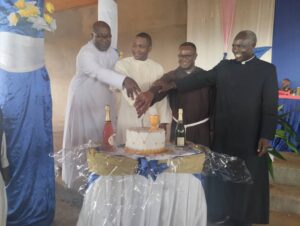
In his insightful homily, Archbishop Nkea underscored the significance of Saints Peter and Paul as co-founders of the Church of Rome, emphasizing the unity of the Catholic world under the leadership of Pope Francis. He quoted Saint Augustine, highlighting the Church as the mother of all believers and stressing the importance of fidelity to the Holy Father in Rome for authentic Catholic identity.

Archbishop Nkea exhorted the newly ordained priests and deacons to dedicate their lives to the service of Christ and His Church, emphasizing the primacy of proclaiming the Gospel and administering the sacraments to the faithful worldwide.

Following the solemn ceremonies in the Cathedral of Bamenda, festivities continued at the Friary of Bambui, where a celebratory feast honored the four newly ordained brothers amidst a spirit of jubilation and communal rejoicing.

Meanwhile, in Douala, Brother Michel Tiague was also ordained on the same day, adding to the blessings received by the Church on this memorable occasion.

Looking forward, the brothers continue to offer prayers for Brothers Elvis Tadzenyuy and Gotran Tata, who are set to be ordained priests on August 16th, 2024, at Saint Theresa Parish in Sop, within the Diocese of Kumbo.

As the Capuchin Order and the Church in Cameroon celebrate these ordinations, the community remains united in prayer and support for the ongoing vocations within its midst.

            Gideon N. WIRSIY.

Celebrating the “Cook”

23 YEARS BY FIRE

  Mr Laisin Edwin, the friar’s long serving cook in the custody (23years) is appreciated by Shisong Fraternity as he quits his noble profession as COOK. This ceremony of thanksgiving took place in the Sacred Heart Fraternity (Shisong) on Sunday  14 April 2024.

While thanking God for such a figure “Ta Lai” (as called by many friars) who had served different generations of friars, the House Guardian of Shisong, Br. Felix Afoni,  implored the Most High’s blessings upon him and his lovely family for good health, peace and harmony.


Celebrating Fraternal Proximity


Fraternal proximity

            On Sunday 31st of march 2024, Easter Sunday, the fraternity of Shisong entered the Novitiate Fraternity Sop. This was a moment to celebrate ‘fraternity’, to celebrate ‘brotherhood’ in the context of Jesus’ victory over death through his Resurrection.  This fraternal moment was spiritually filled as brothers all gathered for vespers. From the chapel, all proceeded for supper where the Guardian of Sop, Br. Cornelius B. Wirsiy welcomed all the friars, expressing to each, showers of Easter wishes and blessings.

This fraternal moment continued the next day with prayers, mass, works, lunch to share the Easter Joy as brothers. The fraternal joy was heightened with the birthday celebration of some friars (Br. Cornelius, the Guardian and Br. Gui noel).

An Easter Football Encounter  between the Postulants and the Novices spiced this moment of fraternal proximity. The day ended with another great fraternal touch: the GREAT TOMBOLA. 

Oh! What a joy when brothers live together. And the Lord gave me brothers.


ministries in bambui

RECEPTION OF MINISTRIES IN BAMBUI FRIARY

 FEBRUARY 12, 2024.

Today, February 12, 2024, St. Francis’ Capuchin Friary Bambui, Cameroon, lives another great event and moment in the life of nine friars who received the ministry of lector (Brs. Keflet Aseni, Gideon Nyuyshiyi, Magloire Demaya, Melchizedek Kpudzeka, Dimitri Mbombo, Herbert Yenika, Mbimenyuy Bongli, Achilis Ntumnyuy, and Emmanuel Fang) and four other friars, who received the ministry of Acolyte (Brs. Zachaeus Ntumnyuy, Steven Italo, Adolf Baba, and Anicet Njutapvoui).                   

This celebration began at 5:30pm with vespers in the Fraternity chapel, followed by the Eucharistic celebration, animated by friar students, officiated by the Custos, Br. Kenneth Ayeni Kinyuy, and concelebrated by all the other Friar formators of the fraternity.
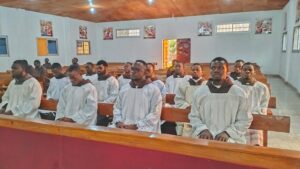
In his homily, the custos dwelt on the word: Scroll, which appears a number of times in Holy Scripture, and holds the content of divine revelation. He focused more in the book of the Apocalypse (5:6) where we read that the scroll had seven seals and only Christ could break it or open it. Therefore, this seal must be continuously opened and this can only be realized when people give up everything and avail themselves as ministers and servants of the Scroll breaker, who himself is the Word. The Custos underlined that if today, people fail to persevere in the faith, resolve to embrace violence and other forms of evil, then we, as ministers and servants of the Word, need to ask ourselves if truly we are breaking the seals of the scroll and planting them in the lives of the people. Therefore, as Franciscans, with the gospel being our rule of life, our intellectual, moral, and spiritual influence should create positive marks in the society.
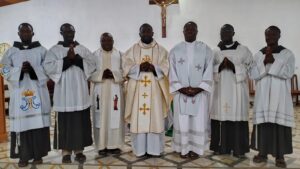
To the Lectors in particular, the father custos exhorted them to explore the Wisdom of God found in Sacred Scripture, in fact, to become Scriptures for others to read through their life of witnessing. To the Acolytes, the custos made reference to the book of Daniel (5:1-25), where Belshazzar took the sacred vessels from the temple in Jerusalem and drank fromthem together with his noble men and concubines, and immediately a hand appeared and wrote on the wall declaring the ruin of his pride, and the end of his reign. Consequently, the Acolytes were called upon to show reverence to the sacred vessels, for their care of these sacred vessels would portray the place God occupies in their lives, the reverence they have for the Holy. To crown it all, the preacher, reminding all friars that they are all vessels that still require the infilling of the Holy Spirit, urged that we all pray and work to avoid externalism and truly serve faithfully the Lord in the ministries in which we have all been called.       

Feelings of Brothers after the reception of Ministries     


FRIAR THADDEUS ESOPE (OFM CAP)

12/02/2024 

Visit to the novitiate

MOTHERS VISIT THEIR CHILDREN

VISIT OF CWA, SOP PARISH TO THE NOVITIATE FRATERNITY,

FRIDAY- FEBRUARY, 9 2024.

   
It was at about 12:25 PM that a large crowd of Catholic Women Association (CWA), dressed in their marian uniform stormed the friary and all settled around the fount of Our Lady, singing Marian songs. This was an occasion for these mothers to express their joy for the presence of the Capuchin Friars in Sop Parish. The Divisional President of the CWA, Mme Cornelia Liydzeka, speaking on behalf of the mothers, expressed her joy for the presence of the friars, reminding them that their tradition of visiting the Novitiate Fraternity and bringing them some food stuffs as mothers, has not and will never be forgotten. On his part, the Fraternity Guardian, Br Cornelius Bamenjo expressed his heartfelt thanks to the mothers, for always coming to their assistance, spiritually as well as materially.   

Consecrated Life Celebrated / La Vie Consacrée Célébrée

Celebration of Consecrated Life in Bambui Deanery

Friday, February 2, 2024.

Sr. Marceline Mokia Mbuh, a Capuchin Sister of Mother Rubatto (Bambili), tells us that this celebration took place in Bambili with the Sisters of Christ, the Capuchin sisters of Mother Rubatto, The Capuchin Friars, and the Marist Fathers, all present in the Deanery. It was an occasion to thank the Lord for his call and a moment to renew the call to follow Christ.                                                                                                                                        The message retained for the day was: “Consecration is not a burden rather a joy. It does not bring sorrow, it brings joy. Consequently, a sad religious is a contradiction”. Thus, celebrating this day, according to sr. Marceline, remains an occasion for people to know who we are, the life we have chosen and the value of consecration in the world today. Moreover, it is necessary to let young people know that it is not what they are that makes them happy but who they are. All in all, my wish and prayer is that all Consecrated Persons, beginning from me, radiate joy to the world.

Sr. Marceline Mokia Mbuh, Capuchin Sister of Mother Rubatto 

Was Consecrated Life celebrated in Mamfe Diocese? 

Sr. Elizabeth Kinyuy (Capuchin Sister of Mother Rubatto, Mamfe), what have you to tell us about the celebration of Consecrated Life in Mamfe?                                                                                                  Sr. Elizabeth Kinyuy tells us it was a wonderful celebration in Mamfe, on Sunday February 4, 2024, around their Chief Shepherd, Mgr. Aloysius A. Fondong. She tells us that, they as Consecrated Persons in the Diocese of Mamfe, did celebrate their consecration in the context of the Silver Jubilee of the Diocese. She makes us understand that the Bishop thanked all Consecrated men and women for the witnessing in his Diocese. He equally reminded them of the Letter of Pope Francis calling on consecrated men and women to go back to the roots. Sr. Kinyuy tells us that this celebration gave her an opportunity to revisit, to revise, to check, to edit, infact, to evaluate her calling, and motivation for choosing this life. As her own message of the day, sr. Kinyuy said: “If we are to be true witnesses we must do so in joy.

The inner joy that the challenges of life cannot take away”. She profited to check the things she clings to, which take her off from the lane, from the life she has willfully accepted to live. How to do away with what prevents her from being faithful to her spouse, was the assignment she gave herself. The Bishop, Aloysius A. Fondong, left a question to all Consecrated men and women present, that if their founders and foundresses were to come back to this life, will they really recognize them as their disciples? A question Sr. Elizabeth rephrased as: if my foundress, Mother Rubatto was to come back, will she recognize me as her daughter?


Sr. Elizabeth Kinyuy (Capuchin Sister of Mother Rubatto, Mamfe)
World day of consecrated life in the Archdiocese of Bamenda

The day of Consecrated Life in the Archdiocese of Bamenda was celebrated in Bambui Deanery, precisely in Our Lady of Fatima Parish, Bambili, on Sunday the 4th of February 2024, in the presence of Mgr. Andrew Fuanya Nkea, the Archbishop of Bamenda Archdiocese.

The Archbishop ceased this opportunity to express his gratitude to all Consecrated Persons in the Archdiocese, for their close collaboration with him and for their life of witness amongst God’s People.

He encouraged the Christians present at this solemn occasion to always support the Consecrated Persons God has given them.

To the young people present, he exhorted them to embrace this way of life without fear, without hesitation for God who calls, gives the grace even though we need to collaborate with his grace.  Other activities spiced the day, such as, Choral music, sketches, and fashion parades.

Br. William Kongnyuy (OFM. Cap. Bambui)

Bafoussam Diocese was not left out

“IT’S OUR LIFE, IT’S OUR FEAST” was the slogan adopted to adorn the day of the Consecrated Life in Bafoussam. The celebration of Consecrated Life in the Diocese of Bafoussam took place at the St. Joseph Cathedral Bafoussam, with about 44 Religious Orders/Congregations/Secular Institutes/New Communities. The celebration was preceded in February 1, 2024, with activities such as: a visit to an orphanage in Kouogouo II (Bafoussam Deanery), a friendly match with the Diocesan clergy and religious men at the Cathedral Stadium, a friendly match between the religious women, vespers and a cultural evening at the Cathedral hall.


February 2, 2024, at 9:55, Consecrated Men and Women, working in the Diocese of Bafoussam, coloured the Cathedral with their presence at the Eucharistic celebration presided over by His Lordship, Mgr. Paul Lontsie-Keune, Bishop of Bafoussam.

Commenting on the Table of the Word, the Chief Shepherd, expressed gratitude to all the consecrated men and women for their presence in the Diocese, for the touch they give to the lives of the faithful in the Diocese, stressing that the Church in Bafoussam needs them and loves them. He encouraged the all present saying that in the face of secularism and all the ills society undergoes, all that the world proposes to man in today’s society, consecrated persons should still stand as witnesses and true witnesses to Gospel life. He acknowledged challenges that come as a result of their consecration, saying that some, as a result of those challenges start nurturing the idea to quit. He reassured such   consecrated persons to go back to the first day they made their step into the congregation. He regretted too the fact that elderly consecrated persons turn to devalue the young ones who just come into the life, telling them they have no space because they have made no experience of religious life, hence, making life a hell for the young ones who come into this way of life with a lot of zeal and enthusiasm. He cautioned such persons that even a postulant has something to offer into the congregation, for it is not the number of years spent in the congregation that makes one holy. Moreso, the Bishop exhorted all Consecrated Persons to live their consecration with Joy, for without joy, we start dying and our consecration dies too. To crown it all, Mgr. Paul underlined that Consecrated Life has its beauty and value only through the cross. He then admonished that each Consecrated Persons sees meaning in his or her daily cross as a test to his or her consecration.

The novelty brought by His Lordship, Bishop Paul to this solemn celebration of Consecrated Life, was his invitation to the Diocesan Group “Sainte Anne” (a group for widows) to participate at this celebration. He said that like Anne, the widow in the Bible, they too have consecrated their lives to serve the Lord in his Holy Temple and in the upbringing of their children. He then encouraged them to be faithful to the Lord and in the upbringing of their children.
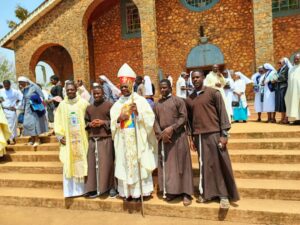
Br. Cedric Verbe K. (ofm Cap.- Bafoussam) 

 How was it in Kumbo Diocese?

 The celebration of Consecrated Life in the Diocese of Kumbo began on Thursday, February 1, 2024 at 8:30am, with the talk at the Cathedral on: DO OUR LIVES AS CONSECRATED PERSONS REFLECT THE JOY OF ETERNITY. This talk helped the participants to revive their calling as missionaries of joy in a society and in an environment where many are saddened due to the socio-political climate and its effects on the populace. After the talk, came sporting activities with two matches of football: the first being: Religious Women against the Youths of Meluf Denary and the last match, Religious Men against the Diocesan Clergy.

On the D-Day, that is, February 2, 2024 at 9am, a Holy Mass was celebrated in the Cathedral Church with the Chief Shepherd, Bishop George Nkuo, Bishop of Kumbo Diocese. A beautiful celebration animated by Shisong Community of the Tertiary Sisters of Saint Francis. The Bishop used the occasion to remind all consecrated Persons to get back to the roots of their call and to use this moment to renew their calling. He expressed the desire that the celebration be extended to all the Faithful, since we are all consecrated, each in his or her own way.  The day ended with some refreshment, and recreational activities.

Capuchin Postulant, Paulino – Shisong

Br. Albert kilofonyuy (Capuchin Novice) gives his own witness                                                                             In the Diocese of Kumbo, the World day of consecrated life which is celebrated on the 2nd day of February as the D-day, rather started with some sporting activities on the 1st of February 2024. These activities took place in the SAC Nso sports complex.            On the 2nd day of February, the world day of consecrated life, the events of the day started with Holy Mass at the Kumbo Cathedral at 9:00am. This Mass was celebrated by his Lordship Bishop George Nkuo, Bishop of Kumbo. The liturgy was superfluous and well animated. What marked most Br. Albert was the fact of seeing many congregations still present in Kumbo in spite of the socio-political situation. This brought to mind the fact of Consecrated Persons being signs, pointers to the future reality; their presence have given hope to the hopeless, and life to the lifeless. May God’s Holy Spirit continue to accompany all Consecrated Persons in being true witnesses to the society.

And in Rome, how was it celebrated with the Pope?

Br. Peter Tar tells us more

  Reflecting on the prophetic anticipation of the Lord’s arrival as foretold by the prophet Malachi, the Pope said that while the people were long for their salvation, prophets kept their hope alive through their prophecy like Malachi in the first Reading for today– “the Lord whom you seek will suddenly come to his temple”- the Pope upheld the figures of Simeon and Anna, who after being enlightened by the Holy Spirit, they waited in hope everyday in the temple for the fulfillment of the promised salvation. “It is good for us to look at these two elders who were waiting patiently, vigilant in spirit and persevering in prayer.  Their hearts have stayed awake, like an eternal flame.  They are advanced in age, but young at heart,” he said. They did not allow their age to weigh down on them nor given in to disappointments and hardship. In the child Jesus, they were able to see the promised Messiah to the nations.  He went on to say that waiting for God is vey important in our faith journey because everyday the Lord visits us, therby revealing himself to us in an unexpected way. We therefore should wait in an expectant hope. The worse thing that can happen to a Consecrated person is to let our spirit doze off; to let the heart fall asleep; to lock hope away in the dark corners of desolation and resignation. Simeon and Anna’s ability to preserve the flame of hope is an indication to Christians, in a world filled with distractions, to remain with their eyes fixed on God in expectation. “By staying awake in expectation of the Lord, they are able to welcome him in the newness of His coming,” he said.

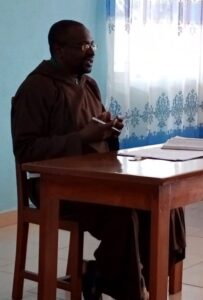
And directly addressing Consecrated men and women, he says that there is the present danger of running behind doing things to the detriment of our religious calling. That sometimes we risk our community and personal life by calculating the odds of success, instead of cultivating in total humility the small seed that has been entrusted to us. That we have lost the ability of patient waiting with open hearts for the Lord like Simeon and Anna.

Obstacles to waiting

The Pope then identified two obstacles that hinder the ability to wait. The first, he said, is the neglect of the interior life, where weariness prevails amazement, where habit takes the place of enthusiasm, where conflicts or negative experiences turn us into bitter persons. He says it is not good to ruminate on bitterness, but to recover the lost grace through an interior life through the spirit of joyful humility and silent adoration in order to reawaken the amazement of the first day of our profession.                                                                                                                                                   The second obstacle is adapting to a worldly lifestyle that ends up taking away the Gospel. This is characterized by speed, activism, and the pursuit of immediate gratification. In this case, silent is banished and lost from religious communities. He then calls us to slow down the pace at which we are going. “Where silence is banished and lost, waiting is not easy, for it requires an attitude of healthy passivity, the courage to slow our pace, to not be overwhelmed by activities, to make room within ourselves for God’s action,” he said.

The Pope continued with a call to cultivate a spirit of waiting,  careful that “the spirit of the world does not enter our religious communities, ecclesial life and our individual journey, otherwise we will not bear fruit.” Like Simeon, he added, “Let us also pick up this child, the God of newness and surprises.  By welcoming the Lord, the past opens up to the future, the old in us opens up to the new that he awakens.” Pope Francis concluded his homily reminding those present that “these questions are for us, for our communities and for the Church.”

“Let us be restless, let us be moved by the Spirit, like Simeon and Anna.  If, like them, we live in expectation, safeguarding our interior life and in conformity with the Gospel, we will embrace Jesus, the light and hope of life.”

Br. Peter Tar (ofm Cap. Rome)


WHERE IS YOUR BROTHER?

Where is your brother?

The Capuchin Friars of the Custody of St. Francis of Assisi in Cameroon, from Sunday the 7th of January to Saturday the 13th of January 2024, gathered in the Dominican Nunery, Bambui, for their annual retreat, preached by Br. Author Nga Abanfegha. This spiritual exercise, had as anchor,  the question by God to Cain in the book of Genesis (4:9): Where is your brother (Abel)? Where is my brother? Br. Author, the retreat director, helped the friars to reconsider the place of FRATERNITY in the life of a disciple of St. Francis of Assisi, who rejoiced in his Testament saying: “And the Lord gave me brothers.” The preacher stressed we all are  members of the same family as friars, infact, that we are all in the same boat where, what affects one, affects all.


Biblical personages were examined in line with the brotherhood such as: Esau and Jacob (Gn. 25:27-34), whereby the conflict between the two brothers brought about their separation especially at the moment Jacob received the blessings of his brother Esau. The page on Joseph and his brothers in Gn. 37 was another opportunity to examine how brotherhood could be shattered; where the brothers of Joseph (all sons of the same father) cultivated hatred for Joseph because he was so loved by Jacob more than the others, he came reporting his brothers to their father (Gn. 37:2), above all, his dreams injected jealousy into the life of his brothers; the consequence being their hatred and desire to eliminate their own brother. Another picture of brotherhood brought for meditation was the story of the Lost Son – the younger brother. At his return, his elder brother refused to welcome him. These stories were therefore seen as realities that a fraternity like ours could undergo, where a brother could fight to be at the place of the other through fraud as in the case of Jacob, where out of hatred and jealousy, a brother could desire to eliminate the other as did the brothers of Joseph and even reject a brother as did the eldest son in the parable of the Lost Son. But in the case of Andrew and Simon, we see a brother who works for the other’s good. Andrew sees Jesus, then goes to bring his own brother to Jesus.


Brothers bringing each other to Jesus


As a result, the retreat director, Br. Author, therefore asked each friar to bring the other friar closer to Jesus, to have the good of each other at heart, avoiding all that destroys, harms or shatters fraternity. This would help us avoid the response given by Cain to God: “I do not know, Am I my brother’s guardian?” (Gn. 4:9)

Twins Speak (paroles aux jumeaux)

Paroles aux Jumeaux

(Twins Speak)

“And the Lord gave me brothers” (Saint Francis of Assisi). In gratitude to God for the richness in vocation for the Custody of St. Francis of Assisi in Cameroon (4 final professed friars and 9 Capuchin deacons), the wish is to hear these friars tell us their feelings, and their motives for accepting to make such steps into the Order. What do they wish for the Order, the Church and God’s People? We shall listen to some of them speak to us. Over to you brothers?  


Final Professed and  Deacons

Br. Adolph Baba

Br. Adolf is happy to give himself to the Order and for the Order accepting him .


Deacons

Br. Rene Mbaku 

Brother Rene is grateful to God for his love and mercy, for having looked upon him, by raising him to the ministry of the Word, a ministry which is not for export, a ministry that carries a message he has to propose to others and to impose on himself, since he has to read the Gospel, believe in it and then, put it into practice. 


Br. Elvis Tardzenyuy

Before the ordination, I was cogitating on the word Reverend. After ordination, many will be calling me Reverend. So, I asked myself if all would end only at that calling. I therefore told myself : “Elvis, that calling of Reverend should be in perfect harmony with your acts.” Truly, I am happy to be ordained a Deacon for the Order and for the Church. I am happy because God has given me this wonderful gift of ministering to His people. This is something wonderful for me. I do not merit it, but his love has made me who I have become. So, my duty and task is SERVICE. Having been ordained, I even asked to know what had changed in me. I am still Elvis, right? But then, something more has happened to Elvis, something spiritual has taken place in me. So, 1Tim. 4:13 is a text that has inspired me in accepting this call to be a minister of God : “Devote yourself to reading, preaching and teaching until i come.” This phrase of St. Paul sums my mission: one who reads (the word of God), preaches (more by deeds) and teaching (according to the mind of the Church).  I therefore pray to be a faithful deacon, a faithful servant of God for the rest of my life.

May God give me this single grace. 

Br. Esope Thaddeus Moseu

I thank God Almighty for this grace to share in this ministry, it’s a great joy, I thank my parents for accepting that I follow God’s call, I thank my formators from postulancy till date, I pray for continues grace to be a good and fruitful minister of the word, and to be part of the goodness of God in and for our custody.                     “Your word Lord is a lamp for my feet”. This is the phrase that leads me into the ministry. Sometimes in life, it is difficult to predict which path to take or steps to make, but I came to realise that at the moment of confusion, the answer is the bible, that is, God’s Word. In it, I gain consolation for my worries. The above word of action  has been a source of comfort and guidance to me, I have seen, I still see and will stil see God’s hands in my life and vocation. In fact, His Word serves as a source of illumination in the darkness of my journey, providing clarity and wisdom, peace and fulfilment, knowledge and truth and hope.

Despite all, God’s faithfulness still leads me on to a place of purpose and fulfilment.

Br Michel Laubryl Tiague 

I thank God for having called me to serve at his altar as a deacon. I’m very happy for this great gift to me and to the Order at large. Before the Ordination I chose as Motto 2Tim 4:2 to preach the Word at all time, welcomed or unwelcomed… because the world is fast changing and the tendency is to please the people and not say what the Word of God demands of us. So I resolutely take upon myself to proclaim it with boldness and therefore live accordingly. I sincerely thank the Community of Bambui and the Custody for making that day a wonderful day.  May God continue to bless and strengthen us in this path of life.

Br. François Djorwe

After the ordination I was very happy and at the same time challenged by what I had brought myself into. This is due to the fact that, today we live in an era where the world is proposing ideas that are very appetizing, ideas which even contradict the Gospel message. So, I chose as motto: Let thy will be done not mine. (Lk 22:42b), as a reminder, that l have been ordained to always search, know and do the will of God. In fact, this is not only a motto but a prayer. Consequently, my vision has always and remains, being a happy and a faithful servant of God wherever I find myself no matter the circumstance.

Br. Fabrice Awembom

I feel very happy and grateful to God for my ordination on this day. I have done nothing to merit this grace and can only express my gratitude to the one who had ordained this from the beginning of time. I equally feel grateful to all who have been journeying with me and have contributed in one way or the other to bring this day to it’s realization. May God himself be their reward.                                                                                                    We are merely servants…”(Lk. 10:17). God’s call, is always a call to loving, humble and selfless service and not to self-glorification. Such is the ministry of the diaconate to which he has called me. I therefore find in this verse in Luke’s gospel a true reflection of what Jesus expects of me as a deacon in the church of which he is the head and it is my wish to commit myself to it with an undivided heart: humble, loving and selfless service in the name of Christ.

Br Philip Nyuysemo Mbungai 

I, Br Philip Nyuysemo Mbungai, OFM cap, feel so happy as I see myself continuing on my vocational journey. I’m glad for God’s call and for His Grace that have led me this far. I chose as my motto: Do to me according to your word (Lk 1:38) this is supported by Psalm 51:11, “Do not cast me away from your presence nor deprive me of your Holy Spirit.” All of these, remind me of the one who has called me and whose will I have to carry. It is for me to be a true servant, dedicated and ready to go out to serve my neighbours, knowing that it is in His will and spirit that I act.

Beloved brothers, may the Lord of all goodness, bring to fulfilment the good work started in you.

May St. Francis and St. Clare intercede for you.

TWINS IN BAMBUI

TWINS IN BAMBUI

Final Profession and Diaconal Ordination


Great things we have promised God, greater things has he promised us, says Saint Francis of Assisi. Saturday,  2nd December 2023, the Order of Friars Minor Capuchins (OFM. Caps), Custody of Saint Francis of Assisi in Cameroon, was graced with a twin celebration, that is, the Final Profession of four friars (Zachaeus Ntumnyuy, Italo-Steven Lele, Adolph Baba and Anicet Ariel) and the Diaconal Ordination of 10 friars (9 Capuchins: Brs. Francois Djorwe, Esope-Thadeus Moseu, Phillip Mbuhngai, Ignasius Kenso, Rene Mbaku, Elvis Tardzenyuy, Michel Tiague, Gotrand Tata and Fabrice Awembom and an Augustinian, friar Michael). This twin event took place in the capuchin friary of Bambui. The Holy mass was presided over by Mgr. Angelo Pagano, Apostolic Vicar of Harar-Ethiopia, the ordaining minister; while the Perpetual vows were received by Br. Kenneth Kinyuy, Regular superior of the Capuchin Brothers in Cameroon.

May the Lord bless these our brothers in the various steps undertaken, to be witnesses of His love amongst His people. 

Pax et Bonum

Br. William Kongnyuy


A Domus Ordinis in Buea? What a blessing!!!

The official blessing & opening of the Capuchin friary in the  Diocese of Buea as a Domus Ordinis by the Provincial Minister Angelo Borghino on the 29th September 2023

One of the greatest fruits of the Extraordinary Custody Assembly convoked by the General Curia animated by the General Councillor fra. Kilian Ngitir, who providentially is the second  Cameroonian Capuchin friar,  accompanied by Fra. Akilu Petros from the Solidarity office of the Order and the Provincial  Minister  fra Angelo Borghino held from the 25th – 26thof September 2023, was the official opening of the Capuchin friary in Buea.

   The Occasion commenced with a Pontifical high mass presided over by fra Kilian Ngitir, concelebrated by Fra Kenneth Kinyuy (Custos), fra cyril Kerla (Guardian of the said fraternity) and the Provincial Minister. Furthermore, in attendance was the august guest, fra Akilu Petros and fra Theophile Seka, a member of that fraternity.

The blessing proper of the sacred vessels, the Lectern, the liturgical books, the Cross of Saint Damian and the general blessing of the house graced the Capuchin presence in the Diocese of Buea with a Domus Ordinis a Landmark in the administration of fra. Kenneth Kinyuy and his council,  the first  indigenous Major superior of the Capuchins in Cameroon as the Custody celebrated her 40th Anniversary (1982- 2022).

Immense thanks go to the mother Provincial for her love, accompaniment, and sacrifices. Immense thanks equally go to Fra Nestor Nyamnjo, the project coordinator for his ingenious and meticulous follow up of this noble project till this stage. We cannot forget our benefactors especially Mr. Divine Feh a great and God-given Contractor, for his untold contributions.

 The story began on the 18th May 2021 with the pecking of the foundation, then the digging and casting of pillars. In the twinkle of an eye the first decking. Then, came the second and third floors. God has been faithful till this blessing and opening of the house this 29th September 2023, feast day of the Archangels Michael, Gabriel & Raphael.

Fra. Theophile Seka ofmcap

A Summary of the Custody’s Assembly

CUSTODY’S ASSEMBLY- DOMINCAN CONVENT-BAMBUI

September 25-26, 2023

A summary of the discussions at the Custody’s Assembly, held in the Dominican Convent (Bambui)

Monday, 25 September 2023

The assembly doors opened at about 9am (Monday, 25 Sept. 2023), with 63 participants. Br. Kenneth Kinyuy, the Custos, welcomed all the brothers present. He expressed gratitude for the presence of the brothers especially the presence of  Br. Kilian Ngitir (General Councilor for Africa), Br. Wachamo Aklilu Petros (from the solidarity office in the Curia), and the Provincial Minister, Br. Angelo Borghino, for making it for the Assembly. The Custos, Br. Kenneth, basing on the word “rapprochement”, indicated that the assembly would be a moment of verification, whereby information received by the Curia and the Provincial has to be verified and clarified so that we all, as friars, move on the same footing and to the same direction.

Br. Kilian intervened after the Custos. He expressed the General Minister and his council’s worry about Cameroon concerning the postulancy project and other projects of the Custody. He acknowledged the fact that the postulancy had been an urgent project for the past 9 years, a project which is being realized today in Mbohtong. He indicated that this giant project was happily welcomed by the Curia even though, along the lines, the project has undergone some misunderstandings, reasons for their presence at  Assembly, an opportunity for clarity to be made on the Postulancy project and to see together the steps to take for the realization of this noble project so dear to the Custody.

After the intervention from the Curia, through Br. Kilian, the Provincial Minister spoke up. He spelt out that the assembly is convened because of the need to enlarge our reflection as a custody, on the custody and its future. Moreover, pointing to the numerous projects of the custody as a major concern, the provincial explained that the fundamental question is not on the mistakes made about these projects not discussed or clarified with him, but on the mentality behind these projects. He even enquired to know if it was important to build people or the walls. He further highlighted the place of authority as service. In his presentation about the animation of the custody’s life by the council, two points were looked into: firstly, that the Custos and his Council ought to animate spiritually, pastorally, and fraternally the life of every fraternity and brother. He stated that in all the superior does, he must ask himself how what he does is of help to the brothers to faithfully respond to the call of Jesus Christ.

Secondly, that listening to the brothers is of prime importance in animating the brothers and of great value or service to fraternal life.

Moreover, Br. Borghino, the Provincial Minister, gave guidelines on how to animate the custody based on his own experience as councilor and provincial.

  • The need of the custos to visit brothers in their fraternities and in their functions such as bursars, guardians etc.

  • The need to create active commissions to assist the council.

  • Giving more accent to formation of brothers in the custody and that a healthy relationship exists between the superiors and the formators.

        After the Provincial’s interventions, brothers went into constituted groups of 7 to evaluate the Custody’s activities. This evaluation was guided by the following questions:  

QUESTION ONE

Approximately five months after the celebration of the custody chapter, how do we evaluate the significant events and moments, as well as the problematic ones? For those who did not participate in the chapter, what perception or feedback could they have gotten? What effect did I have within the various fraternities?

QUESTION TWO

At the custody level we can reflect on these elements: =how do we live the relationship with the custody? What feeling of real belonging do we live and express? Do we feel like active members, who live responsibly, or passive members, who use the custody for their own projects? How do we evaluate our personal commitments in the life and activities of the custody? How is the quality of our communication with each other and with those in charge and service of authority? How do we use forums and social media? To what extent are they constructive and unifying instruments rather than a source of division? What real openness do we experience with respect to the national territory, starting from vocational animation? What are our expectations for the future of the custody? Are our current activities and commitments helping us achieve these goals? How do we live the relationship with the province, what are the expectations? What can and should we grow and improve on?

QUESTION THREE

At the initial and ongoing formation level: how do we evaluate the initial formation path in the custody, what are the strong points and what are the weak ones? What evaluation do we give to ongoing formation? What opportunities can we avail ourselves of and what are the lacks?

The feedback from this workshop was a great help to the brothers to see what has been done, what needs to be improved and how to move on as a Custody.

TUESDAY: 26 September 2023

The second day of the Assembly had as vision, to tackle the projects of the Custody and to bring out solutions to the uncompleted structures. Br. Wachamo Aklilu (from Ethiopia), working in the solidarity office in the Curia, being the first to intervene for the day, briefed the brothers on the following points.

Firstly, he expressed his joy of being present in the custody, indicating it was his second time of coming to Cameroon since 2009 with the inauguration of the Cardiac Center. Then, he presented to the brothers the structure of the solidarity office. He further explained the difficulty of assisting the brothers of the Custody in their projects as a result of the financial crisis that undergoes the Curia.

After his presentation, the brothers went into groups to continue reflecting on the life and projects of the custody through the following questions:

  • At the level of projects how do we evaluate the strong commitment sustained in the construction projects still underway? What sharing took place within the custody

  • At the ecclesial level we can ask ourselves: What participation do we experience in the events of the dioceses in which we are inserted? What is our contribution to the journey of the local church with our own charism? What is our involvement and our communion with the bishops, with the priests, with other men and women religious? How do we evaluate bishops’ relationships with our superiors?

  • Sharing general observations: joys, worries, fears, hopes etc.

After the interventions from the brothers in response to the questions, Br Tobias then greeted the brothers, informing them of his departure for mission to America, precisely in the province of New Jersey.

From his intervention, came closing remarks. The first closing remark from the Custos, Br. Kenneth, who said that what had provoked the Assembly was a mistake in the construction of giant structures in the custody; a mistake God has used to reunite us and to help us reunite our ideas for the good of our Custody. The Custos appreciated the Provincial Father for having a critical eye on him and on our custody. He concluded by thanking the Provincial for being always a father who leads the custody into the “promised land”.

The remarks of the Custos were then followed by those of the Provincial, who in the first place, thanked the brothers for making the Assembly a fruitful one through their frankness and sincerity. He acknowledged being hard on the brothers, yet underlined he has a responsibility before the province to respond to each member of the province.  About the construction of the postulancy, he pleaded that each brother of the Custody sacrifices something in view of the structure. Lastly, he acknowledged the fact that the Custody needs to move towards autonomy, knowing there are modalities to be arrived at. Consequently, there is a need to start reflecting on such modalities.

Br. Aklilu Petros, on his part, equally expressed his joy of meeting the brothers and sharing with them. He appreciated the hard work of the brothers, and encouraged all to keep striving always for the good of the custody, which one day, shall be raised to a Province.

Finally, came the words of Br. Kilian, who articulated his satisfaction for the spirit of collaboration amongst the brothers, exhorting them to continue to strive for perfection, valuing each other as a gift. He added that brothers do away with their differences and learn better ways of handling them. This will then foster unity amongst the brothers and in the custody as a whole.

We thank God for having led us throughout this family gathering.

Pax et Bonum

Br. Cedric Verbe Kohyen

Custody Assembly in the Dominican Nunery – Bambui

Monday, the 25 September 2023, the Capuchin Brothers of the Custody of St. Francis of Assisi in Cameroon, in their numbers ( around 59), in the presence of the Curia (represented by Br. Kilian) and in the presence of the Provincial Minister (Br. Angelo) gathered for an assembly in the Domincan Nunery in Bambui. This assembly has as goal, reuniting all friars of the Custody, evaluating the life, projects and activities in and of the Custody, five months after the Custody Chapter. The fruits of the Chapter shall be published in the next hours.


Silver Jubilee celebration

25 Years of Religious Life

Silver Jubilee 2023

Already 25 years (07/09/1998-07/09/2023) since Brothers Vitalis T. Nyuysever, Donatus M. Wirkom, Francis B. Dor and Cyril Kerla vowed their Yes to God. This anniversary was hectically celebrated in Shisong Sacred Heart Parish (Kumbo Diocese), on Saturday 09-09-2023. It was a moment to thank God for his faithfulness and love; a celebration prepared for through a spiritual retreat in St. Mary of the Angels’ Fraternity Sop, preached by Fr. Andrew Ngah Solii (a priest from Kumbo Diocese). He invited the brothers to look back at the years past, and then, thank God for the 25 years of witnessing as friars. Furthermore, he indulged them to beg from God, forgiveness for the moments of poor witnessing. This would permit them to start afresh the life they had embraced, following the invitation of St. Francis to the friars as he neared death: “Let us begin again for until now we have done nothing.”

Before this great celebration, the Custos, Br. Kenneth Kinyuy, in his circular of August 30, 2023, had addressed the brothers saying: “Dear Brothers Vitalis, Donatus, Francis and Cyril, I humbly beckon you to strive and persevere in your Religious Franciscan-Capuchin vocation in such a way as to become a vivid response to God’s injunction in Leviticus, ‘The Jubilee will be a holy thing for you.’ (25:12). Holiness is the universal target we must never lose sight of. The jubilee is an opportunity to bring back to mind this reality.”

Dear Jubilarians (Brothers Vitalis, Donatus, Francis and Cyril), may God, through the intercession of St. Francis and St. Clare, through the maternal intercession of Mother Mary, continue to bless, guide and lead you in this noble and happy vocation.


Bayon s’occupe ses jeunes

Bayon s’occupe ses jeunes

En vue d’occuper les enfants de Bayon durant cette période des vacances, la Paroisse Sainte Famille, sous la direction de son curé (fr. Felix Ayuvea) et son vicaire (fr. Valery Tukov), avec l’assistance des frères René, François et Nestor, a organisé un camp des jeunes dans lequel ont participé les jeunes de la Paroisse Sainte Famille de Bayon ainsi que les jeunes de Melon 2 (accompagné par le frère Nestor de la communauté des Frères de l’Emmanuel Melong 2). Ce camp des jeunes de Bayon avec les jeunes de Melon 2 a eu lieu à l’enceinte de l’école catholique de Bayon du 11 au 16 août. Ce camp s’est tenu sur le thème “ne vous laissez pas égarer par toutes sortes des doctrines étrangers”, avec un effectif de 70 participants. Les thèmes suivants ont enrichis le séjour des jeunes: Que personne ne méprise pas ta jeunesse (les défis actuels qui menace la vie des jeunes), les risques et les effets néfastes des pratiques sexuelles dans la vie des jeunes, les jeunes face aux défis de la société : la nécessité d’une bonne formation de la conscience morale, et, La Vierge Marie: modèle pour les jeunes.   En plus des thèmes développés pour la formation ou la culture des jeunes,  les activités spirituelles (messes quotidiennes, confessions, écoute, exposition sur la vie des saints…) et les activités récréatives (le sports, la soirée culturelle) ont  meublées leur présence à Bayon. 

Que toute gloire soit rendue à Dieu Père, Fils, Esprit Saint; à notre Mère la Vierge Marie, nos saints patrons, nos anges gardiens, à toutes personnes de bonne volonté de nous avoir assisté tout au long de ce camp de jeunes à Bayon. 


les jeunes après la messe

l’équipe organisatrice


Brothers fetch water for the children


la détente 

Fishing for the Custody and for the Order

Fishing Vocations for the Custody and for the  Order

The first two weeks of July 2023 in Bafoussam Diocese, i.e., from the 5th – 9th of July and from the 12th – 16th of July 2023, were great moment of fishing vocations for the Custody and for the Order in Bafoussam Diocese. For Kumbo Diocese, this same experienced was made from the 25th – 30th of June 2023. These moments permitted the Franciscan Capuchin Charism to be sold to the young who gathered for various vocation camps. 


La joie de la jeunesse

May the Holy Spirit, through the intercession of St. Francis and all Franciscan Saints, help the young, touched by the Franciscan charism,  respond positively to God’s call into the Order.  

Holiday Program in Bambui: Hotcake for children

Holiday Program in Bambui: Hotcake for children

“Let the children come to me, and do not prevent them; for the kingdom of heaven belongs to such as these.” (Mt. 19:14)

Bambui Fraternity organises and hosts a special holiday program for children. This program under the chairmanship of the House Guardian of St. Francis of Assisi Fraternity Bambui, Br. Terence Sahven is aimed at helping kids in and around Bambui develop skills in variant domains of life such as reading and writing, computer elementary, playing of musical instruments such as the piano and the guitar, the fabrication of rosaries and bangles, and the production of liquid soap. Moreover, sports such as football, and other games form part of this holiday program for learning without playing makes Jack a dull boy. The various lessons are dispensed by the Capuchin students (Brs. Esope, Ignatius, Fabrice, Elvis, Augustine, Anicet, Keflet, Gideon, Immanuel) under the umbrella of brothers Terence, Jude, Martin and Aloysius.


This program which started on the 18th of July, and shall run till the 29th of August 2023 every Tuesday and Thursday from 8:00am to 12:00pm and every Sunday afternoon from 2:00pm to 5:00pm in the Capuchin friary Bambui, with free registration. The very first day of the session that took place on Tuesday, 18th of July 2023, recorded about a hundred and fifty-six children (156 children), ranging from the ages 5 to 19. This number is due to a great sensitisation by the friars, the desire of the parents to have their children occupied during this period in order keep them from idleness, in fact, to help them avoid being the devil’s “workshop” and above all, the desire of the children to learn and develop talents or treasures hidden in them.

 Making of rosaries/bangles/liquid soap with Br. Anicet           Reading and writing with Br. Augustine


Computer lessons with Br. Gideon                                   Piano classes with Br. Elvis                                

Guitar classes with Br. Ignatius                                                                    Sports/games with Brs. Esope/Anicet/Immanuel

Hence, while we pray and hope for the best as this program unfolds for our children, who at the end should be each proud to say: “I was there”, we equally are open to welcome suggestions and free donations (material/personal skills/financial) to assist this maiden holiday program for our children.

May St. Francis and St. Clare intercede for us.

 Br. Esope MOSSEU Thaddeus (OFM Cap)


Vows Refreshed

Vows refreshed

The Constitutions of the Capuchin Lesser brothers, paragraph 23,4 states: “Formation in our Order is implemented in two phases: initial and ongoing. Initial formation includes intitiation into consecration according to our form of life, lasting until perpetual profession.”

Therefore, brothers in initial formation after the novitiate experience, are bound to renew their vows of Poverty, Chastity and Obedience, following the formula approved by the Holy See for the Franciscan First Order and for the Third Order Regular of Saint Francis (cf. Constitution, par. 21).

As a result,  brothers, who, in July 15, made their First Profession, are bound to renew those vows until  the day they become perpetually professed or permanent member of the Order.


Brothers listening to some admonitions 


Through this renewal, a brother continues to examine his call into the Order and verifies if he can fully embrace and live the life as it ought to be lived.

May God continue to assist you with His Holy Spirit and through the intercession of Francis and all Franciscan Saints to remain steadfast to you call brothers.

A Time to Cross-Over

A time to cross-over

There is a time for everything. A time to begin and a time to end. The Order celebrates his brothers who move-on to other stages of formation. Postulants making a step into the novitiate (July 14, 2023); and novices making a step out of the novitiate through their embrace or Temporary profession of the vows of poverty, chastity and obedience (July 15, 2023).

Postulants getting set to cross-over into the novitiate 


The reception of the probation habit

*

The novices pronouncing their vows of poverty, chastity and obedience inorder to embrace the Capuchin life as Lesser Brothers

Brothers Godlove, George and Sergius make their triumphal entery into the Order

Brother George MBUYE, before crossing-over to a new stage of life as a friar in Temporal vows , makes a flashback to his dreams as he prepared to enter the novitiate as well as share his experiences in the novitiate. 

A POSTULANT’S DREAM FOR THE NOVITIATE

            Every postulant’s dream at the end of the Postulancy is to put on the habit of probation. It is a sign of progression into the life from one stage to another stage but this is just the surface of what the Novitiate can impart on us and so there is need to go deep and have mature expectations or dreams for the Novitiate. To begin,

            I dream to be a Holy Friar; a good capuchin brother and to follow the path of St. Francis of Assisi. I hope during the 12 months, it will help mold and build me to be God’s best friend.

            Secondly, I expect to interiorize the Franciscan values, learn the capuchin way of praying and working which has given the Order and the Church many capuchin saints and blessed.

            To go further, I hope I get to be a fraternal brother who can make his community livable and loving.

            All in all, I expect to be initiated into the Franciscan Family, the capuchin brotherhood, so that I can be of value to the community and to the world. I pray to be a good example of Saint Francis, loving God and his creation always and everywhere.

Brother George, at the end of his novitiate year, desires to share his novitiate experience. Have his novitiate dreams been realized? He tells us more?

MY EXPERIENCE AS A NOVICE IN THE CAPUCHIN NOVITIATE FRATERNITY

In the first place experiences shape each and every one. God speaks through events, He daily communicates to all who seek his face on how particular assignment(s) should be carried for the benefit of Heaven and earth. John Main in his book “The Joy of Being” says “the church cannot effectively proclaim a past experience. It can only proclaim what it is actually experiencing. It can only proclaim what it is. Therefore, if the gap between what we believe and what we experience makes us inauthentic, our message can convince no one until it has so convinced us that we are transformed by it”. We vow to live obedience, chastity and poverty.

It is in this connection that one who is a novice and has embraced the depths of intense initiation into the truth that the capuchin spirituality and charism holds to it members, should make them all authentic in living fraternal life and observing the rule which is the gospel. In fact, fraternal life is built on prayer, manual work, recreations and visitation of the sick which helps me grow in total consciousness of the presence of God. This is to ascertain that life not based on prayer, a church that is not spiritually founded, a world that is not prayerfully sophisticated, cannot be a world, a church or life that is fully alive. Consequently, for me to be fully alive, as a novice, the foundation stone is prayer without which I am inauthentic in everything that a capuchin novice should be. Novitiate is a decisive stage in the capuchin life where one gets deep into his call to follow Christ in the footsteps of Saint Francis.

As a matter of fact, the novitiate helped me to make the longest journey of my life which is the journey of myself to my inner self. The gospel, that is, the good news I listened to at every Eucharistic celebration made me good and new as well as the journey to my inner world throughout this one year of experience made an authentic change of goodness and newness in my being. I underline this aspect because once in the novitiate, one is called to a spirit of the Holy Scripture where one doesn’t just read to digest its fundamentals but also to listen to Christ who speaks and instructs.

In a nutshell, my experience as a novice is the experience of myself which revealed to me the light that lies hidden within and the darkness of my very person which calls to total surrender of my being to the true identity of who a capuchin is and should always be.

By Mbuye George


The Novitiate Year draws to a close

In few days from now, the novitiate year will end for some and begin for others. Infact, the Order of Friars Minor Capuchins in Cameroon, will soon put to birth three children in the persons of Br. Godlove Lendzemo, Br. George Mbuye and Br. Sergius Yovla through their temporary profession, marking an end to their novitiate/canonical year. 

May St. Francis, St. Clare and other Franciscan Saints pray for you and for us all brothers. 

Happy Birthday to the Capuchin Order

July 3, 2023, the Order of the Friars Minor Capuchins celebrates their 495th anniversary of existence. It was in July 3, 1528 that, through the good offices of Catherine Cibo, Duchess of Camerino, the Capuchin reform was approved by Pope CIement VII in a brief Exponi nobis given at Viterbo  and on the same day officially “sealed,” that is issued in the form of a bull beginning with the words: Religionis Zelus. 

To mark this celebration, the Provincial Father of the Friars of Lombardia, Fra. Angelo Borghino addressed the sons of Francis in the following words:

Dear Brothers

Today, July 3, marks the anniversary of the approval of the bull Religionis Zelus. This circumstance offers an opportunity to be reminded of that spirit of “reform” which characterized our beginnings and which continually challenges us as a proper dimension of our journey, both on a personal and fraternal level.

With this we are once again invited to refocus our lives in the following of Christ, obedient, poor and chaste, in order to take on his “form” more and more, through that path of conformation to Christ and to his sentiments towards the Father, which constitutes the ‘heart’ of our life of consecration.

The beauty of following Christ, according to that particular form to which in freedom we have been delivered, will become increasingly persuasive for us and a witness to those who meet us to the extent that the desire for conversion and change in our hearts remains alive and awake.

The anniversary of July 3 comes at the time when the Provincial Council meets again in view of the “List of Appointments and Transfers.” All this is part of that journey of continuous reform to which our very choice of life always leads us back and which, as provincial minister and council, we are called to accompany and support.

May the Immaculate Virgin, patroness of our Order, St. Francis, St. Clare and all our saints, especially Blessed Innocent of Berzo and Blessed Arsenio of Trigolo, accompany our renewed commitment to follow in the footsteps of our Lord Jesus Christ and to serve the Kingdom of God according to those circumstances and ways to which we will be called.

Fraternally

Brother Angelo Borghino

Minister Provincial

The Curia’s Formation Team in Cameroon

Br Jaime Rey,  Secretary of formation from General Curia visits Cameroon. He arrived Cameroon on Wednesday 24 May 2023 and quits for another mission on Wednesday 31 May 2023. We thank God for his presence and for the impact his presence has had and will have in the Custody of St. Francis of Assisi in Cameroon as far as the formation of brothers is concerned.

50 YEARS ALREADY!!!

Br. Gioacchino Catanzaro warms-up to celebrate 50 years of  Priestly Ministry

Gioacchino.aigd

Br. Gioacchino Catanzaro, we celebrate you for your 50 years of service as a Priest and a faithful servant of God in His vineyard (27 May 1973 – 27 May 2023). This celebration will be marked by a solemn mass celebrated in the Bambui Conventual Chapel (Bamenda) on Saturday 27 May 2023 at 11 am.  We cease this occasion Abba, to thank you for dedicating almost half of your priestly ministry (i.e. 22years from December 2000 till date), for the people of God in Cameroon. May our Good and Holy God, who began this good work in you, bring it to fulfilment.

Forty-six, confirmed Soldiers for Christ in SAPCCCOL-Mbohtong

Confirmation in SAPCCCOL Mbohtong-Sunday, May 7, 2023

Saint Anthony of Padua’s Catholic Comprehensive College (SAPCCCOL) Mbohtong is a co-educational institution; i.e. general education and technical/commercial education. Presently, this beautiful institution hosts over 150 students (both borders and day students) from different areas and different cultural backgrounds, giving a stupendous environment for both intellectual work and human/moral integration. In SAPCCCOL, students learn to accept, love and help one another.

 On Sunday the 7th of may 2023, the Bishop of Kumbo, Mgr. George Nkuo, paid an august visit to this fabulously decked city of wisdom. This visit, after seven years since his last visit to the school, was an occasion for 46 of the students to receive the sacrament of confirmation in the presence of their fellow students, parents and teachers.

The Bishop was over-joyed by the ambiance created by the members of the entire SAPCCCOL family, and in his Homily, encouraged the students, as well as each and every Christian to be a true witness to the faith, and a valiant soldier of Christ. He affirmed time and again, that SAPCCCOL is a school like no other, and a place to be. He equally exhorted the parents to do well to send their children to Saint Anthony, and for those whose children are still out of home, to bring them back home, where education is not only qualitative, but equally affordable and accompanied by moral upbringing. Let us all join hands to give a good name to Kumbo.

No one present at this event, could succeed to hide the joy that enveloped the atmosphere. Parents, teachers, students and invitees were all thrilled by the beauty of the event.


Students welcome the Chief Shepherd


The Bishop with the entire christian community of Mbohtong present at his august visit


Students enjoying their beautiful campus

Br. William Kongnyuy

From Mbohtong, Sunday 7th of May 2023. 

The Chapter Experience – MELONG II

The Chapter Experience at Melong II

The Custody’s 11th Chapter experience which took place from the 18th to the 22nd of April 2023 at the Retreat Center of the Frères Franciscains de l’Emmaunuel in Melong II, ended with a great success. This is due to the fact that almost every Cameroonian friar, leaving in or out of the Cameroonian territory, made it for this beautiful Family time. Within this period of the Chapter, a series of reports were presented such as: The Triennal report of the Custos, Br. Kenneth Kinyuy, a report on the state of finances in the Custody from Br. Aloysius Ngonbi, a presentation on Economy and Custody life: a determinant of fraternal relations by Br. Author Nga and Br. Aloysius Ngongbi, a presentation on the Ratio Formationis of the Order by Br. Kilian Ngitir (General Councilor for Formation in the Order), and a report on the situation of the Custody’s websites (www.emmausoutreach.org / www.capcameroonofm.org)  by Br. Cedric Verbe. These reports gave to all friars a general view of what the Custos, Br. Kenneth Kinyuy and his Councilors (Br. Peter Ghani, Br. Author Nga, Br. Aloysius Ngonbi, Br. Martin Dikwa) had realized within their 3-year mandate of shepherding.

Having gone through these reports, there was need to elect the new shepherds of the custody, which took place on Friday 21st April from 9 am to about 11:25 am. The following brothers accepted to serve their brothers in the Custody of St. Francis of Assisi in Cameroon for three years:


Custos: Br. Kenneth Kinyuy

1st Councilor: Br. Peter Ghani

2nd Councilor: Br. Aloysius Ngongbi

3rd Councilor: Br. Cyril Kerla

4th Councilor: Br. Derick Ajende Ajende


May they be led by the Holy Spirit in this holy mission to the brothers.

Before the official close of the Chapter, there was a need to listen to experiences from brothers in Collaboration: Br. Mark Ndifor and Br. Siver Kibuh (from Kenya), Br. Tobias Wirmum and Br. Mbuh Bertrand (from Gabon), Br. Frederick Bohtila Njumferghai (from Zambia), Br. Calvin Nshalai and Br. André Litika (From Equatorial Guinea), Br. Br. Kilian Ngitir, Br. Joseph Dufe, Br. Peter Tar, Br. Valentine Fuhnui, and Br. Nji Noël (from Italy). Closing remarks were then given by Br. Angelo Borghino, the Father Provincial, who in persona, had presided over the Chapter. All ended with a mass of thanksgiving on Saturday 22nd April 2023, after which all friars departed to their various fraternities.


      The

Finally in Melong II, living the Chapter Experience

Finally in Melong II to live the Chapter experience

Tuesday 18th April 2023, the Capuchin Friars of the Custody of St. Francis of Assisi in Cameroon (those resident in the country and those coming in from other mission territories such as Italy, Gabon, Equatorial Guinea, Zambia) started arriving Melong II (the Retreat Center of the Emmanuel Brothers) for a 3 days study and evaluation of the Custody’s affaires within which, new shepherds will be chosen to watch over the friars of the Custody for a period of 3 years. This is a joyful moment, a time of meeting to share with one another. The Custos, Br. Kenneth Kinyuy welcoming all the brothers, did acknowledge the fatherly presence of the Provincial, Br. Angelo Borghino, the Custos for Tchad / Central Africa, Br. Martial, and the presence of the 13 friars, participating for the very first time at this Custody’s Chapter. 

In fact, how beautiful it is when brothers meet each other.

Brothers in a fraternal moment

The hall, well disposed for work

How beautiful it is meeting each other. The joy of meeting a brother

A gradual match to Melong II for the Elective Chapter

As the day for the Chapter draws nearer, brothers in and out of the Country are warming up for their 11th Custody Elective Chapter. At this chapter, 13 brothers will be making their entry for the First Time (Brs. Anthony, Junior, Valerie, Gerald, François, Thaddeus, Philip, Ignatius, Rene, Elvis, Michel, Gotran, Fabrice). May the Holy Spirit accompany all the friars before, during and after this family gathering.

Hymn for 40yearsexc


The custody’s Elective Chapter fast approaches (18 April – 22 April 2023). Brothers are approaching already the Chapter’s residence: Emmanuel Brothers’ Retreat Center Melong II. May the Holy Spirit lead us safely into this holy ground, accompany us throughout our deliberations and empower us in the mission to be carried out after the Chapter. May St. Francis of Assisi and the college of Franciscans in heaven, intercede for us.

Aspirants of the Ruby Jubilee

Fra Christopher Shiyghan, coordinator for Aspirancy, encounters Capuchin Aspirants from different regions of the country.

His first encounter took place in the Our Lady of Angel’s Novitiate House Sop (Kumbo Diocese) from the  27th to the 29th  December 2022 with six (6) aspirants, all from Kumbo. This encounter was enriched with talks such as: Vocation in the Bible, presented to the young aspirants by Br. Peter Ghani. Then, the second talk was on Vocational Discernment, presented by Br. Christopher Shiyghan. This period of encounter permitted the young and vibrant aspirants to have a taste of the life of the Capuchin Friars Minor in Cameroon through their actuosa participatio in fraternal activities: Prayers, Work, Meals and fraternal recreation.

Fra Christopher, according to the call to proximity, proceeded with his august visit to the aspirants from Bafoussam, Bayon, and Buea. This encounter took place from Friday 17th – Sunday 19th of March 2023, in the fraternity of Balengou, under the guardianship of Fra. Emil Nyuyki. These aspirants, seven in number, that is, 3 from Bafoussam, 1 from Bayon, and 3 from Buea, equally enjoyed some fraternal moments with the brothers: prayers, meals, work and individual sharing with Fra. Christopher. They were drilled on the topic: Vocational Discernment, a topic geared at helping them make informed choices for their future, choices that would enhance their lasting happiness.


His last proximate encounter (still to be announced) will be in Bambui, with all aspirants of the Capuchins in and around Bamenda.

Sunday Reflections with Fr. Dufe Joseph

2 Sam. 7:4-5, 12-14, 16; Rom. 4:13, 16-18, 22; Matt. 1:16, 18-21, 24

Solemnity of St. Joseph, Husband of the BVM

Fr. Dufe Joseph OFM Cap.

This year the Church has shifted the celebration of the Solemnity of St. Joseph from 19 March to this Monday so as not to interrupt the Sunday liturgy and thus preserve the Lenten journey that we have been observing. The father figure of Joseph keeps coming to mind at an era where the same figure in our society is being put into question, especially by some modern medical technological measures whereby a lady can just walk into the hospital and ask to me made pregnant through seminal injection, with sperm gotten from someone whom they do not care to know, and whom the child will never know. Furthermore, Joseph stands as a figure of defence in the same society which offers death of woman and/or child as the solution to what has commonly become known as “unwanted pregnancies”. In the first case, no one cares to know the father of the child. In the second case, the father is known but his identity is hidden, so the elimination of the child becomes the immediate solution.

A journey through the bible tells us that not so much is said about this man, Joseph. In fact the gospel of Mark has just no mention of his name at all. John mentions the name only 2 times, and in doubtful negative situations: “Philip found Nathanael and said to him, ‘We have found him of whom Moses in the Law and the prophets wrote, Jesus son of Joseph, from Nazareth’” (John 1:45-46). This means that Joseph cannot have such a son. In the second instance they are actually admitting that Jesus is the son of Joseph but doubting the son’s divine nature. The Jews “were saying, ‘Surely this is Jesus son of Joseph, whose father and mother we know” John 6:41-42. On the other hand Matthew mentions Joseph’s name 7 times and Luke 5 times. Even as such, none of them gives any details. There is no mention of his place and date of birth, and worst of all, he is not said to have ever mentioned a word – one retreat mistress has said that “Jesus” is the only word of Joseph.

The members of the great association known as the Catholic Men’s Association (CMA) great each other thus: “St. Joseph, man of honour, pray for us”. This greeting is drawn from the Gospel text of today, which is one of the references of Matthew. There are 6 qualities that make Joseph a man of honour, and which we are invited to imitate: 1) Sparing other people’s publicity. There is a strong tendency in us to rejoice at talking about the faults of others thus exposing their faults to the world; 2) Listening to God: many of us find it difficult to obey God in the face of social pressure such as the one that Joseph found himself in; 3) Obedience: after listening to the word of God, the big challenge is to put it to practice; 4) Putting the word of God in practice: Joseph dutifully gave the name that the angel instructed when finally the child was born; 5) Responsible Parenthood: Joseph remained close to his wife and child, especially during the flight to Egypt and when Jesus got missing in the temple. Many men feel that fatherhood ends at reproduction; 6) Silent Listening: so many of us talk so much that we find it hard to listen to our interlocutor, especially when we have taken a few cups of alcohol. Talking too much cheapens the value of words because in the end, supply is always more than demand.

These qualities, and more, made Joseph to stand out as a shining example of an honourable man. Yes, honour is earned and not bought nor inherited; this happens when we live a virtuous life. As man of honour, Joseph was a man of virtue; he put together all the theological and cardinal virtues and lived them: he loved, lived in faith and hoped; he was prudent, just, temperate and courageous, and went just for what matters, the details. The name Joseph means “God adds”. Through his cooperation with the divine plan, God added another person into humanity, the person who was to change the history of the world. A man wrote a book and gave the title: “How to change your wife in 30 days”. By the end of one week he had sold 2 million copies. He later on discovered that he had made an error. He decided to correct the title: “How to change your life in 30 days”. For the next one month he sold only 3 copies. When it comes to changing other people’s life we are experts. But when it comes to changing ours it becomes a problem. Joseph would have loved to change the life of his wife, were he in our shoes, but he rather changed his own life and his plans to suit that of God, and took Mary into his home. This is a great act, it is his own “Yes” which perfectly married the great “Yes” of his wife, and which changed the course of history. Each and everyone of us can change others, we can change the whole world, but only if we each change our lives. Let us pray, on this solemnity of St Joseph, that God may give us a little of the spirit of Joseph, this great man of honour.

4th Sunday of Lent Year A

1 Sam. 16:1-13; Eph. 5:8-14; John 9:1-41

Fr. Dufe Joseph OFM Cap.

God does not see as man sees; man looks at appearances but the Lord looks at the heart. What a challenge to us! This is the message from the first reading, which leads to the anointing of David as the king of the people of Israel. This message makes us appreciate the reason why Jesus did not allow himself to be defeated by the tricky question of the disciples concerning the blind man – as to who sinned in order to have provoked blindness in him. Even after being cured, the controversy did not stop. There were doubts right from his own neighbours as to whether this was the same man who was blind or this was another person. People had believed that since he was born blind he was destined to live and die blind – a kind of compartmentalisation that most of us are guilty of. This is how man thinks, yes, and not how God thinks. In fact, the controversy even included Jesus, as to whether he could be from God or was he some kind of sinner, infringing on the Sabbath – this was the confusion among the Pharisees to whom the cured man was taken.

In a way, the Liturgy of the Church, on this Fourth Sunday of Lent, known as the Laetare Sunday (Joyful Sunday) invites us to retrace one of the fundamental dynamics of our baptismal rebirth, which is the passage from the darkness of sin and error into the light of God, which is the Risen Christ. This is the experience of man who suddenly finds himself cured of his blindness. Already in the Old Testament Revelation, as seen in the anointing of David, the Lord God had shown the People of Israel how much the Creator’s judgment was deeper and truer than the thoughts of the creature. The Lord had thus indicated what the only true criterion for judging a man was, and where man could meet God’s gaze and enter into relationship with him. This place is the heart. By “heart,” of course, the Bible does not mean the center of the innermost drives or the organ that regulates blood flow in the organism-man, but man’s “sacrarium,” his conscience, where he is given the possibility to listen to the very voice of God and recognize it, and so produce the effects of the light which are complete goodness and right living and truth – no matter what others think.

However, unable to remain faithful to what is truest in him, man reverts back to his own petty criteria, producing every wickedness, injustice and falsehood, in order to govern himself, obtaining what, from time to time, he decides to be his good, and hoping to become thus “like God”. God, however, does not give up. He comes to each of us in the twofold way narrated by the Gospel. First, he does so through sacramental signs just as in the ritual performed by Jesus on the blind man. He cleanses us and then places us on the second pedestal, which is that of mission. Siloam is a pool which name means “sent”. We are not sent until we have been made clean. The cleansing process is a very difficult process, but we must go through it if we are to be who we are called to be, not blind people but people of light. Christ, sent by the Father, takes upon himself all our sins, even to the ultimate consequences of our blindness, right to the point of allowing himself to be stripped naked, crowned with thorns and nailed to a cross, rejected by his own people and abandoned by his closest friends. This unheard-of love of Christ can only definitively, in time, overcome all fear of our limitations, for there is nothing about us that can prevent him from loving us.

May it not surprise us that suffering humanity and suffering individual human beings could sometimes become objects of human experimentation. Did the disciples not use the blind man as their specimen for the determination of sinfulness! “Who sinned”, they asked. And did the neighbours of the man not use him as a specimen of identity and finally take him to the experts of human degradation, the blind Pharisees! “Isn’t this the man who used to sit and beg?” they wondered. And did the Pharisees themselves not use Jesus as the specimen for their religious hypocrisy! “This man cannot be from God: he does not keep the Sabbath… How could a sinner produce signs like this”! And only the man who had benefitted from the healing could tell his personal story, even if he was to know the complete version only a short while later.

We are always on the way, but sure that one day we will reach. This is the virtue of hope. Even until now, like the man whose eyes were opened, we may not claim to have known Jesus fully; at least we do have some knowledge of him, based on what he has done for us, and this makes us bond to him. It is precisely this indestructible bond, based on his love and faithfulness to us that encourages us to seek to know him the more. Let us ask, through Mary Most Holy, the grace to be faithful to the truth, to the facts of our lives, grasping the hand that, in every circumstance, Christ extends to us; let us, thus, be shaken out of the torpor or inertia that always undermines us, in order to live totally by Christ, the crucified and risen Love, in this life and in eternity.

Explore the talents of Capuchin Friars in Cameroon

Fra Joseph N. Dufe, in one of his most recent compositions, honours our Mother Mary with a beautiful Magnificat in the “NSO” dialect called “Lamnso”.

Fra Fredrick Njumferghai Bohtila, a writer, in one of his opuses, gives the world ways to work towards perfection.


Where can one find true and lasting happiness? Where can one get true peace? 

Fra Fredrick Njumferghai Bohtila invites you to read on and find it out for yourself 

The rise in suicide cases and mental challenges stem from a lack of self-acceptance and the nature of human beings to search for happiness in the wrong places, a Cameroonian Catholic Priest has said.
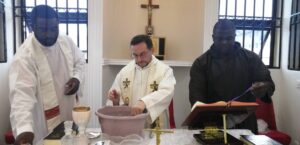
Fr. Fredrick Njumferghai Bohtila says that the more the world develops technologically with people amassing more material wealth, the more they continue to search for happiness which they hardly ever find. When this happens, individuals find life meaningless, the Priest says.
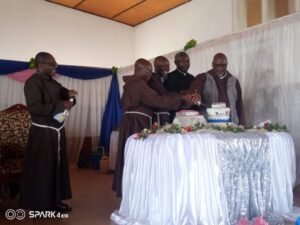
“Suicide cases are on the rise all over the world because people are not happy. Many feel deceived even in relationships. This is because they are questing for joy in wrong places and never find it,” Fr. Bohtila told ACI Africa in an interview Monday, June 14.

The Franciscan Friar of the Capuchin Priest who is based in Zambia has authored a book, “The Spiritual Perfection of the Human Being” which he says is an invitation to find happiness from within.

The book draws teachings from St. Augustine of Hippo’s book, Confessions, which bears one of the Saint’s most popular invocations, “You have made us for yourself, O Lord, and our hearts are restless until they rest in you.”

According to Fr. Bohtila, St. Augustine of Hippo is the model for people looking for internal peace, those who wish to know about themselves and to realize that they were created in the image of God who makes their joy complete.

“A human being today is always out of himself, is always distracted,” the 45-year-old Cameroonian Priest tells ACI Africa ahead of his book launch slated for June 22.

He adds, “Most of the time we are absent minded. We are far, we are pulled by the fascinating world around us and we don’t have that self-acceptance.”

The 100-page book published by the Pauline Publications Africa is divided into three chapters. In the first chapter, the Priest talks about the human being created in the image of God as a call to perfection.

“The perfection we are talking about is coming back to ourselves and discovering who we are,” Fr. Bohtila says, and adds, “Human beings have ventured far and even travelled to the moon. But we believe that the most important journey for a man is when he goes back to himself and realizes who he really is. Only then do we discover the greatness of our mind and the greatness of God in us.”

“Through travelling back to ourselves, we come to discover that the God or the greatness we are searching for is still within us,” the Priest says.

The second chapter addresses the consequences of sin and goes back to the fall of Adam and Even. The Capuchin Priest says that the two who wanted to be like God provide lessons for the society today where not many people are satisfied with who they are.

“Adam and Eve wanted to rejoice in a power that was greater than their own. They wanted to become like God. A creature cannot take the place of God,” the Priest says, adding that the conduct of Adam and Eve is “a fundamental problem today.”

“Most of the time, the human being doesn’t accept himself the way he is. We want to become someone else. And that’s where our sadness begins,” he says.

He further says that his book is aimed at helping people to arrive at self-acceptance, and to know their rightful place in creation so as to live fulfilled lives.

The book also addresses the issue of the divided will and the challenges that people encounter as they make life choices. This, according to the Cameroonian Priest, is the struggle that St. Augustine experienced when he talks about being “divided in himself.”

Fr. Bohtila says that many times, people are divided and that in making choices, many are “prompted by egoistic motives and distorted emotions.”

“We have distorted desires. And so that one blurs our reasoning faculty and our intellectual faculty,” he says, and adds, “We need to be clear in our rationality, in what we are choosing. But now because we are moved by emotions, passions, sometimes our choices are wrong. And those wrong choices don’t help us to grow.”

In the third chapter, the Priest author talks about the healing power of the grace of God. It is this power that St. Augustine of Hippo discovers when he realizes that “he has been moving out of himself and leaving all the good inside.”

Fr. Bohtila says that the world, especially today, needs the message of St. Augustine of Hippo who is honored as a great doctor of the Church.

The Saint is described as one of the Latin Fathers of the Church “and perhaps the most significant Christian thinker after St. Paul.”

The contribution of St. Augustine of Hippo to Christian teaching has been said to have created a theological system of great power and lasting influence.

His numerous written works, the most important of which are Confessions and The City of God are said to have helped lay the foundation for much of medieval and modern Christian thought.

Fr. Bohtila says that he has always looked up to St. Augustine of Hippo and started writing the book that is pegged on the Saint while he undertook his research in Rome.

“I think that the human heart today, despite all the things that we possess even in the advancement of material things in technology, that human being keeps searching for happiness somewhere,” the Priest says.

He adds, “The more we possess things, the more we want more things, which means that the human heart is not satisfied by the things we possess. This is what St. Augustine implies when he says that our hearts will remain restless, until they come to rest in God.”

Fr. Bohtila says that the fundamental relationship stressed upon in the book is to come back to oneself and to realize that the true meaning of life is found within.

Shisong Fraternity joyfully welcomes Fra. GiamPaolo Beghi, the Provincial Bursar

Fra. GiamPaolo Beghi, the Provincial Bursar, visits the Sacred Heart Fraternity Shisong. 

He arrived Shisong on Friday, March 3, 2023 and left for Bambui, on Saturday, March 4, 2023. The joy flowing from his visit to the fraternity inspired the House Guardian of the Sacred Heart fraternity Shisong, Br. Felix Afoni to say: “To have a provincial bursar amongst us is something very important”. His visit, as a consequence, has permitted him to see the reality of our suffering people, to encounter brothers in their reality and to evaluate some projects undertaken by the Custody  to mark their 40 years of presence in the Cameroonian soil.

May God in his goodness, grace his presence amongst us.

Pax et Bonum

Lerone-Alex Bole Nfonba, we love you

Lerone-Alex Bole Nfonba, we love you

Lerone-Alex Bole Nfonba, Feb. 26, 2023 made you 6 years of age in the heavens above (Feb. 26, 2017 – Feb. 26, 2023). In March 3, 2017, the earth from which you were created, opened its mouth to swallow you. We continue to thank God for your life; we miss you; we love you. In the context of the  Ruby Jubilee celebration of the Franciscan Capuchin Way of Life in the Cameroonian soil, know, you have left us a mark, your immemorable mark as the first Cameroonian Capuchin friar to inaugurate that journey of no return. May you continue to rest in peace brother, for you have become “an elder yourself”. Pray for us your younger brothers who daily battle to win ourselves from the rage of Satan, so that when our own time of departure from this pilgrim world reaches, we joyfully match to meet the Lord for whom we had earnestly served.

Lerone-Alex, you were a very talented friar: a composer, a poet, a pianist; in sports, you excelled beautifully. We miss those beautiful moments with you Bro. But know, you remain special.

We love you Br. Lerone-Alex, we miss you.

A gradual move towards the 11th Custody’s Elective Chapter: The Phase of Guardians and Bursars of the Custody

A gradual move towards the 11th Custody’s Elective Chapter:

The Phase of Guardians and Bursars of the Custody

On Monday, the 27th day of February, 2023, at 9:00AM, all the Guardians and Bursars of the Custody of St. Francis of Assisi in Cameroon (in number, 12), gathered in the Capuchin Fraternity of Bambui in Assisi Hall, for a meeting, directed by Fra. GiamPaolo Beghi, the Provincial Bursar, on how collaboration between the Guardians and Bursars be enhanced for a smooth running of the Custody especially with regards to the administration of custody goods.


It should be noted that the first economic visit to Cameroon of the Provincial Bursar was done in 2015, and the second in 2023. The Provincial Bursar exposed to the brother Guardians and Bursars that being guardians and bursars is a service rendered to the brothers, to the fraternity, to the Custody, to the Order and to the Church, a service by which a brother proves his own witness to the Gospel life.  As a matter of fact, the Provincial Bursar did highlight the fact of collaboration between the Guardians and Bursars, where he stipulated that when tension arises between these two services, the fraternity enters into a crisis. Moreover, he indicated that the Guardians and Bursars help their fraternities renew the spirit of poverty, evaluate their variant means of transportation which at times weigh on the fraternity, encourage brothers to work in order to sustain life in the fraternity, to be joyful in living their life of austerity, return to the community the fruits of their apostolates, trust in divine providence, and to avoid financial and material waste. And for a fraternity to run well, it was stressed that fraternal budgets be drawn and evaluated by its members. Above all, that brothers in spending what they have, should always think too of the future. From here, he encouraged that brothers be genuine, truthful and faithful in the accounts they render, for this contribute in making a healthy fraternity. It was equally noted that some brothers may use fraternal goods like cars to render fraternal services and the fruits from those services never reach the fraternity; things to watch against for they murder the fraternity. Furthermore, it was spelt out that it is the role of Guardians to ensure the administration of fraternal goods (i.e., our structures…). And to the Bursars, their need to keep a day book, have a balance sheet which help to project their honesty and transparency. The Provincial Bursar, rounding up his presentation, proposed that the Bursars in the custody from time to time, take up formative courses to help them improve in their running of financial matters in the custody.

This encounter with Guardians and Bursars ended up with these last words from the Provincial Bursar at about 4:45PM: that as the Custody helps or supports the different fraternities of the custody, so too, different fraternities of the custody should take as task to help, defend and support the custody.

We thank the Provincial Bursar for all the sharing and the Province of Lombardy in general for all they have been and remain for our beloved custody of St. Francis of Assisi. May our Good and Loving God continue to watch over us as we prepare our hearts for the upcoming elective chapter. 

Pax et Bonum

Nécrologie: A nous revoir frère François Tabe Akono

Frère François Tabe Akono, Ministre Régional OFS francophones, conduit vers sa demeure.

La famille (OFS) Ordre Franciscains Séculier du Cameroun, conduit leur frère François Tabe Akono, Ministre Régional OFS francophones, à sa demeure. Il rendit l’âme le 14 janvier 2023.

16 février, une grande veillée sans corps eût place dans son domicile. Et le lendemain, la levée du corps et hommages à Soa le 17 et inhumation à Akonolinga le 18 février.

Avant son dernier soupir, il demande que son corps soit habillé et transporté jusqu’à sa tombe par la Grande Famille Franciscaine. Que saint François, sainte Claire et les autres franciscains en haut t’accueillent et te présente au Père Céleste papa François.

Requiescat in Pace frate 

Formation of Brothers in the fourth year of Post-Novitiate

The 4th Year of Post-Novitiate
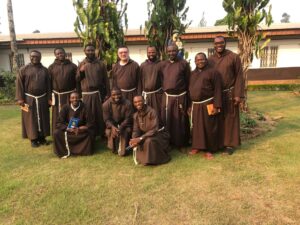
The brothers in the fourth year of Post-Novitiate, gathered in St. Francis of Assisi’s Friary Bambui, under the umbrella of Br. Martin Dikwa, the brother in charge of this stage of formation, for their second session of Post-Novitiate, i.e., from Sunday, 12th February to Saturday, 18th February 2023. It saw the participation of all the six brothers in the fourth year of experience in the life after the Novitiate. The brothers in this stage of formation are: Br. Romaric Koumetio, Br. Jude Thaddeus Fonsi, Br. Boris Berinyuy, Br. Andrew Ndzewiyi, Br. Bill Collins Formonyuy and Br. William Kongnyuy. These brothers make their experience of the life  in the fraternities of Sop, Mbohtong and Bayong.
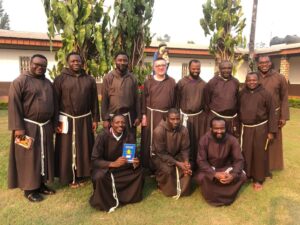
Primordially, their second encounter of formation had as objective: To lead the brothers into a living relationship with Christ, to be more conformed to Him and to find their identity in Him (Const. No 32, 3). This explains why the formative session was animated by different presentations and discussions on topics inspired from the reality of religious life in today’s society. It was equally an opportunity of a “one-to-one” encounter with the Br. Martin Dikwa, the coordinator of the fourth year Post-Novices. What was on the menu for these six young men?

On Monday 13th February, discussions were on  human formation; friendship with persons of the opposite sex and the use of the mass media, a formative subjet matter of  our time, presented to them by Br. Divine Etimbi.

On Tuesday 14th February discussions were centered on the VIII Plenary Council of the Order: On the grace of working, handled by Br. Martin Dikwa. It was noted summarily that work is grace because it puts us in contact with ourselves, with brothers, with people, with creation, and most importantly with the creator (God).

On the third day of the session, that is on Wednesday 15th February,  the session was on the Capuchin apostolate with Br. Amos Bamenjoh as the resource person.

The presentation of the document: The gift of fidelity, the joy of perseverance of the Congregation for Institutes of Consecrated Life and Societies of Apostolic Life was the object of Thursday, 16th February. Issues treated from this document included: Gazing and listening, Enkindling awareness and separation from the Institute and Juridical norms.
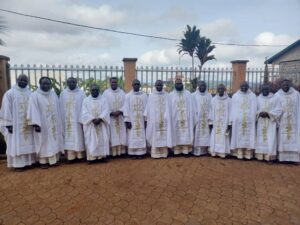
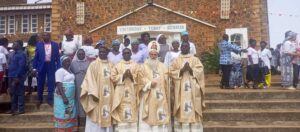
On Friday, 17th February, the last day of the second session, we were graced with the presence and intervention of Br. Aloysius  Ngongbi, who drilled us on:  Christ in the Franciscan experience.

Having been nourished throughout the week with such enriching teachings, brothers, on Saturday, 18th February, returned to their fraternities to make visible in their lives what they had digested within the formative week in Bambui.

May the Holy Spirit continue to enlighten you all brothers in this process of discernment.


In memory of Father Magic

Today, February 15, 2023, marks the 5th anniversary of departure of Fra. Roberto Pirovano, popularly known as Father Magic. We pray he enjoys the Beatific Vision and from there intercede for our Order and particularly, for the custody of St. Francis in Cameroon, where he served for a good number of years.

We thank you Fra Roberto, for having participated in sowing the the jewel of Franciscan Capuchin Brotherhood in our land.

Father Magic, continue to rest in peace.

The New Provincial and his council

Today, Wednesday 15 February 2023, the New Provincial and his council were elected.

The Provincial Minister: Fra. Angelo BORGHINO

The Provincial Vicar: Fra. Daniele REBUZZINI

Second Councillor: Fra. Paolo BOTTINELLI

Third Councillor: Fra. Agostino VALSECCHI

Fourth Councillor: Fra. Giorgio PERACCHI

²  

May the Holy Spirit enlighten you and lead you brothers in your mission.

PROCLAMAZIONE DELLA ELEZIONE MP e Consiglio (1)

Pax et Bonum

The Custos, Br. kenneth, and Br. Terence at the Provincial Chapter

The Provincial Chapter


The Custos, Br. Kenneth Kinyuy, accompanied by Br. Terence Sahven, as delegates of the Custody, made their move from Cameroon, Friday February 10, 2023, to the Provincialate as participants at the Provincial Chapter. This chapter of the Province of Lombardia kicked-off On Saturday 11, 2023. Tuesday, February 14, 2023, various custodies or delegations of the Province of Lombardia, echoed through their reports on the life of their custodies or delegations, a presentation at which the Cameroonian Custody wasn’t an exception.

Capuchin Organic Farm

Visit Br. Cyril Kerla in the Capuchin Organic Farm-CIG to get quality products


Saint Anthony of Padua’s College Mbohtong

St. Anthony of Padua Catholic Comprehensive College Mbohtong – Shisong is a co-educational boarding and day school in the Diocese of Kumbo, under the proprietorship of the Capuchin Friars Minor (Custody of St. Francis of Assisi). It is located 3km from Shisong Catholic Hospital up the plateau above the Hospital and opposite the Kumbo Council forest. The school enjoy variant facilities: firstly, a very calm environment that favours studies and meditation, secondly, beautiful and spacious classes, a spacious chapel and hall; thirdly, quality teachers with brothers intervening in practically all domains.


SAPCCCOL 2023 2024

Contact the Principal for more information

Br. Joseph Mengven

Tel: +237 678 171 838 or +237 672 899 530
For the school is 681722162

Emmaus Outreach Center (EOC)

The Emmaus Outreach Centre (EOC), Bamenda, is a centre that caters for the mentally impaired and homeless persons. It reaches out to those who have been marginalised by their families and by the society, in most cases because of mental disabilities. It is a place of welcome, friendship and support. It stands as a witness to the Gospel values that we preach. Remember that Jesus reached out continually to people in need, some of whom were mentally disturbed like the man living in the cemetery in the country of the Gerasenes (cf. Lk 8:26).

Our society largely neglects, rejects or scorns the mentally impaired persons, even to the extent of blaming them for their own conditions. Unfortunately such non-Christian attitudes abound in our society. The EOC helps to break down these non-Christian attitudes.

Brief history of the EOC

The EOC was initiated in the year 1997 by a Saint Patrick missionary priest, Reverend Fr. Byrne Brian, living and serving in the Archdiocese of Bamenda in fulfilling the Catholic Church’s mission of evangelization. After formally proposing to the then Archbishop Paul Verdzekov (of Blessed memory) his project of setting up an Emmaus Outreach Centre – Bamenda, the Archbishop accorded his consent and approval for setting up such a centre to fulfil the Gospel of Christ by meeting the needs of the homeless and dejected persons of the society. This Centre is for Christian Charity not a profit making organization. With the help of his Mother house back in his country, he ran the EOC till August 2005 when he was transferred from Bamenda Town to Bafmeng. He then solicited the help of the Order of Friars Minor Capuchins (OFM Cap.) living and working in the Archdiocese of Bamenda to take over the charitable apostolate. The OFM Cap. willingly accepted to continue with this apostolate because it was in line with their main charism – to welcome the lepers of our time – as St. Francis of Assisi our Founder welcomed and embraced the lepers of his time.

The EOC project was a personal initiative of Fr. Brain Byrne, but upon taking over from him by the OFM Cap. and being also in accord with the then Archbishop of Bamenda, His Grace Paul Verdzekov, it was made clear that the EOC is a project of the Archdiocese of Bamenda under the direct care of the OFM Cap.

This project started in rented houses till the time of the handing over from Fr. Brain to the OFMCap. Since the population did not want these people to live close to them, and the cost of renting houses kept increasing as a way of exploitation of the situation, we then turned to the government for help and we were given this land that is outside the residence of the population and not far from the town, for these people love going out to the streets in town. In 2007 with the help of our missionary brothers and some benefactors mostly from Italy, the centre was constructed in the new site above GBHS Down-Town Bamenda, where we are presently.

The mentally impaired persons living in EOC are called Residents and those staying and helping them are called Assistances. Presently, we have 20 Residents, with two Assistances, 3 workers and the Director, a Capuchin Brother, Fr. Pascal Fomonyuy OFMCap.. In the centre we assure the feeding of the Residents, they have their rooms to sleep, they have good water supply and there is a psychiatric nurse who follow each case. Many have come here in the past years and were healed and went back home. Some have gone and come back again since Psychotic disorders are so complex and you cannot claim to treat it once and for all. Some are off and on. It takes a very long time and some are for life. Some of the residents were brought here by charity groups with no information about their family background. These ones have become permanent members of EOC because they have nowhere to go after their treament. Some have even died in the centre. We buried some and some families took back their relatives to bury. Some families bring the brothers or sisters to us who are sick, we also invite some that we see on the streets or we provide them with something to eat on the streets. Some sick persons come by themselves.

The EOC, is a complex reality that live only from charity. For now we have no income generating activity to support the EOC. Thanks to our Missionary Brothers for their help and support through their benefactors abroad who are very much interestd with the idea of the centre. With the passage of time, the missionary brothers are getting old and the number coming to Cameroon has greatly dropped. The funding of this charitable activity has greatly dropped. This also is due to the current COVIT 19 pandemic and the socio-political crisis in the North West and South West Regions (Anglophone crisis) of Cameroon.

With the current Anglophone crisis, many people have been calling the centre with so many traumatised cases. There is also so much drug abuse amongst the young and calls keep coming for more help and a place to keep these affected brethren.

Our major setback for now is the presence of the DDR centre very close to the EOC. The ex-combatants are very free and so, some of the Residents turn to follow them and sometimes, smoke. We need a strong fence that can keep the centre very secured.

We have a big land for farming and so we have engaged ourselves in farming so as to support the centre with fresh food from our farm. We intend to extend the farm and even to keep some animals. Some of the Residents are willing to work and others are not just ready to do anything. Our vision now is to buy less vegetables and to cultivate much using natural manure and less chemicals.

Because of insecurity around the Town of Bamenda now due to the anglophone crisis we prepared some personal batches for the Residents to help them as they move around in town.

The water situation of the centre is relatively stable. The centre is enjoying a constant water supply from the hill of the centre. Some maintenance work is needed to be done in the water catchment areas. Our neighbours depend on us for water and so if there is no strict control it may not be enough for us and for them. Our sources of water have greatly reduced and the demand from the outside community is really high. We are looking forward to work more on our water sources for next year. The demand this year is really high. The population around the centre is depending on us for water during the difficult moment of the dry season.

Other foreseen works to be done in the EOC are:

  • the road at the main entrance to the centre is very bad and needs serious repairs at the beginning of the raining season.

  • Levelling of some places and planting of flowers and grass in the centre to make the place beautiful, welcoming and a good place to live in.

  • The beds and the rooms of the Residents need to be arranged. Lots of repair works is needed.

  • The centre is in need of a good car for running its activities.

I render thanks to all the Capuchin brothers especially in the missionary centre in Milano and the benefactors who have been helping us all this while in the centre. May God bless you.


Br. Pascal FOMOMNYUY OFMCap.

Tel: 654 785 224

Director Emmaus Outreach centre

My Custody, my Family (Remember Lot’s wife)

Remember Lot’s wife (Luke 17:32)

As the elective chapter fast approaches, above all in the context of the ruby juby jubilee celebration of the life and presence of the Capuchins in Cameroon, brothers of the Custody did assemble for a spiritual exercise, a retreat, directed by Br. Francis Dor. This spiritual exercise took place at the Dominican Nunery Bambui, from January 8 – Januanry 12, 2022. Br. Francis, underlying the need of each friar making the custody his family, helped us to remember Lot’s wife. This, he drew from Jesus’ warning to his listeners, to remember what happened to Loth’s wife, how her disobedience made her turn into a pillar of salt. This was infact to help the brothers know, that they need to remember they are part of a family and must do everything to keep that family moving. This explains the reasons for which at this spiritual exercise, the director explored topics such as building authentic relationships, the call to holiness, a call to be friends to each other, a sense of belonging, topics which helped enriched the retreatants.  We did not only meditate from Scriptures, but too from one of Dolly Paten’s  pieces: Family

[Verse 1]
When it’s family, you forgive them
For they know not what they do
When it’s family, you accept them
‘Cause you have no choice but to
When it’s family, they’re a mirror
Of the worst and best in you
And they always put you to the test
And you always try to do your best
And just pray for God to do the rest
When it’s family

[Verse 2]
Some are preachers, some are gay
Some are addicts, drunks, and strays
But not a one is turned away when it’s family
Some are lucky, others ain’t
Some are fighters, others faint
Winners, losers, sinners, saints
It’s all family


[Verse 3]
And when it’s family, you trust them
And your heart’s an open door
When it’s family
You tolerate what you’d kill others for
When it’s family, you love and hate and take
Then give some more
Somehow you justify mistakes
Try to find some better way
To solve the problems day to day
In the family

You take the trouble as it comes
And love ’em more than anyone
Good or bad or indifferent, it’s still family
You choose your lovers
You pick your friends
But not the family that you’re in, no
They’ll be with you ’til the end
‘Cause it’s family

[Verse 5]
When it’s family, you forgive them
For they know not what they do
When it’s family
They’re a mirror of the worst and best in you
When it’s family
When it’s family
Let me be all that I should be to the family

At the close of the spiritual retreat, brothers in perpetual profession gathered for an assembly that took place still at the Dominican nunery on Friday, January 13, 2023 in order to prepare for the Chapter that comes up in April 2023 at Melong. Responsibilities were shared – the srutineers were chosen, the liturgical commission reinforced, the communication communication reinforced, the moderators and the secretaries too were elected. It was also a great moment to go over the Custody’s states of the Chapter which was detailed to the brothers by Br. Terence Sahven.


(more…)

CAPUCHIN BROTHERS RECEIVE NEW MINISTRIES AT THE CAPUCHIN FRIARY BAMBUI

The Installation of fourteen Capuchin brothers into Ministries at the Capuchin Conventual Chapel in Bambui.


Installation of Five Capuchin brothers as Lectors Brs Tumnyuy Zachaus, Italo Steven, Baba Adolf, Augustine Tardzenyuy, Anicet Njuptavieu and nine other brothes as Acolytes: Brs François Djorwe, Thaddeus ESOPE, Philip Mbunghai, Ignatius Kenso, Rene Mbaku, Elvis Tardzenyuy, Michel Tiague, Gotran Tatah, Fabrice Awembom.
On the 3rd of November 2022, feast of St. Martin de Poress, at the Capuchin conventual chapel of Bambui-Bamenda, during a solemn evening Mass that began at 5:45pm, the Regular Superior of the Friars of Cameroon custody installed 14 brothers who are studying theology in the St. Thomas Aquinas Major Seminary Bambui to the minor ministry of lectors and acolytes, the mass was concelebrated by the other brothers priests of the community. In his homily, the preacher (Superior), called on the brothers who are to receive the ministry to strive daily to carry out the function the church is entrusting to them, for the lectors, to always carry the word of God on their lips and their heart, and that they are called to deliver this words to the ignorant. For the acolytes, he admonishes them to pay attention in serving Christ, not only on the alter, but also to those who are poor, the marginalized and to be victims, for Christ came not to be served but to serve. And he finally told us all to be faithful in carrying out our various functions with alot of enthusiasm and care, for it is not our call but Christ’s. Finally he ended by telling us to love the Church like St. Martin de Poress and to be selfless for the sake of Christ whose word we proclaimed. There after, those to be installed lectors came forward and each was given a Bible which is the appropriate gesture of the installation, and likewise the acolytes were given the chalice.
After the mass, there were some photos, then the celebration continued in the friars refectory with the cutting of the cake and then common recreation that those who received the ministry invited all the members of the community, the occasion ended with the compline.

Fra. Esope Thaddeus
Ofmcap.Mbunghai, Ignatius Kenso, Rene Mbaku, Elvis Tardzenyuy, Michel Tiague, Gotran Tatah, Fabrice Awembom.
On the 3rd of November 2022, feast of St. Martin de Poress, at the Capuchin conventual chapel of Bambui-Bamenda, during a solemn evening Mass that began at 5:45pm, the Regular Superior of the Friars of Cameroon custody installed 14 brothers who are studying theology in the St. Thomas Aquinas Major Seminary Bambui to the minor ministry of lectors and acolytes, the mass was concelebrated by the other brothers priests of the community. In his homily, the preacher (Superior), called on the brothers who are to receive the ministry to strive daily to carry out the function the church is entrusting to them, for the lectors, to always carry the word of God on their lips and their heart, and that they are called to deliver this words to the ignorant. For the acolytes, he admonishes them to pay attention in serving Christ, not only on the alter, but also to those who are poor, the marginalized and to be victims, for Christ came not to be served but to serve. And he finally told us all to be faithful in carrying out our various functions with alot of enthusiasm and care, for it is not our call but Christ’s. Finally he ended by telling us to love the Church like St. Martin de Poress and to be selfless for the sake of Christ whose word we proclaimed. There after, those to be installed lectors came forward and each was given a Bible which is the appropriate gesture of the installation, and likewise the acolytes were given the chalice.
After the mass, there were some photos, then the celebration continued in the friars refectory with the cutting of the cake and then common recreation that those who received the ministry invited all the members of the community, the occasion ended with the compline.

Fra. Esope Thaddeus
Ofmcap.

The Phases of 40th Anniversary Jubilee celebration with Ordinations & Perpetual Professions

SOLEMN PROFESSION

of Br. Junior Noumessing, Br. Anthony Fonyuy, Br. Gerald Galabe and Br. Valerie Tukov

at the Capuchin Conventual Chapel, Bambui, August 25, 2022

This is a stage that marks the end of initial formation. For article of 4 of paragraph 23 of our Constitutions reads: “Formation in our Order is implemented in two phases: initial and ongoing. Initial formation includes initiation into consecration according to our form of life, lasting until perpetual profession, and preparation for work and ministry, which may begin during initiation. Ongoing formation follows initial formation and is lifelong.” Hence, with this step of perpetual vows of poverty, chastity and obedience for the rest of one’s life, officiated by Br. Kenneth Kinyuy, with the reception of vows of Br. Junior Noumessing, Br. Anthony Fonyuy, Br. Gerald Galabe and Br. Valerie Tukov, these brothers officially make their definitive yes to live for the rest of their lives as faithful followers of Christ in the footsteps of Father Francis.


The 40th Anniversary of the franciscan Capuchins ( 1982-2022) was celebrated with different phases. From it’s official launching at the Sacred Heart Parish Shisong marked the celebrations for the presences ( shisong, Mbohtong & Sop), solemnized by priestly ordinations in the Diocese of Kumbo where the capuchin have served since their arrival as well as ordination which highlighted the celebration in Bafoussam the centre of the capuchin presences in the Western Region of Cameroon ( Bafoussam, Bangante & Bafang). Furthermore, the euphoria of solemn professions at the St. Francis of Assisi Capuchin conventual friary Chapel, Bambui graced the Celebration in the Archdiocese of Bamenda on 25th August 2022.

The 40th Anniversary, spiced with Priestly Ordinations

Still in the context of the 40th anniversary of the presence of the Capuchin friars, in the Cameroonian soil, 4 friars were raised to the presbyteral order: Br. Junior Noumessing (ordained at St. Joseph cathedral, Bafoussam by Mgr. Paul Lontse Keunne on May 7, 2022), Br. Gerald Galabe by Archbishop, Mgr. Andrew Nkea at the St. Joseph Metropolitan Cathedral Bamenda (April 2022), at Br. Anthony Fonyuy and Br. Valerie Tukov by Mgr. Angelo Pagano at the Sacred Heart Parish Shisong in April 2022.

.


PRIESTLY ORDINATIONS BY MGR. ANGELO PAGANO OFMCAP. A MISSIONARY WHO WORKED IN THE CUSTODY OF CAMEROON BEFORE BEING CONSECRATED BISHOP.

All roads lead to Buea to end the jubilee celebration in May 2023.

Fra. Theophile Seka ofmcap.

Fra Felice Trussardi a.k.a Father Jesus

A TRIBUTE TO FRA. FELICE TRUSSARDI LUIGI

Padre Felice Trussardi a missionary franciscan capuchin worked in Cameroon for so many years especially in the Areas of formation in Shisong, Sop And Bambui & he equally served as major superior for several mandates. He died in italy his home country. He contributed a lot in formation material and in administrative documentation.
He is remembered today as a very prayerful friar, deligent in his work, a good reader & writer, a spiritual master, spiritual director, confessor Counsellor and his love for children as well as the less privileged was heroic. He was a very detached, simple & jovial friar. He had a mastery of virtually any subject. He worked tirelessly for the franciscan Capuchin Custody of St. Francis in Cameroon.
Fra Felice Trussardi Luigi of Jesus
Rest in Peace as we pray for you especially during this month of November.

Fra. Théophile Seka
Ofmcap.

Rest in Peace Padre Roberto Pirovano a.k.a father Magic

TRIBUTE TO FRA. ROBERTO PIROVANO AKA FATHER MAGIC

Fra Roberto Pirovano was a missionary franciscan capuchin brother who served in cameroon and worked in Parishes such as Shisong and Big Babangki as well as in the formation of young brothers. This month of November when we remember & pray especially for the dead. we thank God for his services and missionary zeal, love for children and care of the less privileged.
May his gentle soul rest in the bosom of the Lord. Continue to rest in the Lord.
We remain grateful for your passage amongst us.

Fra. Theophile Seka
Ofmcap.

Capuchin friars @ 40 years in Cameroon

A RUBY JUBILEE IS A YEAR OF GRACE FOR US CAPUCHIN FRIARS IN CAMEROON

Peace & Goodness ! How Can we repay the Lord for His goodness to us?

The first cameroonian Custos & Council

Dear brothers and sisters as saint Francis would call every creature of God fratello & sorella. We the friars of Cameroon are humbled but at the same time grateful to the Most high God for his unfathomable graces bestowed on us during these years of Active and faithful  service to the Church, the World and to our cameroonian society specifically in the diverse areas of our presences in Cameroon and Mission Lands.

Furthermore, celebrating 40 years is also celebrating your unflinching spiritual, Moral, financial and material support as friends, benefactors, well wishers, people of Goodwill, & biological families etc.. The love and fraternity we have shared these forty years inspite of the odds has grown from strength to strength.  Today, we rejoice because the seed that was sown by brother Umberto Paris aka Father Taa of blessed memory  has grown to its bounds.  Today, the first cameroonian indigenous capuchin friar, Tobias Wirmum is fulfilled going back memory lane and seeing the journey that was begun in faith as a risk adventure with God has borne many more brothers after his witness of the Capuchin Franciscan way of life in Cameroon. Praise and honor to the Most Holy Trinity that at 40, the Fransciscan Capuchin Custody of St. Francis in Cameroon as a family looking at the joyful and painful moments these past years can rejoice at having contributed to the growth of the Capuchin  charism by providing brothers for service at the highest level of the Order like friar Kilian Ngitir as a General Counsellor for Africa at the General Curia, friar Francis Dor Bongajum as International Spiritual Assistant for the Secular Franciscan Order (CIOFS ), and growing to Maturity has sent some of her members as missionaries to Italy (Loreto), Ivory Coast, Gabon, Zambia, Kenya and soon Equatorial Guinea.

At 40, she has grown to about 100 friars. In fact, the Capuchin charism has spread to all the nooks and cranees of the National territory with vocations booming from both the English and French speaking Parts of Cameroon. The Capuchin brothers are present and serve in six Dioceses : Kumbo Diocese (Sacred Heart fraternity in Shisong Parish, St. Anthony of Padua Comprehensive College Mbohtong, , St. Mary of the Angels Novitiate fraternity Sop, in Theresa Parish Sop), Arch Diocese of Bamenda ( st. Francis of Assisi fraternity Bambui (Theologicum)while other young brothers are in fraternité Notre Dame de Lorette Ouidah Republique du Benin (Philosophicum & franciscum), St. Bernard Parish Big Babanki, Emmaus Outreach Centre Down Town Bamenda), Diocese of Buea (Saint Jude Parish Mile 16 Bolifamba), Diocese of Bafoussam ( fraternité Sainte Trinité de Bafoussam en la Pariosse St. Charles de Ngoauche, la Chapelle St. Pio de Pietriecina de Toket Tonseu, Paroisse St.Kizito de Balengou), Diocese de Bafang ( Fraternité Sainte Famille de Bayong en Paroisse ste. Famille de Bayong). This has been sealed by a smooth and gracefilled transition from Italian capuchin missionaries from our mother Province of San Carlo, Lombardia – Milano to the first cameroonian Major Superior as Custos, in the person of brother Kenneth Kinyuy Ayeni. Not forgetting the sad page of Necrology. However St. Francis will call it the peaceful transitus with sister death that has touched this family may our venerable brothers Umberto Paris, Massimo, Roberto Pirovano, Alex Lerone Mbole & Felice Luigi Trussardi intercede for us as render immense thanks to God for having associated us to this mission of saving souls in the footsteps of St. Francis of Assisi.

In a nutshell, How can we repay the Lord for his goodness to us? Come One, Come All to share our joys, our pains, blessings and graces with us. The launching of the Jubilee Year will be on the 22nd February 2022 at Shisong Parish the First place of settlement of the Capuchins and will end in Buea next Year 2023.

Jubilation ! jubilation ! jubilation is everywhere.

HAPPY FEAST ! BONNE FETE ! BUONA FESTA !

Fra. Theophile Seka ofmcap.

Announcement of Rubby Jubilee( 40th) of the presence of Capuchin Friars in Cameroon

Yesterday evening the 23rd of January 2022 the first group of Friars assembled at the Dominican monastery Bambui to begin the first annual retreat in preparation for the celebration of our Jubilee, a strong invitation to allow God to lead us in this eventful year.

Lots of blessings are going to be dished out to all the Friars but disguised in the call to commitment and humble service such that laziness in spiritual and temporal commitments may rob some persons of the blessings prepared for us. In this light the

Provincial Father has sent a very important thought-provoking letter to all the Friars of the Custody intending to help each one of us line up for the best as we move to a new level of engagement with God and his people.

Let us read the letter with great attention and come out with a road map at the individual and community levels.

Wishing everyone especially those in the commissions preparing the various celebrations a wonderful preparation.

Yours in Christ.

Funeral mass for Brother Felice Trussardi

Dear brothers we bid farewell to our holy and venerable superior; a capuchin icon, and a moving spiritual encyclopedia – Fr Felice Trussardi.

Fr Felice was born on the 18th of Oct; 1956, did his final profession as a capuchin friar minor on the 4th of July 1987, and was ordained on the 25th of May 1991.

He served as a missionary in Cameroon for 28 years, from 1992 to August 2020, when he felt sick and returned to Italy for treatment. He served as regular superior in Cameroon for many mandates. He died on the night of Friday 5th Oct. 2021 in an infirmary in Bergamo, Lombardia, at the age of 65.

On Saturday the 6th Nov. 2021 when the provincial – Br Angelo Burghino announced the passing away of father Felice.  

He was buried on the 9th of November 2021